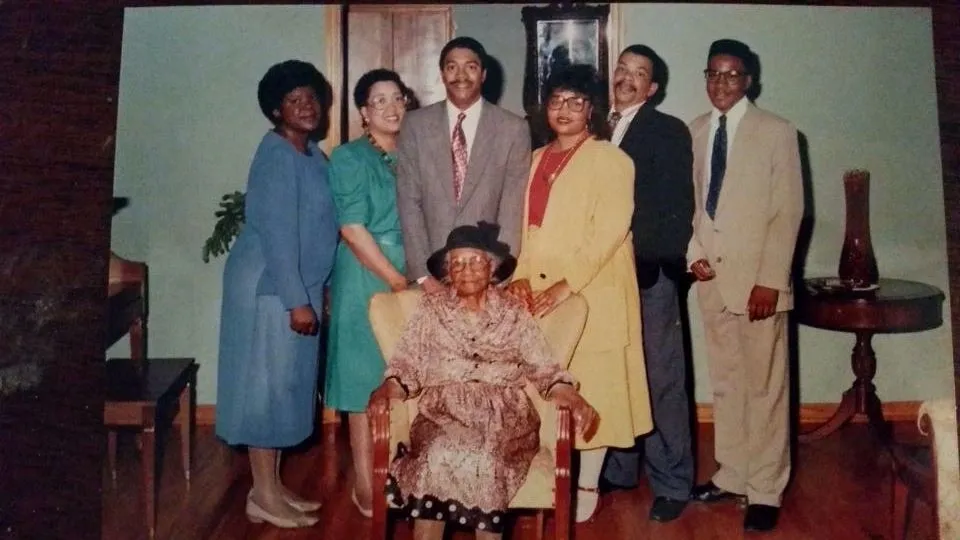
Honoring Puella Coley Harvey on her heavenly birthday — and leaving a record for those yet to come
On September 30, 1896, a baby girl named Puella Coley entered the world in Hawkinsville, Georgia, a place where the memory of bondage still clung to the soil, and where Black families were building new futures out of courage, land, education, and faith.
She was born into a lineage shaped by extraordinary resilience and complexity.
Her maternal grandfather, Dempsey Clark, was forced onto a slave auction block in Hawkinsville in 1847. Rather than submit to a life of brutality, he ran, escaping into the swamp, where he hid for three years. He survived on instinct, faith, and sheer will until he learned that the planter who purchased him had sold him again, this time to a man known not to mistreat the enslaved.
That act of defiance, that refusal to surrender his humanity, became part of the Clark family’s marrow. It became part of Puella.
Her father, Dr. Paul Calvin Coley, carried another kind of inheritance. Family history and local records strongly suggest that Paul was the son of the very enslaver, Jonathan B. Coley, whose plantation Dempsey Clark refused to remain on, most likely one of the Coley brothers. These men later became decorated Confederate officers for their valor at Chickamauga.
This means Puella’s lineage held both the trauma of enslavement and the complicated shadow of the enslaver’s bloodline, a truth carried quietly through generations, and now finally spoken.
Puella’s mother, Lillie Clark Coley, attended Spelman Seminary, part of the earliest wave of Black women pursuing formal education in the South. Puella followed in her footsteps, enrolling at Spelman herself, a second-generation Spelman woman, carrying forward a legacy of learning that began in the aftermath of Reconstruction.
But life shifted suddenly.
Her father wrote his will in 1905, the same year her mother likely died. Four years later, in 1909, Paul died. Puella was no longer a child then; she was a Spelman Seminary student, preparing for a life of learning and service.
When her father died, she had to leave Spelman, return home, and step into adulthood sooner than she ever expected. She moved in with Sarah Brown, her mother’s sister, and the Browns became the family who steadied her when the world changed beneath her feet.
This is where Puella’s story becomes more than biography. It becomes a testament.
She did not break under the weight of early grief. She did not lose her sense of purpose. She carried her parents’ legacy — and her grandfather’s courage — forward with quiet, enduring strength.
She married. She raised children. She built a home where faith, discipline, and love shaped daily life.
And she became the grandmother whose influence still shapes the Harvey family today — not through public accolades, but through the lives she touched, the values she instilled, and the resilience she modeled.
On her 130th birthday, we honor Puella not only because she is part of our past, but because she is part of our foundation. Her life bridges a grandfather who ran off the auction block and hid in the swamp for freedom, a mother who pursued education at Spelman Seminary, a father who earned a medical degree when Black physicians were rare, and the generations who came after.
To remember her is to remember that our story includes bravery, learning, endurance, and love passed down like an inheritance.
If you are a generation yet unborn reading this decades from now, know this:
You come from people who survived, who learned, who built, who loved, and who refused to let hardship define them. You come from a grandmother who lost both parents before she was grown, left Spelman to care for her family, and still created a lineage whose branches reach into the present and beyond.
When you speak her name — Puella Coley Harvey — you are calling forth dignity, endurance, and a story that refused to fade.
Her life is the soil you grow from, her courage is the inheritance you carry, and her memory is the gift you will pass on.
Happy heavenly birthday, Grandma Puella.
Your light still reaches us.