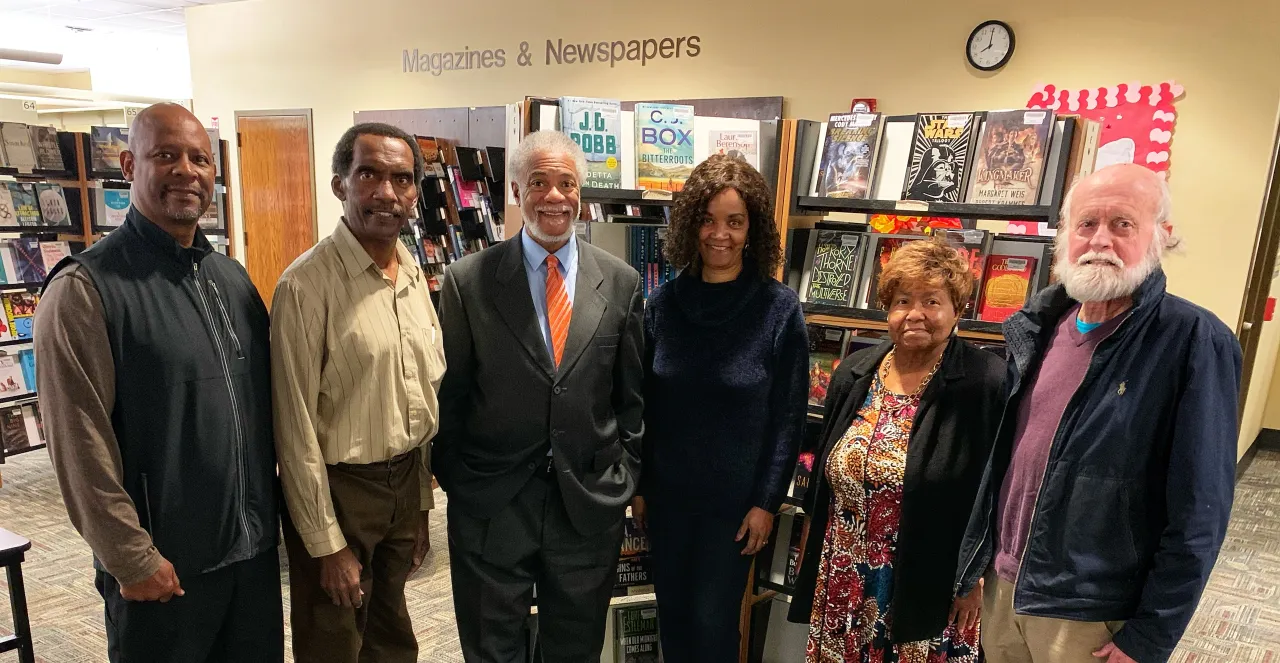
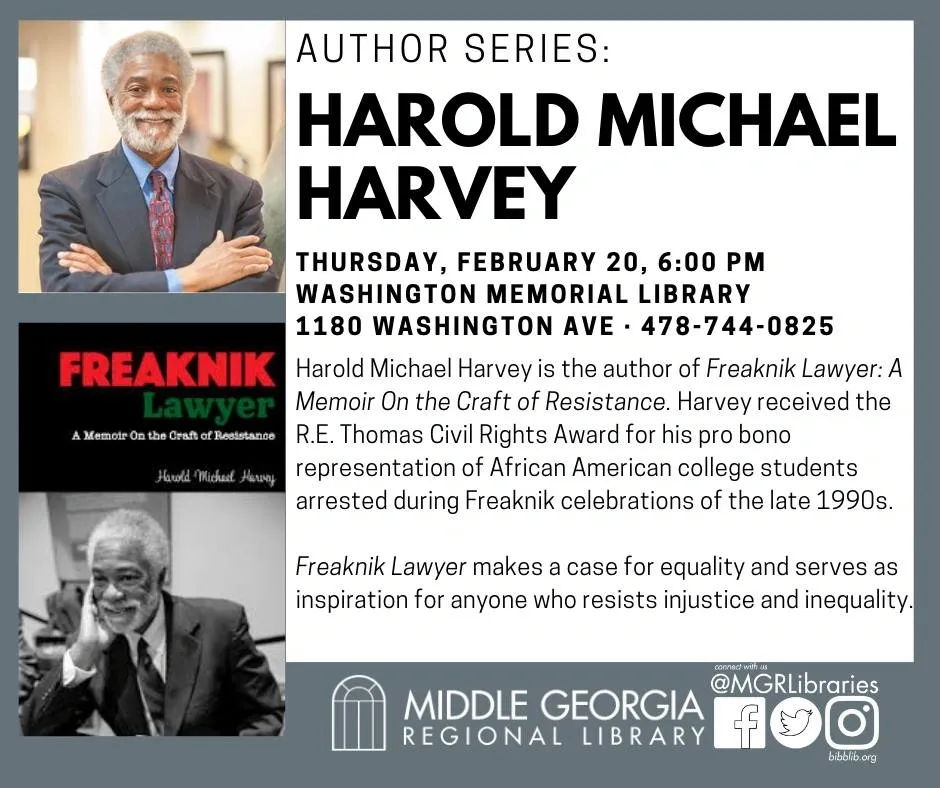
I met Larry Fennelly on a cold, dreary night on February 20, 2020, just days before the COVID-19 pandemic began closing doors and separating people.
I had come to the Washington Memorial Library in Macon to discuss several of my books. About five Maconites showed up. Larry was one of them.
The audience size didn’t seem to matter to him. He listened closely, asked questions, bought a couple of my books, and donated them to the library. He was particularly interested in my writing about Macon history and in the perspective I brought to stories the city had often told differently, or had not told at all.
We took a group photograph that night. Then we kept in touch.
Not long afterward, Larry wrote about the program in The Telegraph. In his March 29, 2020 column, “Facing the truth of our past,” he described Freaknik Lawyer: A Memoir on the Craft of Resistance as “an engaging first-hand narrative of local history.” He wrote about my experience integrating Lanier Junior High in 1965. He said my work gave readers a front-row seat to the social upheaval that accompanied the movement from “the curse of Plessy” toward “the promise of Brown.” [macon.com]
Larry understood what I was trying to do.
I wasn’t simply adding names and dates to Macon’s official account. I was writing from within the history. I told it through the eyes of a Black child who lived through school desegregation, a young reporter who covered the rise of Black political power, and a citizen who understood that public memory depends on who is allowed to tell the story.
Larry encouraged professors at Mercer University to invite me to speak with their students. That invitation never came. But Larry’s advocacy never stopped.
Over the next six years, we corresponded regularly. Whenever I published a new book, he was often among the first to purchase it. More importantly, he highlighted my work in his own writing. He encouraged Maconites to read my books because they offered a different perspective on the city’s official narrative and on the history of Black Macon.
Larry did not treat that difference as a threat. He regarded it as necessary.
That quality was central to the man he was. He had taught in college classrooms for decades and written for The Telegraph across generations. He understood that history becomes impoverished when it is told from only one side. He also understood that writers working outside the customary institutions sometimes preserve truths that those institutions have overlooked.
In 2024, I published Fantasy Five: An Unimaginable History—The Election of Macon’s First Black Councilmembers. The book traces the long struggle that led to the election of the first five Black members of the Macon City Council in 1975, reaching back to Macon’s founding in 1823.
Larry recognized the importance of telling that history through the eyes of a Black Maconite.
In 2025, I organized a 50th-anniversary celebration honoring those five councilmen. Larry came to the banquet. Of course he did. He listened, observed, and later wrote about the commemoration in The Telegraph.
In his January 6, 2026 column, Larry wrote that Fantasy Five gave the election of the five councilmembers both historical context and contemporary meaning. He noted that I had begun the account in 1823, when enslaved people outnumbered those who enslaved them, and that I had given sustained attention to the role of Henry McNeal Turner in local history. He wrote that the book explained not only how the five councilmembers came to occupy their positions, but why the word “fantasy” seemed appropriate to what they had accomplished. [macon.com]
Then Larry offered an assessment I will always treasure.
For years, he wrote, he had believed that every Macon home should contain a copy of Andrew Manis’s Macon Black and White. After reading Fantasy Five, he was inclined to add my narrative to that shelf. [macon.com]
That was more than a book plug. It recognized that Black memory belongs in the city’s accepted history, not in a separate or lesser category. Larry argued that an account written from the Black experience deserved to stand alongside the narratives Macon had long considered authoritative.
He returned to the subject the following month. In a February 17, 2026 column, Larry wrote that local programs, such as commemorations of the first Black councilmembers, were essential because so much Macon history had already disappeared. He identified Fantasy Five as a record of that political milestone and described the loss of local history as a clarion call to everyone who cared about the city. [macon.com]
On Juneteenth 2026, I joined former Macon mayor C. Jack Ellis for a live recording of his podcast, The Middle Georgia Spotlight, at the historic Douglass Theatre. Larry and his wife, Wanda Eanes, were in the audience.
Afterward, Larry and I talked. Later, he sent me the column he had written about the discussion.
That July 8 column would become one of his last pieces for The Telegraph. He wrote that he had been anxious to hear my thoughts on Macon history, voting rights, and the continuing meaning of Fantasy Five. He urged more Maconites to read the book, especially the preface. He called my account of Macon’s racial history compelling and wrote that it could empower citizens of every color. [macon.com]
I did not know then that we were nearing the end of our correspondence.
In August, C. Jack Ellis asked me to help produce another podcast at the Douglass Theatre, this one examining the integration of Lanier Junior High School for Boys. The interview was scheduled for October 16. I would participate not simply as an author or historian, but as one of the fourteen boys who integrated the school.
I sent Larry a copy of the proposed program at an Atlanta address I had for him. I did not hear back.
That was unusual.
Larry had a way of showing up whenever an event in Macon involved me. He had shown up on that cold February night when only a handful of people had come to hear me speak. He had shown up for the 50th-anniversary banquet. He and Wanda had shown up at the Douglass for the Juneteenth program.
I assumed he would show up again.
He did not attend the October 16 program. His absence registered with me immediately.
I had also sent him notice that the James Wimberly Institute for Black Studies and History would honor me on October 17 for Fantasy Five. Larry was not there either.
I began to wonder whether I had somehow lost favor with my friend.
When the video of the discussion with C. Jack Ellis was ready, I emailed it to Larry as an attachment. My message was simple:
“I thought you would enjoy this discussion.”
Then, last night, Wanda Eanes appeared in a dream.
We were standing on the porch of their Macon home. I handed her a copy of one of my books that Larry had ordered through the mail. Larry was not home.
The dream seemed to recreate an event that had actually occurred, perhaps in 2023. When I awakened, I wondered why my mind had carried me back to that porch and to that particular day.
Later in that day, an email came from Larry’s account.
It was Wanda.
“He would have enjoyed this discussion,” she wrote, “but sadly, he passed on September 2.”
In that moment, the previous weeks’ absences took on an entirely different meaning. Larry had not turned away from me. I had not lost favor with my friend. He hadn’t ignored the program I sent him or decided my work no longer deserved his time.
He was gone.
The public record describes Larry Fennelly as a longtime journalist, English professor, Army veteran, and passionate advocate for the arts. The Telegraph remembered him as a man who spent decades encouraging Macon’s cultural community and who continued attending local events and writing until shortly before his death. [macon.com]
That is all true.
But I knew something else about Larry.
He showed up.
He showed up when the room was nearly empty. He showed up when the weather was bad. He showed up when the subject was difficult. He showed up when Black history challenged the comfortable account a city had told about itself. He showed up not merely to be seen, but to listen, to buy the books, to give them away, to write about them, and to urge others to read them.
Larry did not have to agree with every sentence I wrote to understand the importance of my voice. He recognized that the history of Macon could not be complete without the testimony of Black Maconites who had lived it. When he believed a book mattered, he did more than offer private praise. He used his own public platform to bring that book before the community.
That is what a true friend does.
My final email to Larry arrived too late for him to view the discussion I wanted to share. But Wanda’s reply contained a gift in the midst of grief: “He would have enjoyed this discussion.”
I believe he would have.
I can imagine Larry listening carefully, considering the history, and looking for a way to tell Macon that this conversation mattered. I can imagine him reaching for the thread that joined the integration of Lanier Junior High to the struggle for voting rights, the election of the Fantasy Five, and the continuing contest over who gets to narrate the city’s past.
Perhaps that is why the dream brought me back to his porch.
Once before, I had carried a book to Larry’s home. Now, after his transition, memory brought me back to that same place. Larry was not there, but Wanda was. The book was still in my hands, and the work that had connected us remained.
I will miss his emails. I will miss seeing him in an audience. I will miss knowing that somewhere in Macon, Larry Fennelly was reading what I had written and thinking about how he could encourage someone else to read it too.
Most of all, I will miss the friend who always showed up.
This time, when I looked for him, he was absent. But the words he left behind were still there, bearing witness to the friendship, affirming the work, and reminding Macon that its history must be told through more than one pair of eyes.
Thank you, Larry, for showing up when it mattered.
And thank you for making sure my voice, and the history it carries, was not unheard.