Is the comic book -- excuse me, the graphic novel -- the literary form of the 21st century?
With its frenetic visuals, its ability to communicate complicated stories in an accessible format and its undeniable allure for the growing ranks of readers (such as myself) in their 20s and 30s seeking both the validation and elevation of the pop culture they were raised on, it may be possible to answer in the affirmative.
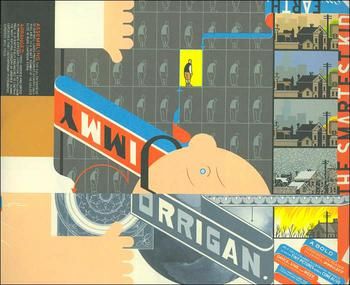
Certainly, the medium, sometimes also called "the cartoon narrative," has never enjoyed a better reputation and reception in the adult world of books, with serious, respectful reviews in serious publications. This year alone we have seen the publication of major graphic works, including Chris Ware's Jimmy Corrigan (Pantheon), Daniel Clowes's David Boring (Pantheon), Joe Sacco's Safe Area Gorazde (Fantagraphics), not to mention the stunning third volume of the Drawn and Quarterly Anthology (Drawn and Quarterly) and Ben Katchor's The Beauty Supply District.
Okay, an armful of books does not a movement make, but consider this: More than a few of these works not only tap into a burgeoning post-20th-century self-referential nostalgia, they also manage brilliantly to bridge the ever-widening chasm between visual and print generations. Thus, the ascendancy of the graphic novel becomes less about economics and more about the intertwined abstractions of demographics and esthetics. A fusion of styles and fascinations has facilitated the maturation of the comic book into a smart, funny, haunting work of literature with effects.
In Michael Chabon's latest novel The Amazing Adventures of Kavalier & Clay, two plucky young Jews come up with a character called The Escapist, a master of eluding dastardly traps and kicking Nazi butt. In no time at all, they're rolling in cash, their book, as Chabon writes, tapping into a generational optimism. Chabon's novel is an evocation of the dawn of the comic age, that era between the late thirties and early fifties that all those who draw comics today can't help but long for. Indeed, when our new crop of graphic novelists juxtaposes its cast of present-day losers with the glorious comic-book heroes of yesteryear, they are actually pitting themselves against the heroic comic-book creators found in Chabon's novel.
Which is to say that graphic novels aren't just about nostalgia for that simpler, purer time. A kind of double nostalgia is at work in the imaginations of graphic novelists working today -- nostalgia for the thirties and forties and a nostalgia for childhoods in the sixties and seventies, when the young would-be comic artists themselves longed for a purer time when nerdy adolescents could and did create, in the confines of their suburban homes, enduring pop archetypes).
Both Chris Ware's Jimmy Corrigan book and Daniel Clowes's David Boring contain elements of this sensibility, best described as a nostalgia for a time when we still believed in nostalgia (thus a a nostalgia for the nostalgic kids we were). Ware's Jimmy Corrigan, described in the Village Voice as "a quietly brutal portrait of a friendless loser," tells the story of an entire family of friendless losers including Jimmy, his estranged parents and his grandfather.
In the masterfully illustrated novel, Jimmy, a round, fat, clumsy almost-man utterly dominated by his mother, receives an invitation from the father who abandoned them to get reacquainted. Against his own better judgment, the so-shy-he's-practically-mute Corrigan sneaks off to get reacquainted with Daddy. Things go poorly, and events ensue that include Jimmy being hit by a car and daddy dying suddenly. Throughout the latter tragedy, Jimmy wears a Superman T-shirt, a subtle visual reminder to us that Jimmy has constant fantasies of a superhero nature; fantasies that become morbid nightmares when, in the final pages, he breaks down sobbing and imagines himself poised on the edge of a building, either preparing to finally fly, or to finally jump.
Clowes's character David Boring also searches for an absent father, a father he knows only through the panels of a single issue of his father's comic book, the tale of a macabre super-hero known as Yellow Streak. When the almost adult Boring is discovered by his mother searching this document from another era for some sort of sign, she grabs the comic and rips it into shreds, announcing: "Your father is dead." Clowes also throws in a noir detective element reminiscent of the pulps of the Thirties, and a somewhat incongruous apocalypse motif, yet another ironic nod to his own childhood in the heady days of the Cold War and bomb shelters.
In the lavish Drawn and Quarterly anthology, Raw contributor R. Sikoryak gives us a retelling of Dostoyevsky's Crime and Punishment,the story of the "brilliant, poverty ridden student known as RASKOL!" The comic looks and feels like a superhero caper. In fact, Raskol himself does the dirty deed of murder dressed in a Batman costume. The result is disconcerting and fascinating -- the moody and malevolent Batman imbued with the psychology of a Russian moralist. It's a canny fusion of overlapping fictional legacies: Two precocious adolescents whose lives are forever altered by a violent world that shatters their easy innocence.
American Book Award winner Joe Sacco, whose illustrated Safe Area Gorazde painstakingly recreates the Balkan conflict from a ground-floor perspective in Eastern Bosnia, argues that the "marriage of words and pictures can relay as much information as a documentary film." This is undeniably true, but there is more to it than that. The comic book is a potent marriage of documentary's visual precision and the novel's heart-rending gusto. The brilliance of, say, Art Speigelman's now-classic Maus was not that he told the story of the Holocaust, but that he was telling the story as his father told it to him (documentary) and then making it his -- and our -- own by portraying Eastern Europe's Jews as mice (fiction). In an era where we seek to find the benign comforts of a nostalgic childhood that we knew, even as kids, never did exist, in a future we want to imagine as freed from the shackles of history's bloodiest century, we turn to the comic book -- excuse me, the graphic novel -- to tell our stories.
If Hal Niedzviecki could draw anything other than stick figures, he would be a graphic novelist. Instead, he's the editor of Broken Pencil magazine and the author of Ditch, an unillustrated novel to be published next fall.