It's gift-giving season and publishers are bringing out the big guns. New editions of popular titles by J. K. Rowling and Dan Brown? Attention getting CanLit novels like the Giller Prize winner by David Bergen?
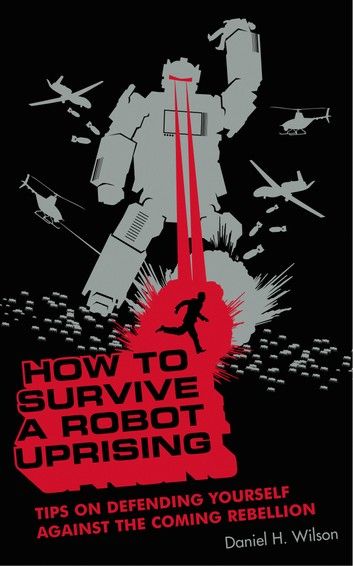
Guess again. This season, a whole other category of books may dominate. Think: How to Survive a Robot Uprising: Tips on Defending Yourself Against the Coming Rebellion. Think: Me Write Book: It Bigfoot Memoir. Think: Bar Mitzvah Disco (photos from over-the-top coming-of-age parties of the Seventies).
Never heard of them? But you've seen them. They're the impulse buys piled up next to the cash register. They're the books stocked by Urban Outfitters and hipster gift stores. They're the books you pick up, laugh at, and figure would be just about right for that co-worker who's into sci-fi ( The Space Tourist's Handbook), the friend who watches too much TV ( Hey! It's That Guy!: the Fametracker.com Guide to Character Actors), and the horny, recently divorced uncle whose lecherous hound-dog stare never fails to creep out the Hanukkah festivities ( Get This Party Started! 50 Naughty Games for Twosomes, Threesomes, Foursomes and More).
Pop-culture-inspired handbooks for situations you're never going to face featuring information you're never going to need, these gimmicky, kooky, sometimes just plain stupid books have at least one thing in common: There are more and more of them out there, because they sell. (And a good chunk of them are being written by Canadians.)
"We're seeing surprising growth in this area," is how Jamie Broadhurst, director of marketing for Raincoast Books puts it. Raincoast is the Canadian distributor for many of the publishers of the stupid-kooky book type. They distribute San Francisco-based Chronicle Books, which publishes The W orst-Case Scenario series, the best-known example of the useless-information genre. (Four million copies are in print, including recent titles The Worst-Case Scenario Survival Handbook: Golf and The Worst-Case Scenario Survival Handbook: Dating and Sex.) Raincoast also distributes Quirk Books, a publisher primarily devoted to, as its website puts it, "impractical reference books."
According to Broadhurst, these kinds of books attract young generations of pop-culture-savvy style-mongers. "They appeal to a different audience," he says, than the people who buy traditional fiction and non-fiction. "People who have grown up with the Internet and make less of a distinction between text and image. They're interested in the interplay between the two and are looking for books that are well-designed and fun."
So it is that, at their recent sales conference, many Raincoast sales representatives reported that the surprise hit of the season so far has been the Chronicle Books title Fuck This Book. Here is this season's poster boy for the stupid book. Author Bodhi Oser's scheme is simple: Wander around with bumper-stickers that say Fuck and a camera. Place bumper sticker over sign to create hilarious incongruities like "Fuckle Up and Drive Safely" and "Please Do Not Fuck the Pigeons." Snap photo.
Fuck This Book captures many of the key ingredients of the genre. It feels vaguely subversive, it's brightly rendered, and you can spend two minutes or two hours thumbing through it. It takes a single silly idea and goes with it. And goes with it. And goes with it. Finally, Fuck This Book is populist-inspired in that arm's-length Internet way. You can visit the website and order your own bumper stickers and submit/peruse more hilarious pics. Similarly, Hey! It's That Guy! came into being because the creators of the Fametracker.com website noticed that the character-actors gallery was one of the most enduring and well-frequented sections of their site. Bar Mitzvah Disco also began, and lives on, as a web-based project.
Clearly, there is a specific recipe for the success of these kinds of books. And if anyone knows what it is, it's David Borgenicht, president and founder of Quirk Books and the man who originally conceived of and continues to co-write The W orst-Case Scenario series.
"Our sales have grown substantially since 2002 and continue to do so," Borgenicht notes. "Over all, the market for these kinds of books has grown a lot." Borgenicht's Philadelphia-based company printed 50,000 copies of its fall title The Space Tourist's Handbook. Another book he's expecting to do well with is Yoga for Regular Guys, featuring a professional wrestler, bodacious babes and a forward by horror schlockmeister Rob Zombie. And of course there's the perennial hit The Baby Owner's Manual: Operating Instructions, Trouble-Shooting Tips, and Advice on First-Year Maintenance -- over a quarter of a million sold -- and The Brick Testament, a bizarre and surprisingly popular series of books featuring retellings of stories from the Bible in Lego. Yes. Lego.
So how does Borgenicht account for the rise of the stupid book?
"We look for a concept that has a clear core market and, if published and packaged correctly with real, useful, and/or cogent information, has the ability to cross over into non-book stores."
In other words, it's all about marketing. In an era where book sales are largely stagnant, and serious fiction and non-fiction struggle for attention, the quirky-kooky-stupid book is perhaps the single genre that manages to attract younger readers while finding a new market in an industry dominated by the whims of one or two giant chain bookstores.
This rare example of growth in the book industry is hardly going unnoticed by Quirk and Chronicle's competitors. Traditionally high-minded publisher Bloomsbury is hoping to score big with How to Survive a Robot Uprising. And it's Crown, a staid Random House imprint, that has released Bar Mitzvah Disco. Meanwhile Penguin imprint Plume has jumped into the game with the illustrated Bigfoot autobiography Me Write Book. And high-art publisher Princeton Architectural Press is developing a new reputation with crowd-pleasers like Lost: Lost and Found Pet Posters from Around the World.
"There are certainly more publishers trying to do quirky books, quirk-esque books," notes Borgenicht. "Some are just knock-off artists, others are doing it quite well. But you can't just slap the word handbook on something and expect it to sell any more."
So as more publishers jump into the quickly expanding kooky gift-book market, will we see less emphasis on traditional works of fiction and nonfiction?
"It's too hard to tell, but I don't think so," says Doug Pepper, who acquired Bar Mitzvah Disco for Crown Books before moving back to Toronto to take on his current job as president of McClelland & Stewart. "There's a market to be had, but it's not like publishing companies are saying we're going to reduce our literary nonfiction program to make room for this."
"There's no universe I could envision in which someone is holding Alice Munro in one hand and Hey! It's That Guy! in the other and wondering which one to buy," quips Adam Sternbergh, one of the authors of the guide to B-list character actors and a Canadian now based in New York. Co-author Tara Ariano, of Toronto, agrees: "I don't think it's a zero-sum game, I buy all kinds of books stupid and serious."
The stupid-book genre might not replace traditional books, but obviously some highly intelligent people are turning their attention to the format. Website mavens Ariano and Sternbergh, have proposed books related to their Fametracker.com project before, but this was the one that took, a lowest-common-denominator project that precludes any of the fascinating observations they surely possess regarding contemporary society's obsession with celebrity.
Pittsburgh-based Daniel H. Wilson, author of the Robot Uprising book, has a doctorate in robotics from Carnegie Mellon. But, as he admits, this one-gag project featuring such fare as "how to treat a laser wound" shares as much with Hollywood as it does with the serious engineering projects of the future. Toronto-based illustrator/writer Graham Roumieu's Bigfoot memoir has some very funny moments, but it's the offbeat pathos captured in the scribbled drawings that almost elevates this book from the one-joke genre. What would this emerging talent have accomplished if he hadn't had to package his imagination for the gift-book market?
At the end of the day, the creators of these books, like the publishers, are seeing an opportunity and seizing it. And the books, lightweight though they may be, are often as least as original as your average short-story collection featuring aging characters seeking meaningful epiphanies from the quotidian doings of life in the prairies. So maybe what this undefinable and surprising genre needs are more people -- critics, authors, publishers -- to take it seriously. Is it time to give the stupid book some respect? And if it is, when will Canadian publishers find their way into this niche? Ian Phillips ( Lost and Found Pet Posters), Roumieu, Ariano and Sternbergh are all Canadians who took their projects to U.S. publishers. And it was San Francisco-based Chronicle who initiated publication of last year's stupid book, So You Want to Be Canadian.
"We've always left it to the Americans to do this kind of thing," laments M&S's Pepper. "We probably all look at it like a good thing that we don't stoop to that kind of publishing, but as far as I'm concerned, there's nothing to be ashamed of."
Well, that's for legions of gift-getters to decide. When the holidays are over and the dust has settled on the discarded wrapping paper, will you proudly display your copies of Fuck This Book and the Bigfoot memoir? Or will you hide the already well-thumbed tomes under that Winston Churchill biography perennially adorning your coffee table?
Get this stupid book started!
How to Write a Handbook that will Provide No Discernible Useful Information, Have a Catchy Premise and Jump-start Your Career as a Bona Fide Author:
Start a website and get a ton of hits. This will impress the market-oriented publishers.
Make fun of something you're an expert in. This technique led PhD-wielding roboticist Daniel H. Wilson ( How to Survive a Robot Uprising) to a book deal, a movie deal with Paramount and a column with Popular Mechanics.
Take/collect pictures of weird, gross or nostalgic things. The sub-genre of weird images collected in one big book includes everything from nasty foods of the 1950s to crime-scene photos.
There's no such thing as a stupid idea! Stupid books include Everything I Ate: A Year in the Life of My Mouth (guy takes a picture of everything he eats for a year) and Vice Dos and Don'ts, Vice magazine's book entirely devoted to making fun of random people who dress badly.
-- Hal Niedzviecki