Call it the mystery of the girl detective. Nancy Drew's 75th year as the world's premiere teen-lady sleuth is winding down and her hold on the imaginations of girls and women shows no signs of abating.
Since 1930, Nancy Drew has kept girls huddled under their blankets, their surreptitious reading aided by a flashlight. Night merged with morning as youngsters followed the plots and adventures of the well-off, motherless girl with an abnormally encouraging father, two cheery sidekicks and a boyfriend of convenience roughly as important to Nancy as the blue roadster she used to zip off to her ceaseless adventures.
An outdated portrait of an overprivileged young lady with an unrealistic amount of freedom and very little in the way of angst, lust, jealousy or irony, this is a character who should seem as out of step with the times as a bunch of hepcats heckling a soda jerk.
Surely as women became increasingly more independent, and pop culture spewed out generations of newer, grittier, and more realistic girl heroes, Nancy Drew would inevitably find herself a forgotten curiosity.
But Nancy Drew is still going strong. Though the original series of mysteries ended in 2003, Simon & Schuster, owner of the Nancy Drew brand, is keeping Carolyn Keene busy.
Indeed, the pseudonym under which the Nancy Drew stories have been written all these years just keeps cranking out mysteries.
Simon & Schuster has rolled out two new series in the last two years. Nancy Drew Girl Detective (first-person Nancy) debuted in 2004 and even made The New York Times bestseller list.
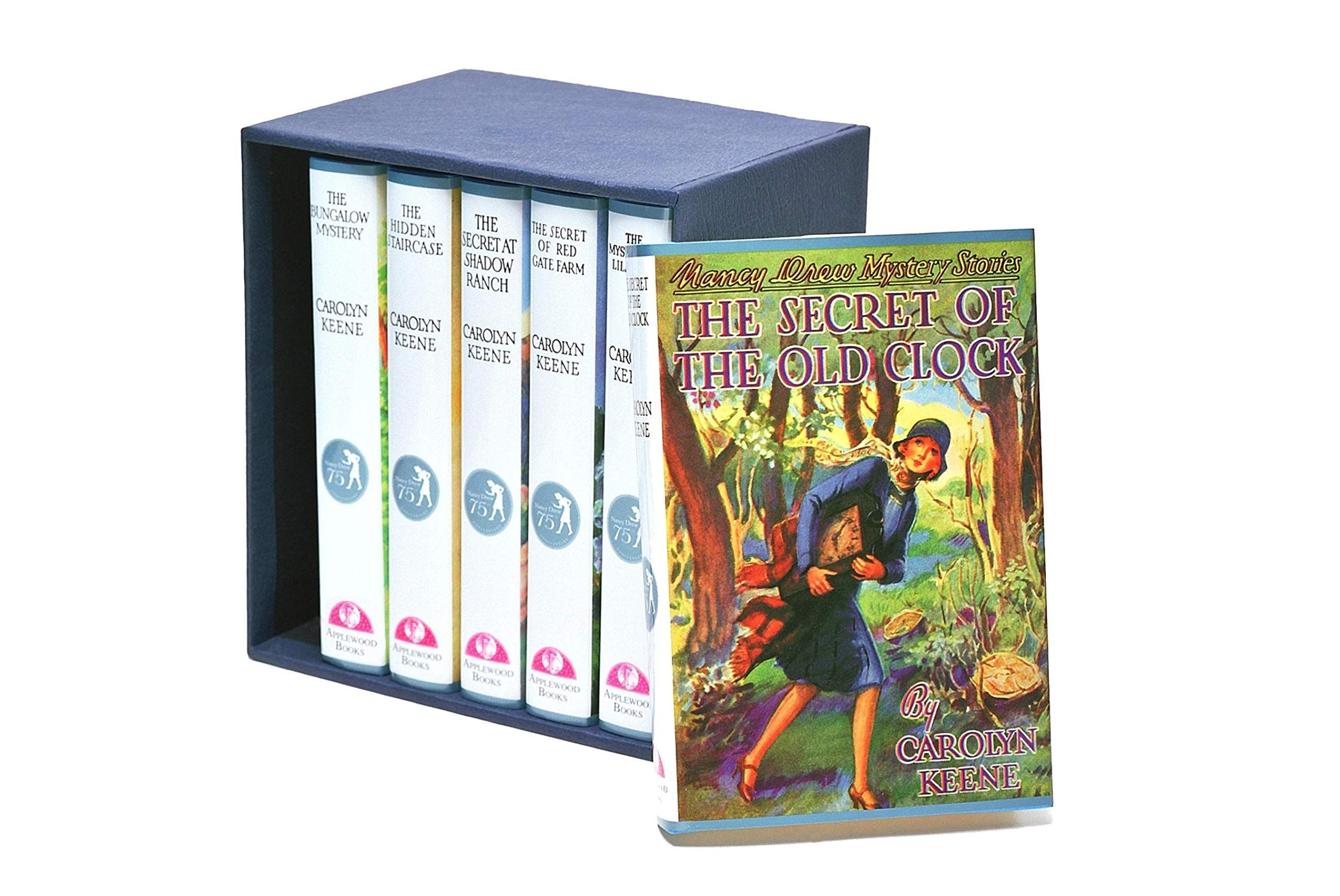
This year, the Nancy Drew: Girl Detective Super Mystery series debuted, as well as a series of Nancy Drew graphic novels. And for the purists, the American history-oriented small press Applewood has been steadily re-issuing original unmodified Nancy Drew books complete with exact reproductions of covers and text (including the casual ethnic slurs that were cut out of the books as the times changed). All that plus Nancy Drew computer games and a line of apparel hawking everything from drawstring pants to scarves, handbags and collectable anniversary pins. As a Nancy Drew website (nancydrewsleuth.com) proudly notes: "Nancy Drew has solved over 350 cases and sold over 200-million books in 14 languages."
Nancy Drew not only keeps making money, but she is increasingly a source of scholarly debate. Essays assess the historical and social impact of Nancy, and a bevy of academic events that started in the 1990s culminated in a massive open-to-the-public conference held this year in New York City.
The event featured guest speakers, readings, parties and, of course, the inevitable discourse on "The Secret in the Subtext: Lesbianism and Nancy Drew." Among the many who spoke at the conference was Melanie Rehak, whose recently published book Girl Sleuth: Nancy Drew and the Women Who Created Her documents the history of the young detective's creators and anonymous writers.
"People show up with their kids," says Rehak, who's been touring around the United States discussing the history of the girl detective. "It's the kids who want to know more about Nancy Drew." For Rehak, the enthusiasm girls continue to show for the Nancy Drew character has been an eye-opener. "The books still get handed down. I got the books from my mother who got them from her mother."
And so Nancy Drew has become the ongoing exception to the rule. At a time when the accepted wisdom is that tween girl readers want characters who openly discuss their burgeoning insecurities about everything from fitting in to fooling around, Nancy Drew, a character who never tried to fit in and who rarely gave Ned Nickerson more than a firm pat on the back, continues to be inexplicably popular.
"The icon of Nancy Drew seems to exist in a different space from contemporary pop culture," Rehak notes. "There's this whole other arena in which the Nancy Drew being passed along is the Nancy Drew from the thirties and forties. Having everything dated makes the mystery better."
For Ilana Nash, an English professor at Western Michigan University who writes about Nancy Drew in her new book American Sweethearts: Teenage Girls in 20th-Century Popular Culture, Nancy's archaic demureness is one of the great clues to her longevity. Nash argues that Nancy stands out in an era of hyper-sexualized girl heroes facing such dilemmas as buying their first bra (in the inaugural episode of Disney's Lizzie McGuire TV series).
"Nancy Drew never uses her body, she never puts herself up as a spectacle to get something done." In contrast to midriff-baring pop figures from Buffy the Vampire Slayer to Britney Spears, Nancy Drew is a reserved, quietly efficient character who, as Nash notes, "is allowed to go anywhere, do anything, accomplish anything."
But despite Nancy Drew's enduring presence and undeniable influence, many who read the books as girls now consider her reserve and lack of a meaningful interior life serious flaws.
As a result, Nancy Drew is the obvious inspiration for a growing number of reinventions penned by up-and-coming women writers in their 20s and 30s who want to give the girl detective a more substantive update than Simon & Schuster is likely to undertake.
Brooklyn-based writer Margo Rabb was inspired by Nancy Drew to create her own series of books featuring two displaced teenage sisters who wrestle with the death of their parents while solving crimes and hiding their Jewish New Yorker identities from the curious residents of small-town Indiana. The Missing Persons books have clearly connected with readers: Rabb gets regular fan mail and her series will soon be available as far away as Japan and Croatia.
Toronto writer Emily Pohl-Weary will unveil her take on Nancy Drew this coming spring with a series of books entitled Natalie Fuentes: D.I.Y. Detective. Sixteen-year-old Natalie uses clippings from the newspaper as part of her zine and as inspiration to right social injustices such as the racially motivated attack on her high school's caretaker. And these are just the most recent additions to a Drew-inspired oeuvre that includes girl detective Hazel Green, and Zodiac P.I., the Japanese manga comic series focusing on a teenager who uses the zodiac to solve crimes.
"There are some things that don't hold up," says Rabb about her decision to delve into girl-detective territory. "Even when I was a kid, Nancy seemed prissy and prudish with her special friend Ned. She was 18 in those books. Now, an 18-year-old would be explicitly doing it with Ned."
Pohl-Weary also read Nancy as a kid and agrees that the girl sleuth could use a bit of an update: "Nancy lived in a rich, suburban, racist world. Her hair was always perfect and the crimes she solved often involved privileged heiresses being swindled out of their money."
But despite the flaws of the original, both of these younger women writers are committed to the icon. Rabb explains it this way: "I wasn't a tomboy. I was really into girly stuff as a kid. For girls who actually do feel a feminine connection and want a heroine, here's a strong independent woman who also has perfect outfits."
So the question becomes, will reinventions, updates and graphic novels usher in the second Nancy Drew century, or end up diluting and corrupting an icon whose continued impact and success seem to be derived from her amber-like ability to be frozen in time and place?
On the one hand, the modern updates seem unlikely to inspire young readers the way the Nancy of the thirties and forties did. The graphic novels "based on the series by Carolyn Keene" feel like cheaply done after-school specials. Nancy's college adventures as chronicled in the mid-nineties Simon and & Schuster spinoff series Nancy Drew Goes to College are as forgettable as the anonymous authors who penned them. On the other, Rabb's books are clever, sad and full of nuance, managing to capture the ageless appeal of the girl detective despite self-doubt, loneliness, crushes, cellphones and Google.
Still, Rehak isn't so sure that a postmodern Nancy Drew dealing with hidden identities, boy trouble and social injustice can ever replace the original icon. "Zillions of other books deal with adolescence romance," she says. "Children naturally long for ways to shut their brains off a bit and not be constantly dealing with their own psychological development."
But Nash disagrees. She credits Nancy Drew-inspired reinventions such as television's girl detective Veronica Mars for keeping the tradition alive and relevant.
"The image of the girl sleuth isn't as radical as it used to be. Nancy Drew as she was no longer has shock power," she points out. "The endurance of the girl sleuth as the icon continues -- but she has been eclipsed by her followers."
So do girls want a strong young female character as unshakable as her legacy? Or do they want a socially attuned, emotionally complex Nancy dealing with the problems of the 21st century?
That mystery, clearly, has yet to be solved. Seventy-five years old and still as youthful, smart and liberated as ever, Nancy Drew remains an enigma: a pretty girl who doesn't get sidetracked by boys, a smart girl who does exactly what she wants yet lives in a world of naiveté and convention, a bestseller who is penned anonymously, is endlessly reinvented and never seems to change.