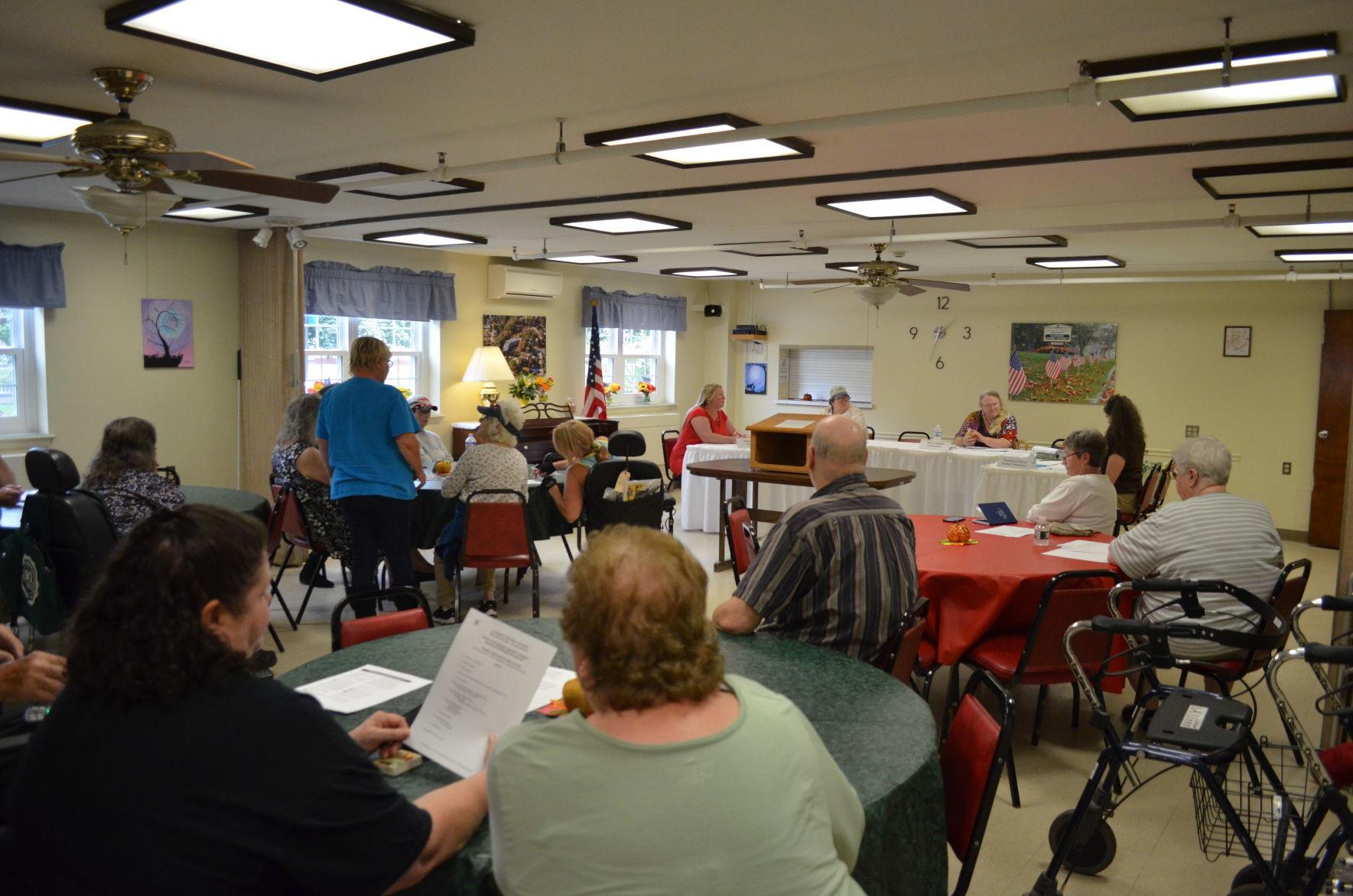
CLAREMONT — The Claremont Housing Authority board of commissioners discussed residents’ concerns with the smokers’ gazebo out front, new rules from Housing and Urban Development that could change the way the senior apartment complex Marion Phillips is funded, and raising the rent on some apartments at the monthly meeting.
Commissioners Kathleen O’Brien and Ann Campbell were in attendance, as was commission chair Doreen Needham; a fourth seat on the commission remains vacant. Director of Housing Michelle Aiken, also the executive director of Marion Phillips and the secretary and treasurer of the commission, answered questions.
Two gazebos
The senior housing complex has two gazebos, a brown one in the front of the building on Broad Street, and a white one behind the building. The white gazebo is designated for the complex’s smokers; the brown one is in proximity to the sidewalk and the parking lot.
Resident Kimberly Bombria spoke to the commission. “A lot of tenants in here right now are smokers. We need to reconsider the brown gazebo over the white gazebo; the white gazebo seats 6 and it’s a tight fit at best. (When it’s full) they’re out there in the rain and snow, which isn’t fair. I understand Marion Phillips is trying to set an example and make things look nice, but we have rights as smokers, too.”
Later in the meeting the commissioners took up the question. Ann Campbell explained that HUD rules require smoking areas to be 25 feet from public areas. “This is a smoke-free building,” she added. “An area doesn’t have to be provided for smoking at all.”
“We recognize people smoke,” said Campbell. “There’s no way to make the brown gazebo a smoking area.”
Bombria asked if there might be a way to expand the white gazebo to offer the smokers more shelter from the weather. After some discussion Aiken said she could look into a bus-shelter type thing that could be placed in the back.
Voucher system could change financial status
Aiken reported she has been to some trainings on “the repositioning of public housing.” The Department of Housing and Urban Development is pushing public housing places, like Marion Phillips, to change to a project-based voucher system. Currently not all the residents of Marion Phillips use vouchers; the CHA issues Section 8 housing vouchers, which can be used elsewhere in the community. “Instead of 140 vouchers scattered, which is what we have now,” said Aiken, “We would have 96 vouchers in one place.”
HUD is offering a carrot to public housing facilities that change over: in the case of Marion Phillips, they could receive an additional $118,000 a year. HUD also wields a stick, although it’s unclear when it will descend; Aiken said that HUD is predicting a future time when the public housing authorities will no longer receive capital funds the way they do now. According to the workshops Aiken attended, Marion Phillips is a candidate for “streamlined conversion” to a voucher system.
The streamlined conversion has several elements, Aiken explained. Marion Phillips has about $300,000 in the bank, which it would not be able to keep; they would have to spend it down or give it to HUD. For tenants, the conversion to an all-voucher system would mean their right to their apartment would be protected for 15 years, but it wouldn’t protect them from eviction. Rent increases could be up to 120% of fair market value for each unit. Tenants could opt out of the conversion to an all-voucher system, but that would mean they’d have to pay the rent without the vouchers “if they choose,” Aiken said.
The voucher would stay with the tenant, she explained. “You could take your voucher and go to Florida,” said Aiken.
“Can I have mine now?” quipped a woman in the audience.
According to the HUD website, the conversion to an all-voucher system would alter the financial status of the public housing facility, in that it could borrow against the value of the building. “Right now we could not do that; they don’t let us take out loans,” said Aiken.
Asked if that meant a bank could foreclose on the building, should a loan not be paid, Aiken answered, “Yes.” However, she believed the 15-year contract would protect the tenants.
The change would require several steps on the part of the commissioners, including meeting with the city manager, and there would need to be two tenant meetings before the CHA applied to HUD. “We don’t have to do this, but there’s no reason not to,” said Aiken.
Fair market values
Rent payments for some public housing units will be going up. Aiken said that in discussions with an administrator at Southwestern Community Services, she learned they are having a hard time placing people because the rent they’re offering landlords is too low. Therefore, she presented a sheet of rent increases to the commissioners, which was not shared with the public. Commissioner Kathleen O’Brien abstained from voting, saying it was new information to her. Commissioners Needham and Campbell approved the increases.