My parents first took me to the circus when I was six years old. Much to their surprise, the clowns' center ring performance actually frightened me. As we sat in front-row seats, I cried while watching those bizarre characters with their wild orange hair and frozen smiles. To me, they resembled playground bullies, hitting each other over the head with rubber chickens and buckets of water. Their trickster pranks seemed to suggest something darker lurking beneath their white-faced facades. Despite Mom and Dad's calm assurances it was all make-believe, I came away from that encounter with the first truism of my young life: Never trust a clown.
My unsettling perception of clowns changed when years later, a friend showed me an old black and white video of a man dressed in an ill-fitting jumpsuit and white-faced clown makeup. His character was referred to as “Bip, the clown." His artistry was at once mesmerizing and endearing, and revealed a magic soul that radiated from behind the mask. From simple to elaborate, comical to poignant, he portrayed through expressive mime our “life without words” with amazing eloquence of movement.
His name was Marcel Marceau.
The Silent Poet
He spoke to us in poet voice
with features pale profound,
In rhythmic grace and wordless song
he murmured not a sound;
Inside an ageless box of glass
he stirred the truth of time,
Reshaping while escaping life
through hidden doors of mime;
His fluid hands would flutter-dance
as birds embraced in flight,
And mirrored soft our struggles
with the darkness and the light;
He called us to our childhood youth
in dreams so simple sweet,
And shared our silent promise
of tomorrows yet asleep;
In silent worlds we watched unfold
the beauty of his art...
This gift of inspiration
in the language of the heart.
Known as “The Master of Silence,” Marceau’s humor was subtle, boundless and irresistible. In the YouTube video link that follows, he introduces a scene vignette that takes place at a small café in Paris:
"Do not the most moving moments of our lives find us all without words?"
--- Marcel Marceau (Wikiquote.org)
In one of his most moving and admired pantomimes, Marceau flawlessly portrayed the metamorphosis of man. This famous routine is captured in the next video. From the embryo to his birth as an eager child, we watch his journey travel through to confident adulthood. His life continues into the fragility of old age before finally culminating in death, and resounds back to his beginnings in embryonic form. The lighting begins with gray shadows and grows brighter as his life begins. The quality of the video is a bit grainy due to the pre-digital age of this 1965 film, but is nonetheless mesmerizing and magically timeless:
"To communicate through silence is a link between the thoughts of man."
--- Marcel Marceau (Various Quote Sources)
Marceau portrayed many moods and personae...from passersby on the street, to lion tamers, sculptors, tango dancers and many others. His acts included various characters in a play which captured the drama of humanity through his brilliant and subtle movements. In “The Tribunal,” he cast himself as the defendant, judge, jury and executioner. “Creation” signified the beginning of the world with Adam and Eve in the Garden of Eden. Regardless of subject and theme, Marceau’s brilliant reflections of people were fluid photographs of the soul.
It is not surprising to learn that this legendary artist led a remarkable life. He was born, Marcel Mangel, on March 22, 1923 in Strasbourg, France. His family was Jewish and fled to Limoges with the onset of World War II in France. (His father perished in the horror of Auschwitz in 1944. His mother survived.) In order to avoid discovery by the Nazis, Marcel changed his last name to Marceau. Both he and his brother, Alain, worked with the French Underground and helped many children escape to neutral Switzerland. Marcel spoke English, French and German fluently, and served as an interpreter and liaison officer for the Free French Forces and allied armies.
"The people who came back from the concentration camps were never able to talk about it. My name is Mangel. I am Jewish. Perhaps that, unconsciously, contributed towards my choice of silence."
--- Marcel Marceau (Jewishpress.com)
When the war ended, Marceau enrolled in Charles Dullin's School of Dramatic Art at the Sarah Berhardt Theatre in Paris. His parents had introduced him to the world of theatre and the arts as a young boy. After seeing a Charlie Chaplin film at the age of six, his lifelong dream was to become a mime.
In 1947, "Bip the Clown" was born and appeared at theaters throughout Paris. Bip was based on the 19th-c French Pierrot, the melancholy drifter. Two years later, Marcel established the Compagnie de Mime Marcel Marceau, the only pantomime company in the world at that time. "Mime, like music, knows neither borders nor nationalities,” he once said. By the mid 50’s, he had popularized this beautiful art form all over the world. His school, École Internationale de Mimodrame de Paris, Marcel Marceau (International School of Mimodrame of Paris, Marcel Marceau), was founded in 1969.
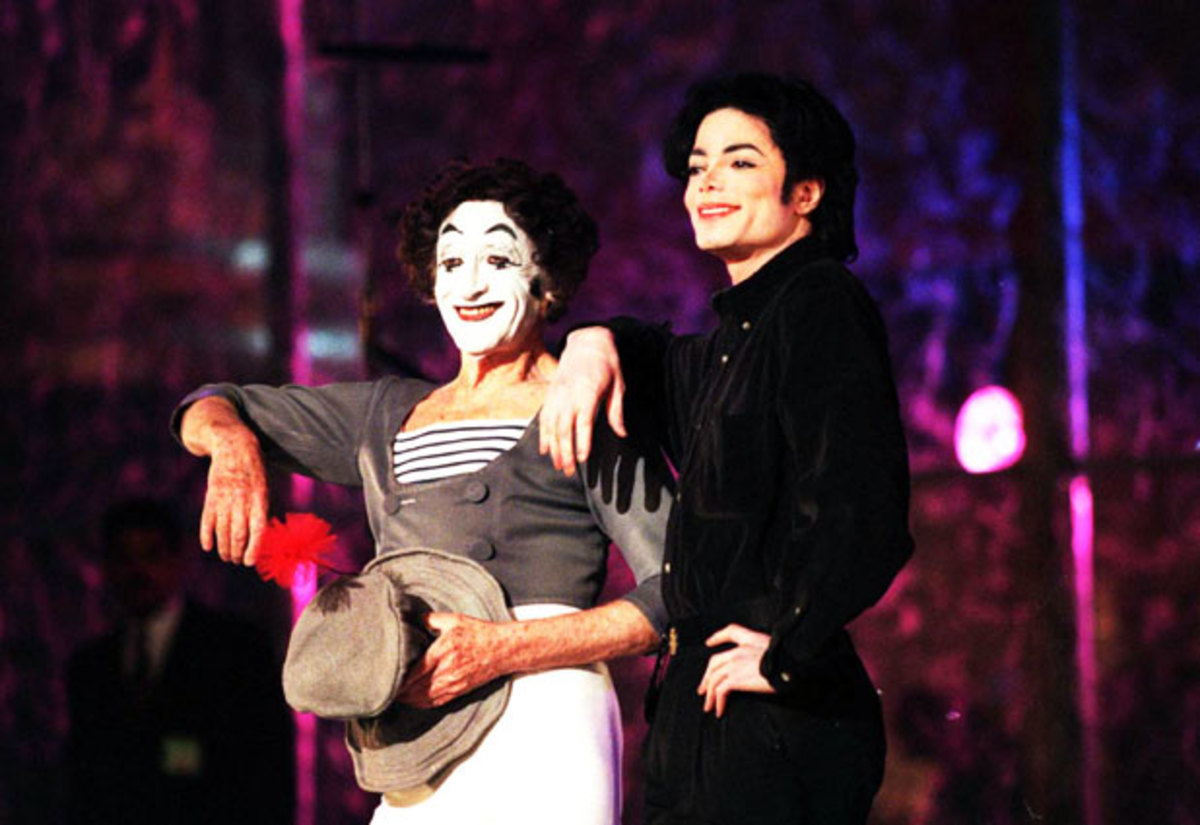
Marceau was also a teacher, author and painter. Although his work influenced the world of art, he often expressed disappointment over street imitators who worked the tourist venues in ways that reflected poorly on the world of mime. He was pleased, however, when artists such as Michael Jackson (a long time friend), improvised some of his unique inspiration of movement with their dancing and performance art.
"I used to sit in the audience and watch how he would defy the laws of gravity, like he was stepping on air. I would take some of those things and include it into rhythm and dance when I moved."
--- Michael Jackson (Wikipedia.org - "Marcel Marceau")
Among his many awards and honors, Marceau was made a commander of the Order des Arts et des Lettres, an Officer of the Legion d’honneur. He was awarded honorary doctorates from Princeton University, the University of Michigan and Ohio State University. He also received the Wallenberg Medal from the University of Michigan in appreciation of his humanitarianism and courage in helping Jews and other refugees during World War II.
Marcel Marceau passed away in his southwestern town of Cahors, near Toulouse, France, on Sept. 22, 2007. He had retired from the stage two years earlier.
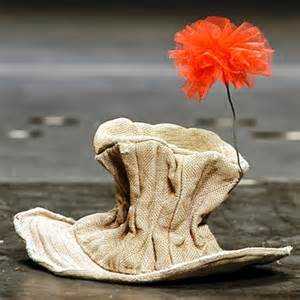
There is so much more to add about this extraordinary man’s life…it would literally fill volumes. But I prefer instead to end this hub by humbly tipping my imaginary, crumpled old hat with respect and homage in a silent prayer: "Merci, Marcel, pour mes rires et mes larmes." (Thank you, Marcel, for my laughter and my tears.)
End Notes: Biography sources and publications:
1. The Jewish Virtual Library (Jewishvirtuallibrary.org) "Marcel Marceau
2. Marcel Marceau – Biography - IMDb (imdb.com)
3. Gloria Spielman, Marcel Marceau: Master of Mime, (Kar-Ben Publishing; 9-28-2011)
© Genna Eastman. All rights reserved.