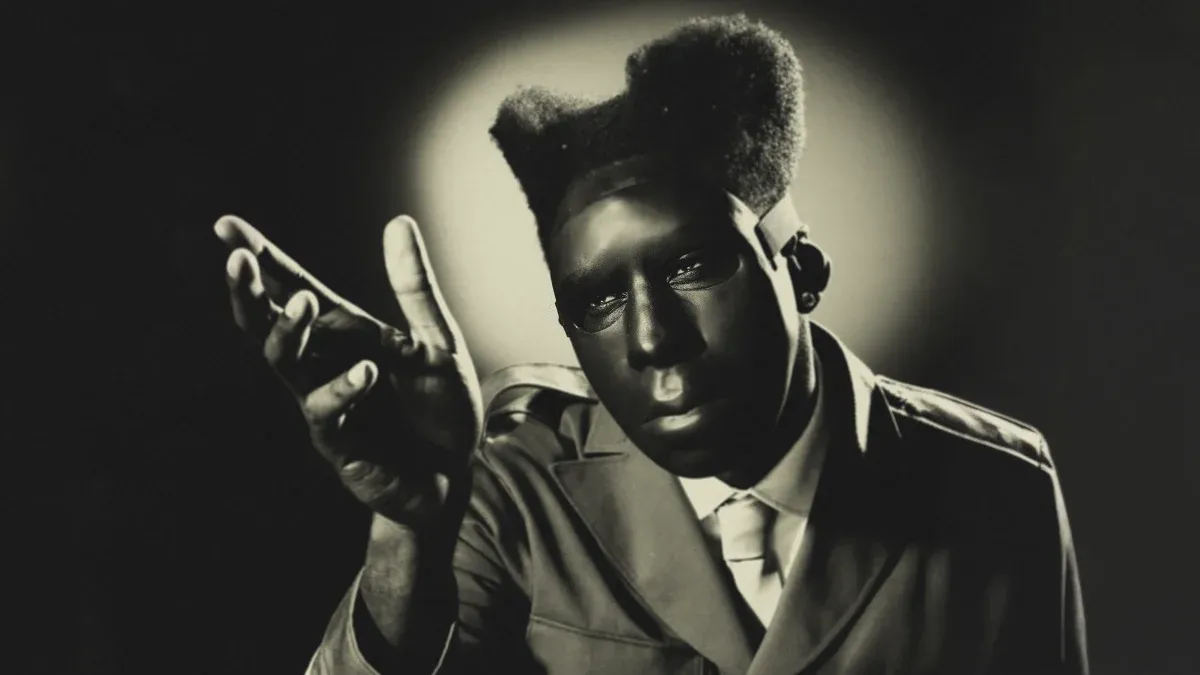
Hip-hop artist Tyler, the Creator has taken his listeners on a thirteen-year long self-growth journey, and we have reached the climax with his newest project. Released late last month, Chromakopia gives us an idea of what really goes on in Tyler’s life, away from the fame he has built from his past seven albums.
We learn from his newest album that behind his outwardly-facing, loud, and confident persona is a thirty-three-year-old who is struggling with the concept of growing up, his sexuality, and his relationship with the press. Although each song on the album unravels different dilemmas that Tyler is facing, none is as consequential as “Take Your Mask Off”, which acts as a self-diss track from the artist.
At the start of the song we immediately get thrown into the first verse, where Tyler brings forth the character of a teenage boy who is falling down the path of gang culture as a means to look tough. In reality, however, the kid comes from a middle class family, cosplaying as a gangster to try and prove something. “And none of them face tats gon' hide the fact that you sad, bruh. You ain't a thug, you was in drama club, you's a actor,” Tyler raps.
Tyler was a polarizing figure at the start of his career, who would often just say whatever he wanted regardless of the consequence, to the point where he was ultimately banned from the United Kingdom for five years for hateful comments in his songs and on social media. However, Tyler has later revealed that this act was simply him overcompensating for growing up in a strict and stable household–similar to the kid in the song.
Each verse is capped with the melodic chorus, “And I hope you find yourself, And I hope you take your mask off,” referencing the different facades Tyler has put up throughout his life.
Tyler introduces a second character, a queer Christian preacher who represses his sexuality in fear of judgment. “Had you thinkin' God would hate you so you covered it up, Gotta hide how you live, what you really enjoy,” he raps. This figure directly represents Tyler’s struggle with his own sexuality. From often saying homophobic slurs in his earlier albums, to now not putting a label on who he likes, it is clear that Tyler was experiencing insecurity, personified through the preacher in the song.
The last character shows the dilemma that Tyler has of settling down, in lieu of his music career. We get to know the story of a mother who gave up her dreams for her children, and her secret regrets of that decision. At thirty-three and single, Tyler is aware of the pressures of starting a family, but does not think he could give up what he has for that. He struggles to grasp this, believing that his thoughts are selfish, but knows it can not be any other way.
Tyler ties the three characters to his own life in the final stanza, along with some sharp digs at himself. He opens the verse by acknowledging his body changing from his age, along with the internal battle he continues to face with the media and his outward appearance. The last section is dedicated strictly to ridiculing himself, mentioning his failing clothing lines and his selfishness. We end with a call to action, with Tyler begging with himself to change ways soon, and that time is running out.