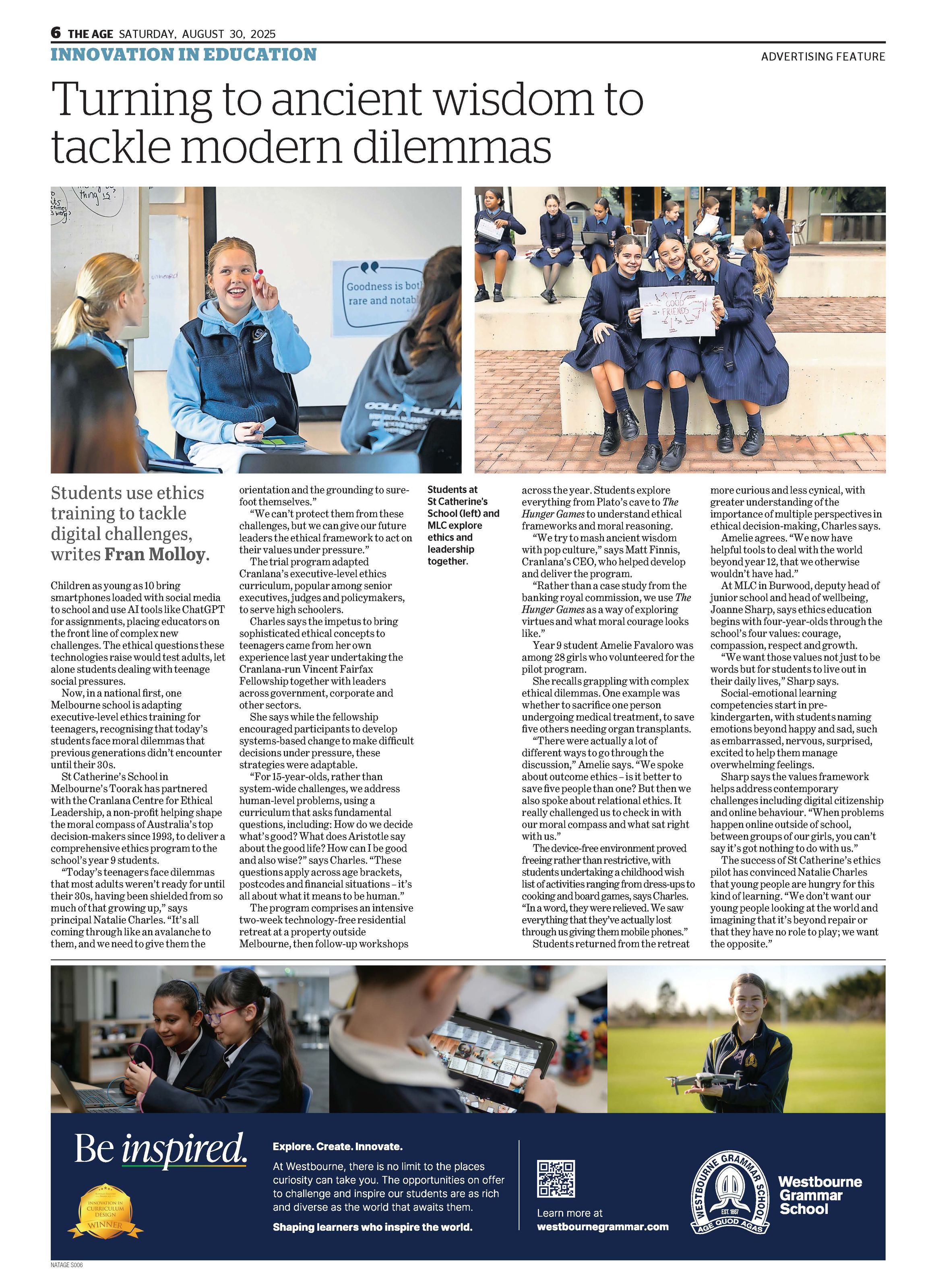
Students use ethics training to tackle digital challenges, writes Fran Molloy.
Children as young as 10 bring smartphones loaded with social media to school and use AI tools like ChatGPT for assignments, placing educators on the front line of complex new challenges.
The ethical questions these technologies raise would test adults, let alone students dealing with teenage social pressures.
Now, in a national first, one Melbourne school is adapting executive-level ethics training for teenagers, recognising that today's students face moral dilemmas that previous generations didn't encounter until their 30s.
St Catherine's School in Melbourne's Toorak has partnered with the Cranlana Centre for Ethical Leadership, a non-profit helping shape the moral compass of Australia's top decision-makers since 1993, to deliver a comprehensive ethics program to the school's year 9 students.
"Today's teenagers face dilemmas that most adults weren't ready for until their 30s, having been shielded from so much of that growing up," says principal Natalie Charles.
"It's all coming through like an avalanche to them, and we need to give them the orientation and the grounding to sure-foot themselves."
"We can't protect them from these challenges, but we can give our future leaders the ethical framework to act on their values under pressure."
The trial program adapted Cranlana's executive-level ethics curriculum, popular among senior executives, judges and policymakers, to serve high schoolers.
Charles says the impetus to bring sophisticated ethical concepts to teenagers came from her own experience last year undertaking the Cranlana-run Vincent Fairfax Fellowship together with leaders across government, corporate and other sectors.
She says while the fellowship encouraged participants to develop systems-based change to make difficult decisions under pressure, these strategies were adaptable.
"For 15-year-olds, rather than system-wide challenges, we address human-level problems, using a curriculum that asks fundamental questions, including: How do we decide what's good? What does Aristotle say about the good life? How can I be good and also wise?" says Charles. "These questions apply across age brackets, postcodes and financial situations-it's all about what it means to be human."
The program comprises an intensive two-week technology-free residential retreat at a property outside Melbourne, then follow-up workshops across the year. Students explore everything from Plato's cave to The Hunger Games to understand ethical frameworks and moral reasoning.
"We try to mash ancient wisdom with pop culture," says Matt Finnis, Cranlana's CEO, who helped develop and deliver the program.
"Rather than a case study from the banking royal commission, we use The Hunger Games as a way of exploring virtues and what moral courage looks like."
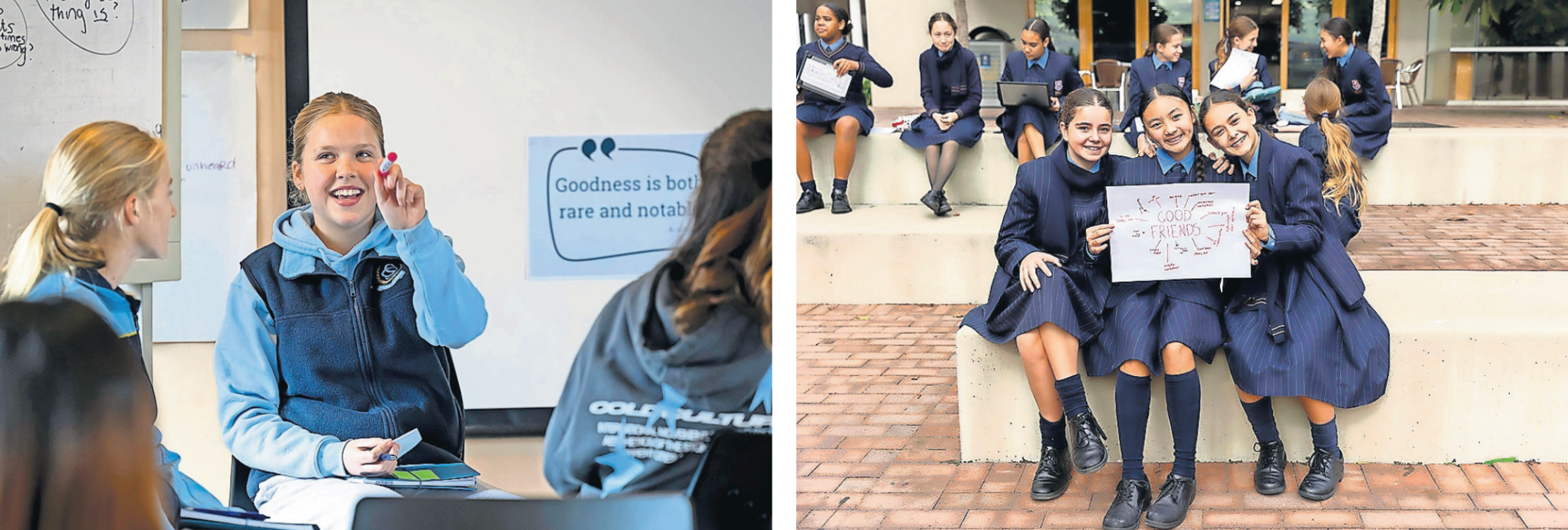
Year 9 student Amelie Favaloro was among 28 girls who volunteered for the pilot program.
She recalls grappling with complex ethical dilemmas. One example was whether to sacrifice one person undergoing medical treatment, to save five others needing organ transplants.
"There were actually a lot of different ways to go through the discussion," Amelie says. "We spoke about outcome ethics-is it better to save five people than one? But then we also spoke about relational ethics. It really challenged us to check in with our moral compass and what sat right with us."
The device-free environment proved freeing rather than restrictive, with students undertaking a childhood wish list of activities ranging from dress-ups to cooking and board games, says Charles.
"In a word, they were relieved. We saw everything that they've actually lost through us giving them mobile phones."
Students returned from the retreat more curious and less cynical, with a greater understanding of the importance of multiple perspectives in ethical decision-making, Charles says.
Amelie agrees. "We now have helpful tools to deal with the world beyond year 12, that we otherwise wouldn't have had."
At MLC in Burwood, deputy head of junior school and head of wellbeing, Joanne Sharp, says ethics education begins with four-year-olds through the school's four values: courage, compassion, respect and growth.
"We want those values not just to be words but for students to live out in their daily lives," Sharp says.
Social-emotional learning competencies start in pre-kindergarten, with students naming emotions beyond happy and sad, such as embarrassed, nervous, surprised, excited to help them manage overwhelming feelings.
Sharp says the values framework helps address contemporary challenges including digital citizenship and online behaviour. "When problems happen online outside of school, between groups of our girls, you can't say it's got nothing to do with us."
The success of St Catherine's ethics pilot has convinced Natalie Charles that young people are hungry for this kind of learning. "We don't want our young people looking at the world and imagining that it's beyond repair or that they have no role to play; we want the opposite."