The International Baccalaureate program is expanding its country footprint in Australia, writes Fran Molloy.
International Baccalaureate (IB) Diploma study is offered as an alternative to the HSC at many independent NSW schools, some of which also offer the IB primary years and middle years programs.
While available at public schools in other states, the IB curriculum is not offered at NSW public schools.
New additions to the state’s 30-plus IB schools include St Ursula’s College Kingsgrove, Aurora Southern Highlands Steiner School in Bowral, The Riverina Anglican College and Central West Leadership Academy in Dubbo.
“We have seen significant growth across schools in Australia, including both public and independent schools,” says Stefanie Leong, who heads up Asia-Pacific development for the International Baccalaureate Organisation.
Leong says that as of June, 288 IB programs were on offer in Australia across 214 IB World Schools, including at public schools in South Australia, ACT, Queensland and Victoria.
“We continue to receive interest from public and independent schools keen to adopt the IB philosophy and approaches to learning and teaching, and being part of an international learning community,” she says.
REGIONS TARGET HIGH ACHIEVERS
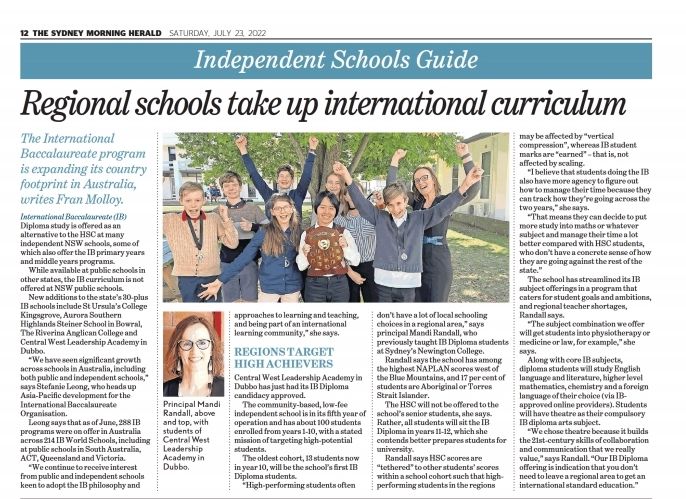
Central West Leadership Academy in Dubbo has just had its IB Diploma candidacy approved.
The community-based, low-fee independent school is in its fifth year of operation and has about 100 students enrolled from years 1-10, with a stated mission of targeting high-potential students.
The oldest cohort, 13 students now in year 10, will be the school’s first IB Diploma students.
“High-performing students often don’t have a lot of local schooling choices in a regional area,” says principal Mandi Randall, who previously taught IB Diploma students at Sydney’s Newington College.
Randall says the school has among the highest NAPLAN scores west of the Blue Mountains, and 17 per cent of students are Aboriginal or Torres Strait Islander.
The HSC will not be offered to the school’s senior students, she says. Rather, all students will sit the IB Diploma in years 11-12, which she contends better prepares students for university.
Randall says HSC scores are “tethered” to other students’ scores within a school cohort such that high performing students in the regions may be affected by “vertical compression”, whereas IB student marks are “earned” – that is, not affected by scaling.
“I believe that students doing the IB also have more agency to figure out how to manage their time because they can track how they’re going across the two years,” she says.
“That means they can decide to put more study into maths or whatever subject and manage their time a lot better compared with HSC students, who don’t have a concrete sense of how they are going against the rest of the state.”
The school has streamlined its IB subject offerings in a program that caters for student goals and ambitions, and regional teacher shortages, Randall says.
“The subject combination we offer will get students into physiotherapy or medicine or law, for example,” she says.
Along with core IB subjects, diploma students will study English language and literature, higher level mathematics, chemistry and a foreign language of their choice (via IBapproved online providers).
Students will have theatre as their compulsory IB diploma arts subject.
“We chose theatre because it builds the 21st-century skills of collaboration and communication that we really value,” says Randall.
“Our IB Diploma offering is indication that you don’t need to leave a regional area to get an international standard education.”