Remote families all over Australia are making enormous sacrifices to get the best education for their kids, writes Fran Molloy.
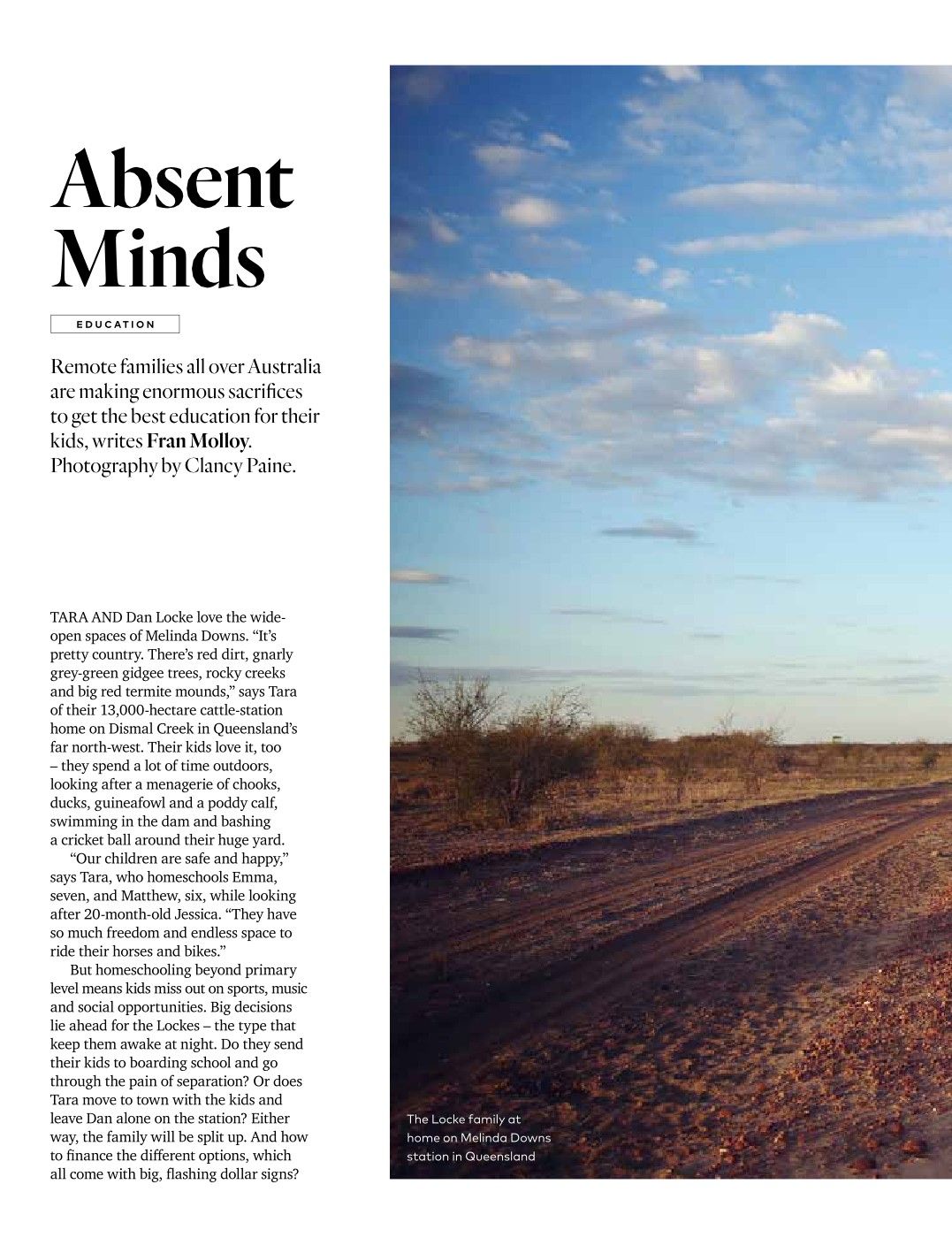
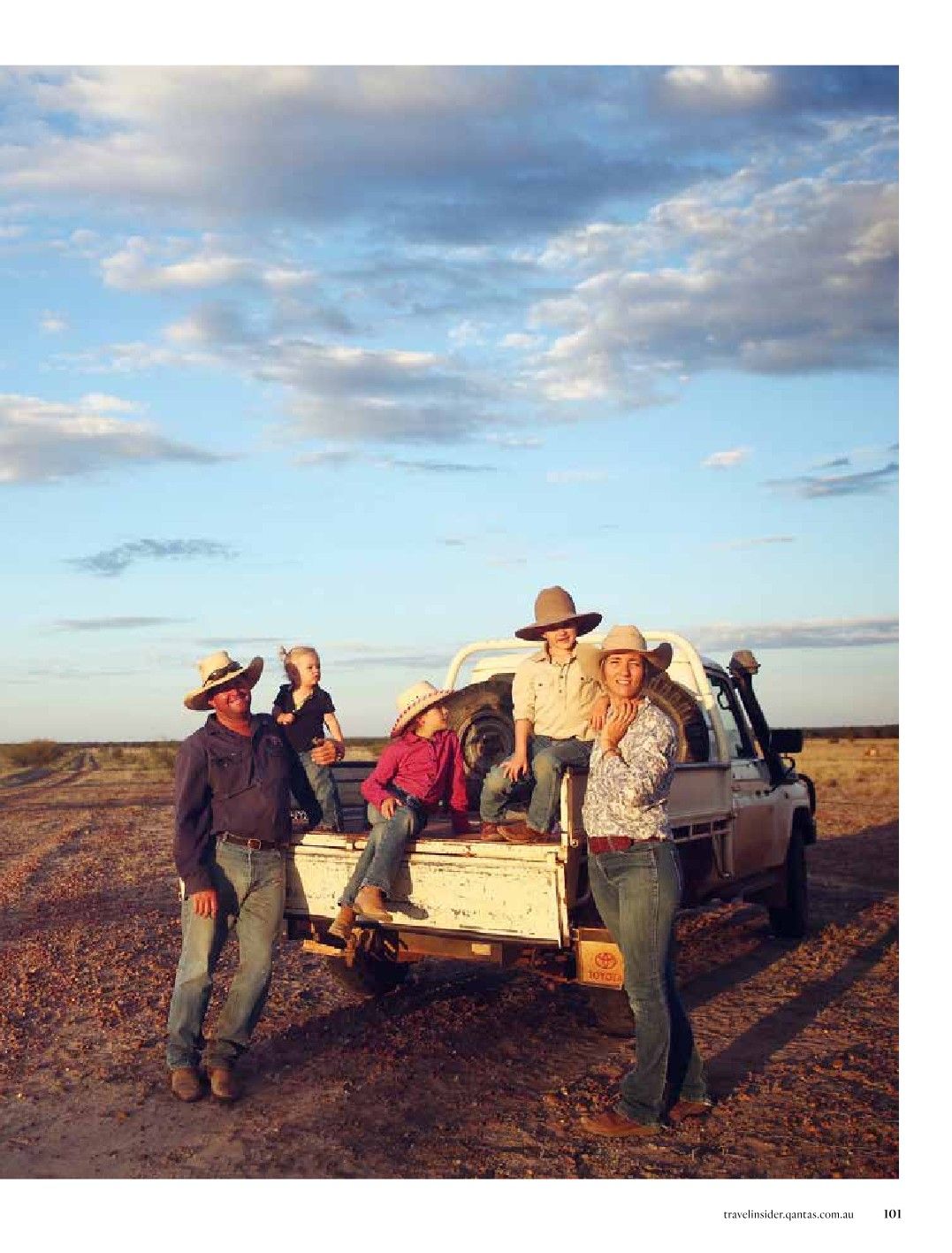
TARA AND Dan Locke love the wide-open spaces of Melinda Downs. “It’s pretty country. There’s red dirt, gnarly grey-green gidgee trees, rocky creeks and big red termite mounds,” says Tara of their 13,000-hectare cattle station home on Dismal Creek in Queensland’s far north-west.
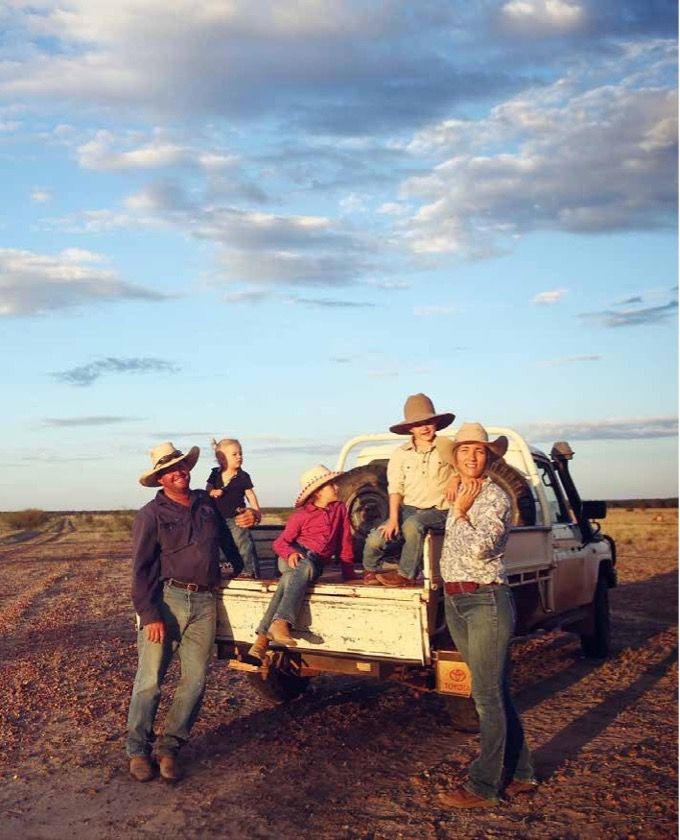
Their kids love it, too – they spend a lot of time outdoors, looking after a menagerie of chooks, ducks, guineafowl and a poddy calf, swimming in the dam and bashing a cricket ball around their huge yard.
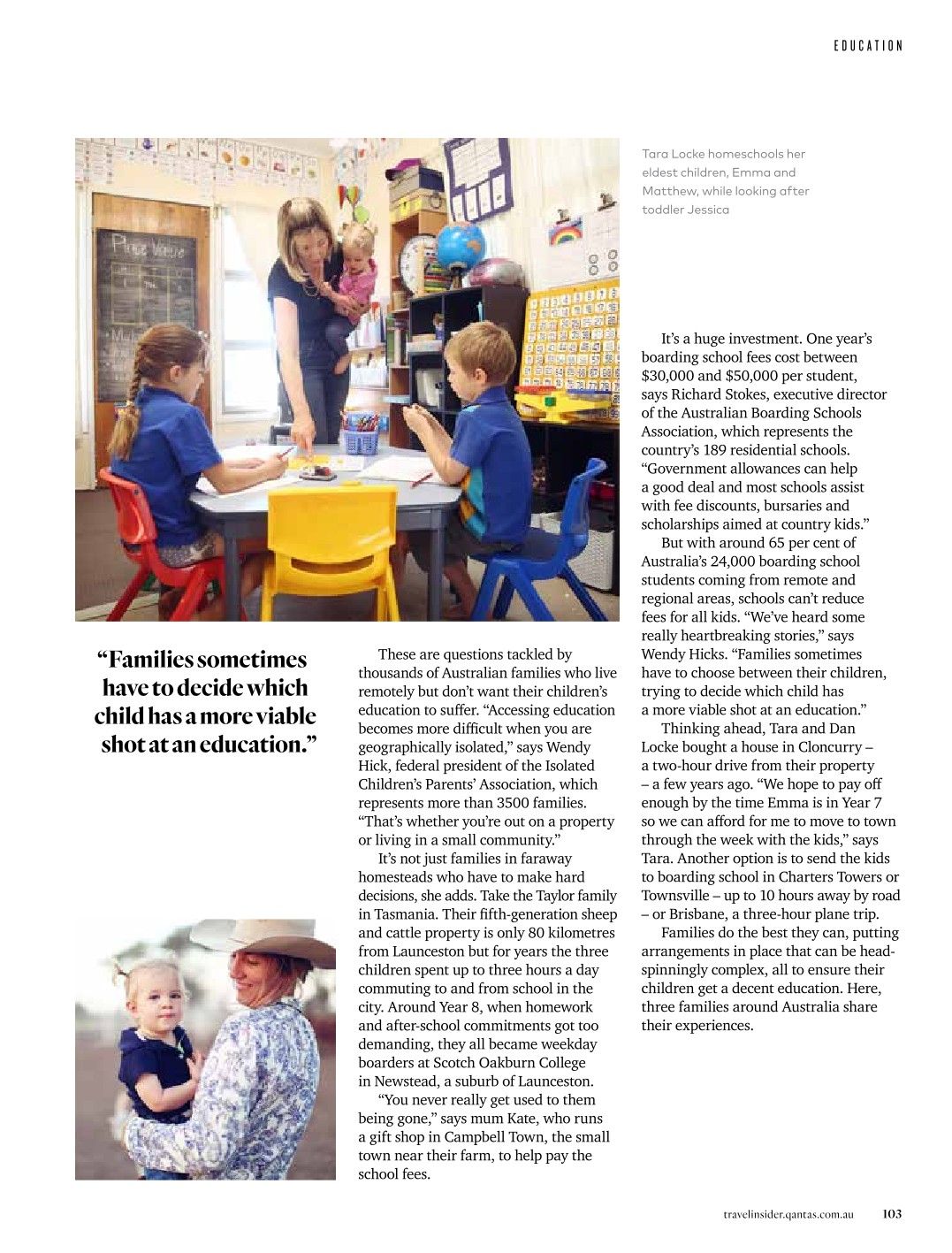
“Our children are safe and happy,” says Tara, who homeschools Emma, seven, and Matthew, six, while looking after 20-month-old Jessica. “They have so much freedom and endless space to ride their horses and bikes.”
But homeschooling beyond primary level means kids miss out on sports, music and social opportunities. Big decisions lie ahead for the Lockes – the type that keep them awake at night. Do they send their kids to boarding school and go through the pain of separation? Or does Tara move to town with the kids and leave Dan alone on the station? Either way, the family will be split up. And how to finance the different options, which all come with big, flashing dollar signs?
These are questions tackled by thousands of Australian families who live remotely but don’t want their children’s education to suffer. “Accessing education becomes more difficult when you are geographically isolated,” says Wendy Hick, federal president of the Isolated Children’s Parents’ Association, which represents more than 3500 families. “That’s whether you’re out on a property or living in a small community.”
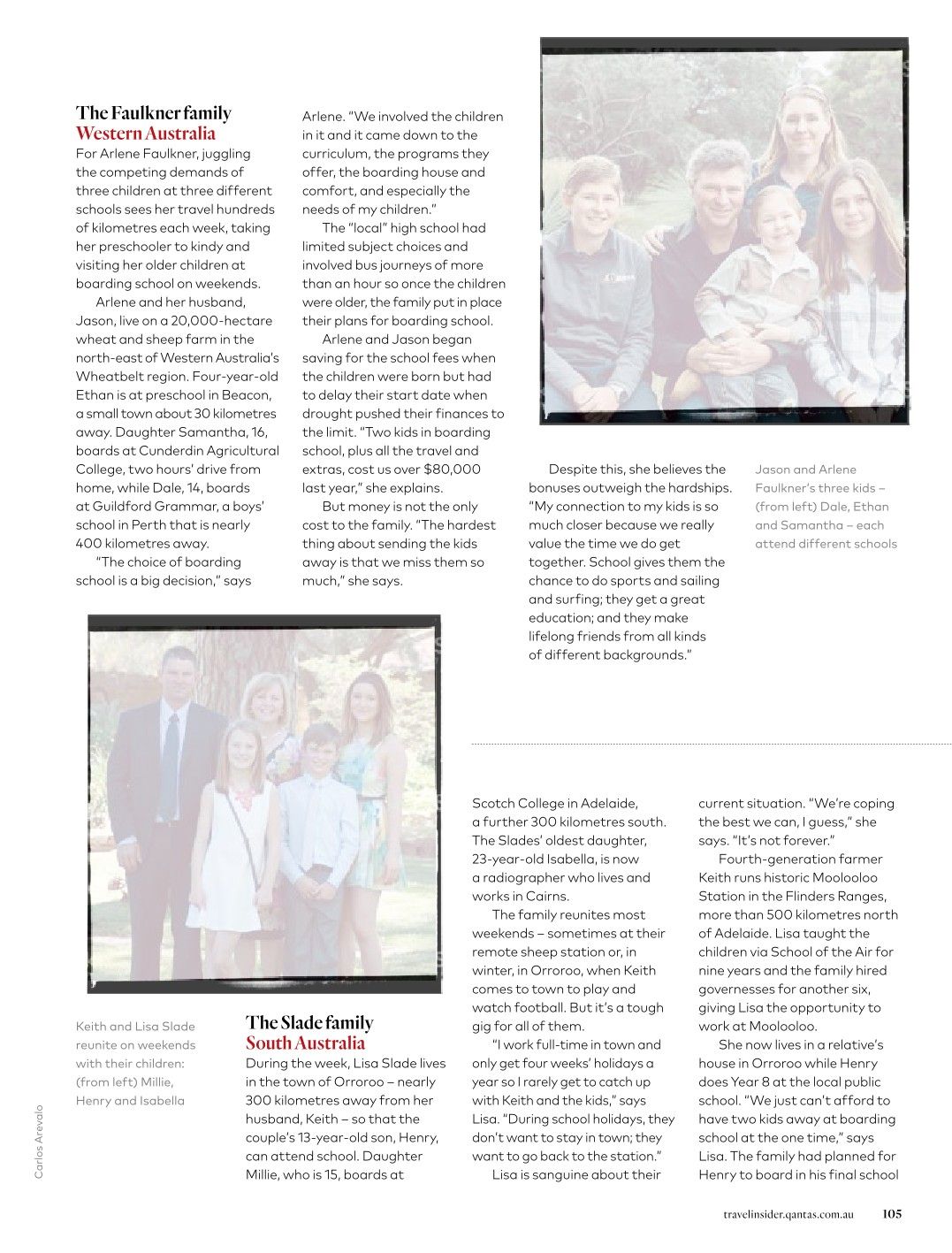
It’s not just families in faraway homesteads who have to make hard decisions, she adds. Take the Taylor family in Tasmania. Their fifth-generation sheep and cattle property is only 80 kilometres from Launceston but for years the three children spent up to three hours a day commuting to and from school in the city. Around Year 8, when homework and after-school commitments got too demanding, they all became weekday boarders at Scotch Oakburn College in Newstead, a suburb of Launceston.
“You never really get used to them being gone,” says mum Kate, who runs a gift shop in Campbell Town, the small town near their farm, to help pay the school fees.
It’s a huge investment. One year’s boarding school fees cost between $30,000 and $50,000 per student, says Richard Stokes, executive director of the Australian Boarding Schools Association, which represents the country’s 189 residential schools. “Government allowances can help a good deal and most schools assist with fee discounts, bursaries and scholarships aimed at country kids.”
But with around 65 per cent of Australia’s 24,000 boarding school students coming from remote and regional areas, schools can’t reduce fees for all kids. “We’ve heard some really heartbreaking stories,” says Wendy Hicks. “Families sometimes have to choose between their children, trying to decide which child has a more viable shot at an education.”
Thinking ahead, Tara and Dan Locke bought a house in Cloncurry – a two-hour drive from their property – a few years ago. “We hope to pay off enough by the time Emma is in Year 7 so we can afford for me to move to town through the week with the kids,” says Tara. Another option is to send the kids to boarding school in Charters Towers or Townsville – up to 10 hours away by road – or Brisbane, a three-hour plane trip.
Families do the best they can, putting arrangements in place that can be head-spinningly complex, all to ensure their children get a decent education. Here, three families around Australia share their experiences.
The Faulkner family - Western Australia
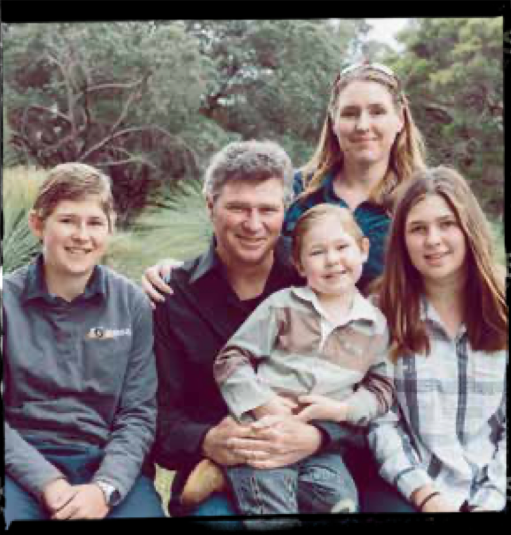
For Arlene Faulkner, juggling the competing demands of three children at three different schools sees her travel hundreds of kilometres each week, taking her preschooler to kindy and visiting her older children at boarding school on weekends.
Arlene and her husband, Jason, live on a 20,000-hectare wheat and sheep farm in the north-east of Western Australia’s Wheatbelt region. Four-year-old Ethan is at preschool in Beacon, a small town about 30 kilometres away. Daughter Samantha, 16, boards at Cunderdin Agricultural College, two hours’ drive from home, while Dale, 14, boards at Guildford Grammar, a boys’ school in Perth that is nearly 400 kilometres away.
“The choice of boarding school is a big decision,” says Arlene. “We involved the children in it and it came down to the curriculum, the programs they offer, the boarding house and comfort, and especially the needs of my children.”
The “local” high school had limited subject choices and involved bus journeys of more than an hour so once the children were older, the family put in place their plans for boarding school.
Arlene and Jason began saving for the school fees when the children were born but had to delay their start date when drought pushed their finances to the limit. “Two kids in boarding school, plus all the travel and extras, cost us over $80,000 last year,” she explains.
But money is not the only cost to the family. “The hardest thing about sending the kids away is that we miss them so much,” she says.
Despite this, she believes the bonuses outweigh the hardships. “My connection to my kids is so much closer because we really value the time we do get together. School gives them the chance to do sports and sailing and surfing; they get a great education; and they make lifelong friends from all kinds of different backgrounds.”
The Slade family - South Australia
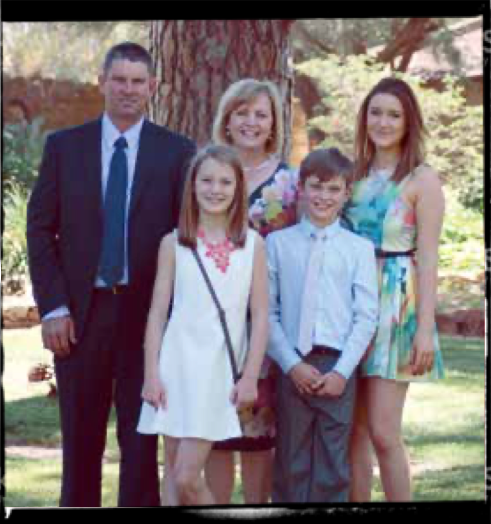
During the week, Lisa Slade lives in the town of Orroroo – nearly 300 kilometres away from her husband, Keith – so that the couple’s 13-year-old son, Henry, can attend school. Daughter Millie, who is 15, boards at Scotch College in Adelaide, a further 300 kilometres south. The Slades’ oldest daughter, 23-year-old Isabella, is now a radiographer who lives and works in Cairns.
The family reunites most weekends – sometimes at their remote sheep station or, in winter, in Orroroo, when Keith comes to town to play and watch football. But it’s a tough gig for all of them.
“I work full-time in town and only get four weeks’ holidays a year so I rarely get to catch up with Keith and the kids,” says Lisa. “During school holidays, they don’t want to stay in town; they want to go back to the station.”
Lisa is sanguine about their current situation. “We’re coping the best we can, I guess,” she says. “It’s not forever.”
Fourth-generation farmer Keith runs historic Moolooloo Station in the Flinders Ranges, more than 500 kilometres north of Adelaide. Lisa taught the children via School of the Air for nine years and the family hired governesses for another six, giving Lisa the opportunity to work at Moolooloo.
She now lives in a relative’s house in Orroroo while Henry does Year 8 at the local public school. “We just can’t afford to have two kids away at boarding school at the one time,” says Lisa. The family had planned for Henry to board in his final school years but, much to their delight, he has just won a boarding scholarship to Adelaide’s Prince Alfred College so will board there next year.
After many tough drought years, Lisa’s move to Orroroo means she can bolster the family income by working in admin at the local hospital. While she’s hoping to be back on the station full-time within a couple of years, Lisa says they always wanted to let their kids choose their own futures.
“Keith and I love the station but we also know how hard it is. Sending our kids away to get a good education gives them choices. We love the open spaces, the people around us, the lifestyle: we think the good outweighs the bad.”
The Bennett/Gibson family - Northern Territory
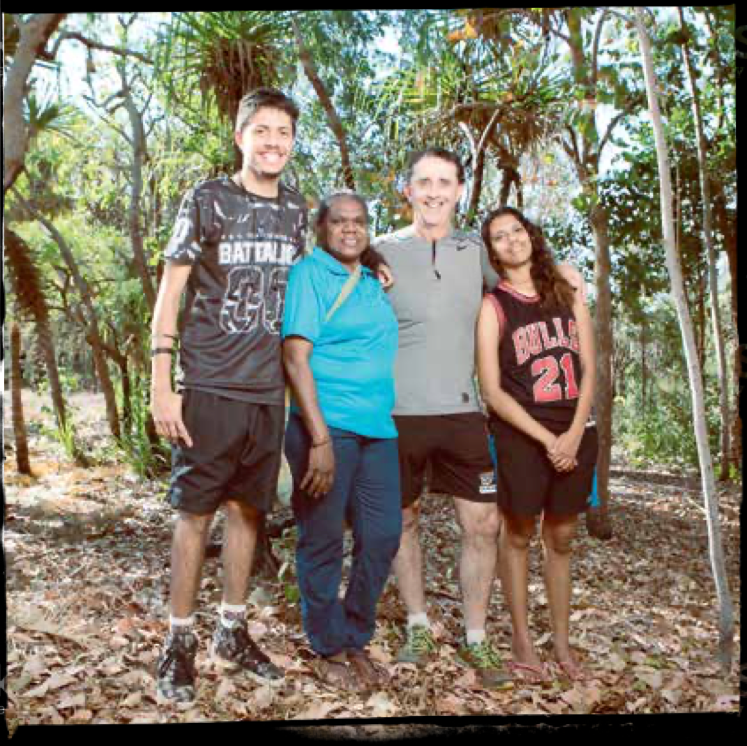
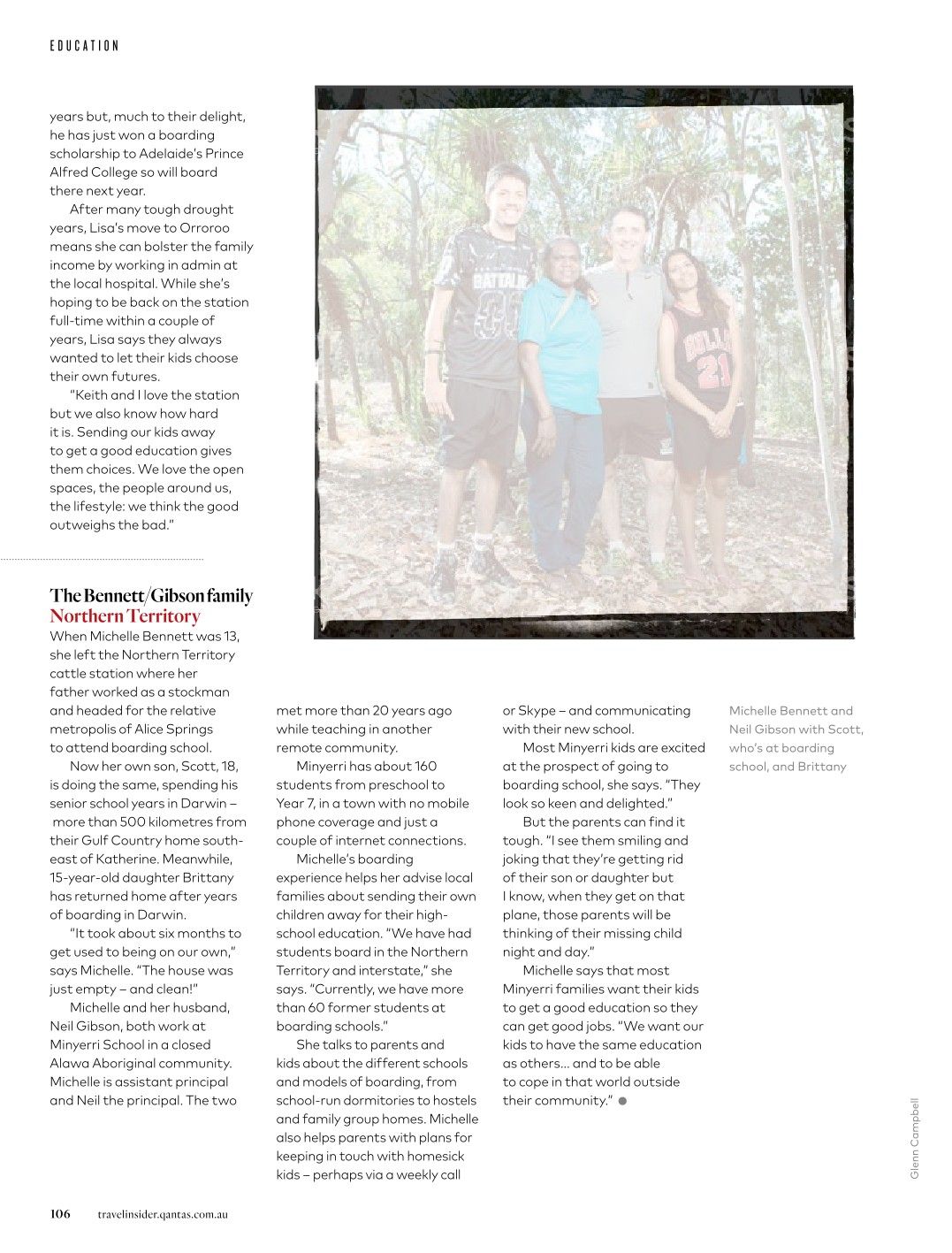
When Michelle Bennett was 13, she left the Northern Territory cattle station where her father worked as a stockman and headed for the relative metropolis of Alice Springs to attend boarding school.
Now her own son, Scott, 18, is doing the same, spending his senior school years in Darwin – more than 500 kilometres from their Gulf Country home south-east of Katherine. Meanwhile, 15-year-old daughter Brittany has returned home after years of boarding in Darwin.
“It took about six months to get used to being on our own,” says Michelle. “The house was just empty – and clean!”
Michelle and her husband, Neil Gibson, both work at Minyerri School in a closed Alawa Aboriginal community. Michelle is assistant principal and Neil the principal. The two met more than 20 years ago while teaching in another remote community.
Minyerri has about 160 students from preschool to Year 7, in a town with no mobile phone coverage and just a couple of internet connections.
Michelle’s boarding experience helps her advise local families about sending their own children away for their high- school education. “We have had students board in the Northern Territory and interstate,” she says. “Currently, we have more than 60 former students at boarding schools.”
She talks to parents and kids about the different schools and models of boarding, from school-run dormitories to hostels and family group homes. Michelle also helps parents with plans for keeping in touch with homesick kids – perhaps via a weekly call or Skype – and communicating with their new school.
Most Minyerri kids are excited at the prospect of going to boarding school, she says. “They look so keen and delighted.”
But the parents can find it tough. “I see them smiling and joking that they’re getting rid of their son or daughter but I know, when they get on that plane, those parents will be thinking of their missing child night and day.”
Michelle says that most Minyerri families want their kids to get a good education so they can get good jobs. “We want our kids to have the same education as others... and to be able to cope in that world outside their community.”