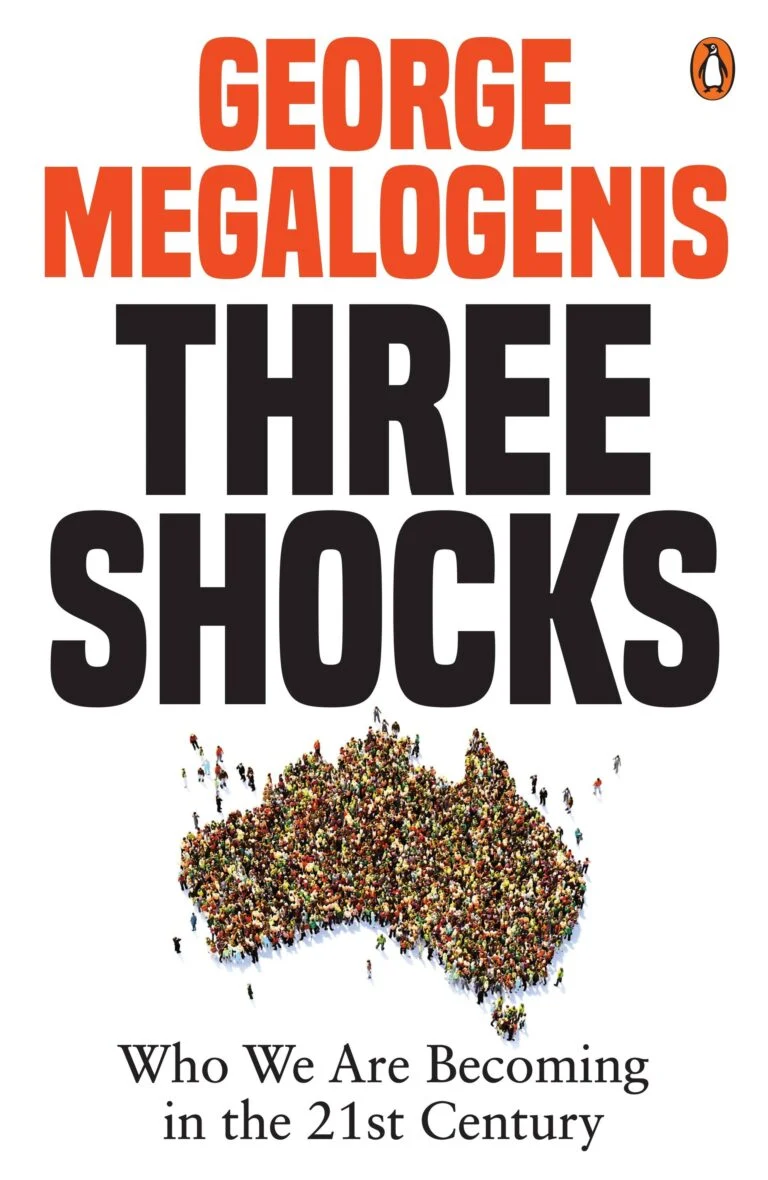
George Megalogenis and I, sons of post-war Greek immigrants, now in our early 60s, like many of us, we were shaped by a “grammar school” or selective public education and by the weight of our migrant parents’ expectations. In the 70s, as he suggests in his new book Three Shocks: Who We Are Becoming in the 21st Century, the term “dirty wogs” was as ruthless as any racist term.
The third generation “are mainstream now”, he once told me when, “they’ll be fine”, years ago, I complained that my son wasn’t keen on trying to get into Melbourne Boys High School.
In Three Shocks by Megalogenis, the 40-year political economy journalist has again deftly melded demography, economy and politics to write a defining book on modern Australia’s transformation. Melbourne is the nation’s “first middle-class city”, in the 19th century, where “cosmopolitan and provincial sides of our national character have staged their longest battle”.
Megalogenis traces Australian politics from Paul Keating’s unexpected victory in March 1993, the election of John Howard, who, with Peter Costello, continued the economic policies of Bob Hawke and Paul Keating but sought to reframe Australian identity, to the re-election of the Albanese Government in May 2025. He examines the entrails of immigration, the economy, demography, and the workforce in Australia in the last 30-odd years.
A key takeaway, as he writes, is that “The major political parties have too often been slow to recognise the implications of a majority migrant electorate”.
The first shock: a majority-migrant nation
A key anchor in Megalogenis’s argument is, first, a “glorious, confronting transformation” in the population’s makeup. Australia now has a “majority migrant national population”, defined as citizens who are migrants or have at least one migrant parent, a threshold crossed in 2018 that confirmed a “nation of genuine diversity”.
In his dry, tongue-in-cheek humour, he calls immigrants “New Australians”. A term well recognised by anyone over 55 and almost completely absent from the vocabulary of anyone under 40. We, our parents, were all New Australians from the days of Menzies until 1972, when Whitlam was elected, ushering in a dramatic Labor reform government.
His Australia is a tree, its roots Indigenous, its trunk “old Australia” or white Anglo-Saxon Australia, and the branches and leaves non-Anglo, immigrants. The joint Melbourne and Sydney family tree was shaped, he writes, as follows: “65 per cent New Australians, 33 per cent old Australians and less than two per cent First Nations”.
“It’s a time measurer or timeline”, he says of the “tree”. “Time rather than culture.”
We met at Osteria DOC on Lygon Street, in Melbourne’s “little Italy”, Carlton, once home to waves of Italian, Jewish and Greek migrants, which he writes are now “whiter” and more professionalised. Matcha cafés and boutiques have replaced much of what was Italian until the mid-90s. A $15,000 workers’ cottage in neighbouring Collingwood can fetch $2 million. The waiters at DOC are not the grandchildren of those who left the ashes of post-war Italy but young, skilled, English-proficient Italians.
The inner suburbs are, according to him, increasingly “inhabited by tertiary-educated, younger professionals; they don’t have kids yet and want to be able to walk to their restaurant of choice and to their job in the inner city. It’s more Manhattan-style life that they’re living in”.
He points to Brunswick-Coburg as the sort of local government area in Australia “where more than half of the population growth in that decade, between the Global Financial Crisis and COVID, came from Old Australians,” which he does not mean “retirees were suddenly moving in” but rather young professionals. Teal and Green voters.
“Our parents’ generation started in the inner city, and that is the most diverse part of your capital city. And Melbourne is the benchmark for these trends across the rest of the country. The inner city is gentrifying; the whites are moving in. Yuppies are not moving in with a car. They want to walk to the café or get public transport.”
“The middle-ring suburbs are essentially home to the Chinese Australian diaspora; they are the dominant migrant group. Outer suburbs, Indian diaspora, so the outer suburbs and the middle-ring suburbs are becoming more diverse.”
There is, Megalogenis says, a “flipping of identities, urban identities that were sort of set in stone for the previous 120 years”.
Melbourne, white Australia and our parents
By the 1880s, after Melbourne had become one of the world’s richest cities, it fell into a depression, he writes. After the Immigration Restriction Act of 1901, commonly known as the White Australia Policy, “the country remained relatively closed for about 40 years.”
Alfred Deakin, Australia’s first Attorney-General in a newly federated Australia and a ‘protectionist’, framed the White Australia Policy. Deakin, Megalogenis writes, “wanted Australia to be a white continent”.
For Deakin, an aristocrat born in India who entered the middle classes in Melbourne threatened social cohesion as much as “the peasant from China who was prepared to toil for longer hours and much less pay”. Deakin penned for the London Morning Post, “The yellow, the brown and the copper-coloured are to be forbidden to land anywhere.”
Eugenic views underscored what historian Lawrence James said Australia was seen as, a “White man’s socialist heaven”.
Deakin was as worried, Megalogenis shows, with us, the Greeks, Italians and Levantines, what he called “immigrants of the lower Latin type”, and he wanted an Australia “decidedly antagonistic towards newcomers from South-Eastern Europe”.
“When our parents arrived after the Second World War, they encountered a narrow, restrictive society,” Megalogenis says.
“Many migrants of our parents’ generation had limited schooling and had survived years of war, occupation and civil conflict. They arrived young and often traumatised, but they also found simple opportunities. Their experience revealed an older Australian instinct: despite periods of exclusion, Australians are generally open-minded and want to get along with the world.”
Especially in Melbourne, he says, the new South-Eastern Europeans were more cosmopolitan and civilised than the local middle-class inhabitants.
“Migrants opened cafés and other businesses because they recognised gaps in the market. They lived locally, as everyone else did, rather than forming communities fundamentally separate from Australian life.”
The second shock: the feminisation of the economy
The second great shock, which Tony Abbott completely lost as he sought to garner support from a traditional male Labor cohort, the tradie and ultimately lost his premiership over, was the feminisation of the workforce. Like Abbott, but a slightly pudgier vision of old Australia that Howard’s heirs sought to attract, than Scott Morrison looked for “average dads” and the “quiet Australian”. Both failed to see the reality of a largely feminised economy, says Megalogenis.
A watershed, when “women with tertiary qualifications and professionals across the care and creative industries… overtook men in trades and technical work as the nation’s largest group of workers”. The change came to fruition under him, he says, when Tony Abbott, who was pitching to “tradies” and was among the most macho prime ministers in the country’s history, was prime minister.
Megalogenis reminds us that we were on the lawns of Parliament House on March 15 in 2021 in protest to gender-based violence, with Australian of the Year, Grace Tame and ex-Liberal staffer, who alleged rape, Brittany Higgins, “delivered powerful speeches”; then prime minister, Scott Morrison, who was messaging what he called “quiet Australians”, or dads in the burbs, declined to meet the organisers.
Megalogenis writes that Morrison said that ‘not far from here such marches, even now, are being met with bullets’. The author reminds us also that Morrison was referring to the bloody military coup in Myanmar.
As Megalogenis says, any chutzpah Morrison exhibited in almost “singlehandedly” winning the 2019 election against Bill Shorten’s Labor, the “miracle” win – not unlike Keating’s victory in 1993 in what was seen as an unwinnable election – was evaporating.
His tin-eared response to the genuine concerns of women was made worse by Black Summer of 2019 when Australia was engulfed in fire, when Morrison was vacationing in Hawaii.
The rise of Teals who won what were once blue-ribbon Liberal seats was a classic example of how the Liberals misread and misjudged the dramatic demographic shifts of migration and feminisation.
For Megalogenis, neither major party attuned to these changes, resulting in “a decade of electoral gridlock”. Labor, after their failure to beat Morrison under Bill Shorten, learnt and dramatically increased the representation of women and pitched to the large Indian and Chinese and other immigrant groups.
Overall, Australia’s two main parties had overlooked “the new middle-class constituencies of skilled migrants and professional women” for a long time, yet Labor learnt faster than the Coalition, increasingly influenced by the echo-chamber of Sky After Dark, hunted for votes in Old Australia, that no longer existed in the numbers they wished.
The third shock: unreliable partners and allies
The third shock lies in the instability of its two most important external relationships: the alliance with the United States, and the trading relationship with China. Each partner has become less predictable in an increasingly fractured international environment.
Here, Megalogenis emphasises that China’s rise to world superpower status between the early 1990s and mid-2000s was not something the major political parties, particularly the Liberals, were able to deal with effectively. Not least, for the conservative side of politics, the real political impact of global warming.
While Malcolm Turnbull, one of the last true small ‘l’ Liberals to lead the party, had signed on to the global climate protocols, Scott Morrison, who succeeded him by an internal coup, was an open climate sceptic and faced “alliance pressure” from British prime minister Boris Johnson.
“The British prime minister wanted Australia to commit to reducing carbon emissions to net zero by 2050.” Australia’s role as a “spoiler” resulted in Johnson being bumped from the speaking slot at the online summit on ‘climate ambition’ he co-chaired with French president Emmanuel Macron. President Biden then placed Morrison way down on the list of speakers at his own “virtual climate summit” in 2021, twenty-second behind Bhutan.
Australia has been pincered between a more hairy-chested China, willing to punish what it may perceive as anti-China bias, and a reduction or even cessation of imports from Australia. Trump’s re-election in the US saw a traditional anglosphere ally, one of the Five Eyes, wage a tariff war against its own allies. Trump was happy to violate the free-trade agreement signed between John Howard and George W Bush in 2004.
In the case of China and the United States, Australian exporters, Megalogenis writes, “felt the hypocrisy” of the two superpowers breaching free-trade agreements, like the one signed by Tony Abbott and Xi Jinping in 2014.
One Nation and the anger algorithm
Asked why some Greek Australians, mainly second- and third-generation, are being seduced by One Nation, Megalogenis said their flirtation “cannot be explained by material hardship”.
“It must be ideological.”
For him, it’s “algorithms” in social media feeds that “amplify grievance and anger, drawing out prejudices that may have been beneath the surface and making them feel immediate, current, and intense.”
“Essentially since the invention of the weapon of mass distraction, the iPhone in 2008… This polarisation has been in the water for a good 20 years.”
He says that these Greek Australians “didn’t suddenly become rednecks.”
Megalogenis believes that for One Nation voters, Trump supersedes Albanese or other politicians. The MAGA view “is not a mainstream view of the world.” He says that when the Lowy Institute measured attitudes towards world leaders, Donald Trump was very unpopular. “He is on the same rung as Xi Jinping, with a net rating of around -50.”
Putin and Kim Jong-un were the only leaders more unpopular than Trump, “and we saw that in how the last federal election played out.”
“Among One Nation voters, Trump takes Albanese’s place… That is not, that is not a mainstream view of the world. That is a view of the world formed in a sort of social media bubble, not the shared information most Australians use to process their politics.”
“The algorithm has got the One Nation voter thinking like a Trump voter. It’s a tribal view, hot-housed by something other than local media and local debates.”
Megalogenis, says that reality is that the Trump, MAGA, view of the world is formed less by Australian attitudes. In fact, for him, Trump is the international politician least favourably regarded by most Australians, right down the list along with Putin.
“The irony is that some of the least distinctly Australian political attitudes now come from One Nation voters whose information is heavily sourced from the United States.”
Migration and the “tank” debate
In the context of dramatic changes across Australia’s cities, particularly Melbourne and Sydney, where over 50 per cent are of migrant background, migration has become a hot-button topic again.
The demographic shifts of migration and feminisation of work have seen Melbourne and Sydney as on the “frontline of these changes”, as they had what he says are “the key ingredients for a two-corridor boom – a critical mass of local-born professionals moving into inner city and a near duopoly on skilled migration from India and China heading for the suburbs”.
Melbourne’s population from 2009 to 2019 grew by almost one million, with skilled immigrants mainly moving to outer suburbs. He cites Tarneit in his book as a suburb representing the nation’s “fastest-growing urban corridor”. The population doubled from 22,000 to 57,000, and its average income grew by 17 per cent, indicating the influx of skilled migrants.
Recently, on an ABC program, One Nation’s (former National Party) politician Barnaby Joyce said he wanted to move to net-zero migration, which would reduce migration by over 250,000 people; he said the economy would “tank”.
“No sane economic advisor would tell a party to remove 250,000 people a year for three years.”
“This is the worst kind of post-truth politics.”
Megalogenis says that the only time migration was dramatically reduced to net zero was during the Great Depression and the two world wars, and the only time it was reduced as a government policy was during the White Australia Policy of 1901, which caused great economic harm.
He added that “they did not give him time to get to the punch line”: “The thing about tanking in the sporting sense is that you might get a draft pick. Once you tank the Australian economy, that’s it. We’re done. We’re finished.”
Victoria’s three-party contest
As we head into Victorian elections, Megalogenis says that we’ve not seen an “election, state or federal, since the early 1900s where you’ve had three parties”, in November’s case, Labor, Liberals and One Nation.
He reflects on the Free Traders, forebears of the Liberals, Labor, and the Protectionists, echoing Deakin’s views. It was the Protectionists who sought to close borders who swept to power.
“Weirdly, for the federal Labor Party, Anthony Albanese’s best-case scenario is a minority Coalition government relying on One Nation’s support.”
Across Coalition and Labor areas, “One Nation is largely cannibalising the Coalition vote.”
“The Nationals might effectively disappear for an election, absorbed into One Nation.”
While the Victorian government is long in the tooth, 13 years, and is a natural to lose, on the federal level it may pivot to defending Medicare, super, and wages to beat One Nation.
“Depending on how Labor frames the choice, voters may focus on Medicare, wages and superannuation, while seeing One Nation as offering an Americanised style of politics.”
“If Labor handles that contrast well, it could win seats from the Liberal Party for a third consecutive election, an unprecedented result.”
Megalogenis lays out a new political colour wave: inner cities dominated by Labor, Greens and Teals, where Teals have taken old Liberal seats, and a regional conservative bloc increasingly dominated by One Nation, with the Coalition caught between them. “It is an unstable alignment.”

Mega’s advice to the Liberals
Megalogenis says that by failing to reflect contemporary Australia, “the Liberals have largely counted themselves out of the capital cities.”
“Voters have repeatedly removed the next generation of socially progressive, economically conservative Liberals.”
“This is not currently a mainstream political operation, but voters helped create it because the major parties failed to keep pace with the profound social changes between the global financial crisis and COVID-19.”
“A political movement that mistakes one piece for the whole picture cannot succeed.”
Peter Dutton led the Coalition against Anthony Albanese at the federal election on 3 May 2025. Labor won in a landslide, increasing its majority; Dutton lost his own Brisbane seat of Dickson, which he had held since 2001. His attempt to bypass capital cities and his pitch to out-of-urban and rural Australia looking for the mythical Aussie were a catastrophic political exercise for him and his party.
“There is no credible path back to majority government that bypasses the capital cities,” says Megalogenis.
“A Liberal Party facing an existential threat must learn to identify again with multicultural Australia.”
“The party must draw a clear line against Hansonism rather than trying to outbid One Nation on immigration cuts.”
He says that the “pivotal voter today is a 38-year-old woman” who may have been born overseas or have at least one migrant parent.
“Looking back, Howard now appears more moderate than he did at the time. He respected Australia as it was and as it was becoming, partly because he understood the electoral numbers.”
Megalogenis’s claim that Howard’s successors failed to move beyond Howard’s model and, in doing so, lost touch with contemporary Australia is a key theme.
Megalogenis’s book is a detailed though concise and well-crafted account of how Australia has changed since the turn of the century. It is a natural and essential heir to his 2003 book Faultlines, which detailed the changes that have occurred and are about to occur in a changing Australia.
According to Megalogenis, “Australia’s twenty-first-century challenge is to accelerate integration and to help a new arrival become a new Australian more quickly”.
I throw in the notion of “Patriotic multiculturalism”, which he calls “a useful phrase.”
“The family-tree metaphor is intended to hold the whole story together: First Australian roots, an old Australian trunk and new Australian branches. [Bob] Hawke understood this particularly well, and later [John] Howard came to understand it.”
Megalogenis says in Melbourne and Sydney, where two-thirds of residents are first- or second-generation migrants, “the argument over whether these cities are cosmopolitan is finished.”
“The task now is to establish a shared identity, especially after the tensions exposed by 7 October and subsequent events in Sydney.”
“We cannot simply wait for the next generation to integrate.”
Maybe, perhaps, post-war programs like the “Good Neighbour Policy”, however patronising, helped our migrant parents learn English and understand Australia better. Something similar, more contemporary, may work in an increasingly diverse world, regardless of the atavistic fantasies of One Nation and its supporters.
If one were tasked with producing a comprehensive and fluid read of the key transformation of Australian society over the last 35 years, a detailed understanding of who we are, to someone completely unaware of us, Megalogenis’s book is ideal.
Three Shocks weaves demography, politics and economics, local, parochial and individual, with global issues, seen and unforeseen, to provide a picture of modern Australia. No other book is really needed.
Three Shocks: Who We Are Becoming in the 21st Century by George Megalogenis is published by Penguin and is available across all good bookstores and booksellers.