"If someone forced me to make a side-scrolling action game in this day and age, I'd say I would have to quit my job!" says Tomonobu Itagaki.
Fortunately, the man charged with modernizing the hit Ninja Gaiden franchise — which dates back to a 1989 side-scroller on the Nintendo Entertainment System — got to do things his way.
"The only constraints that the NES version of Ninja Gaiden put on me were this," he says. "One, the main character must be a superninja, and two, his name must be Ryu Hayabusa."
Of course, 2004's Ninja Gaiden for Xbox was not a side-scroller. Itagaki created a gorgeous, fiendishly difficult action game that spawned Xbox 360 and PlayStation 3 installments, plus a bona fide sequel for the 360 next year. But making a killer remake isn't as easy as a certain ninja makes it look. It's just as easy to disappoint old-school fans. Now more than ever, however, game publishers are digging through their back catalogs, finding classic titles they can "reimagine" into new games that'll inspire warm and fuzzy feelings. Why go through the bother of creating a new franchise, after all, when nostalgia sells?
"The worst thing that could happen is if we called something Commando and then it was like Commando... in the year 3000 battling robotic aliens." — Capcom Director of U.S. and UK. Design Kraig Kujawa
Great expectations
Ben Judd was 14 when he first played 1987's Bionic Commando. I was staying over at my best friend Michael Yu's house," he remembers.
"Back in the day when gaming was much smaller and when you pretty much only got four or so games a year, it one of us would get a game, then the other person would crash at that person's house and we would play the new game all night."
Impressed by the innovative swing mechanic that Bionic Commando's
main character, Radd, used to navigate the levels, Judd became an instant fan. Now he's producing Capcom's new Bionic Commando for the Xbox 360 and PlayStation 3.
Some things have changed — Radd now sports a less-goofy name, and the game is set 10 years after the original — but according to Judd, the core appeal remains. "There are now weapons, new enemies, and lots of new gameplay," he says. "If you had to compare the game to anything, I would say we are shooting for what Ninja Gaiden did. They also stuck with the same name but added in new enemies, powers, and gameplay. Yet they still try to keep key elements and features from the original game so that fans would appreciate the new title."
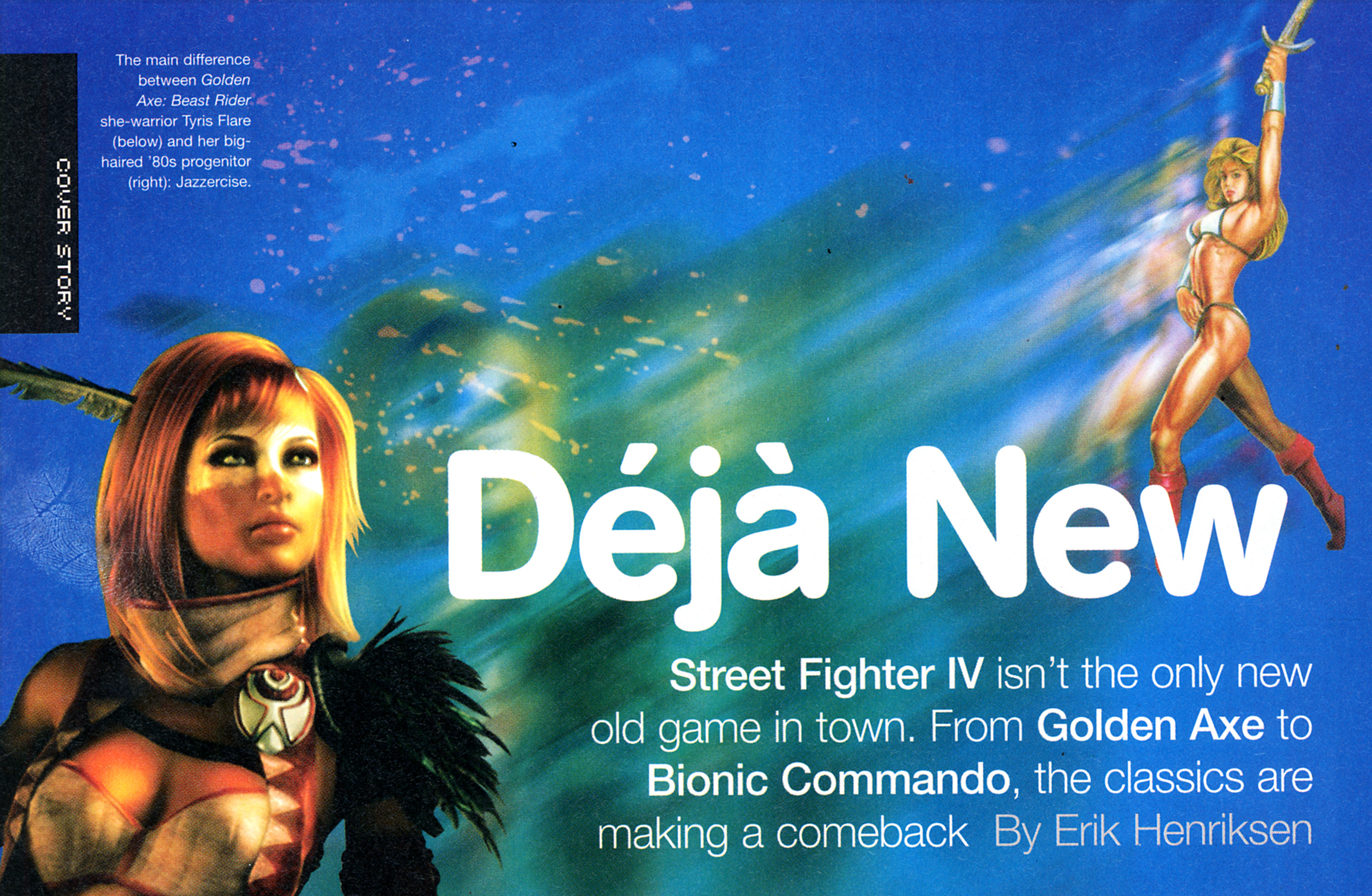
Fan support will only get you so far, though. "We care very much about the hardcore fans, but we also need to make sure that there is enough appeal to propel the game beyond the 'nu retro' niche," says Nigel Cook, producer of Golden Axe: Beast Rider, the PS3 and 360 update of 1989s Golden Axe arcade game. "We need to find the correct balance to attract a wider audience without alienating fans of the original." The development team's solution, after consulting with fans as well as the creator of the original Golden Axe, was to pick a part of the 1989 arcade experience that really worked. "We created a new template that focused in on the main experience we wanted to create — namely, savaging your enemies with beast, blade, and magic in a fantasy world that has a gritty, stylish, and realistic quality to it," Cook explains.
As you'd expect, that world is filled with fan service. "We carefully sprinkle content that is familiar to fans of the old-school game yet is entirely new to an audience who may not have played the original arcade game or subsequent versions," says Cook. For example, in the original multiplayer Golden Axe, players teamed up to ride on creatures, fend off magic-stealing gnomes, and defeat the nefarious leather daddy Death Adder. In the single-player-only Beast Rider, the same ideas aro there — just a bit different.
Our gnomes are darker, twisted versions of the original giggling arcade critters," Cook gives as an example. "But the mechanic is still there. Death Adder is back as the game's villain — he was simply too cool to leave out. And of course the beasts had to be there. One of the elements of the original that everybody remembered was riding the creatures."
Don't you forget it
"There are a lot of Xbox Live Arcade games where I boot it up, I play it for a level, and I either say, 'Hmm, that was kinda cool, but I have other, cooler games to play,' or 'That was kind of not cool, and it's not the way I remember it," says Kraig Kujawa, director of design at Capcom's U.S. and U.K. branches — and a former EGM editor. Kujawa is working on Commando 3, a new PlayStation Network/Xbox Live Arcade title that takes its inspiration from 1985's Commando and its 1990 sequel, Mercs. "So what we really want to do is bring back these old [intellectual properties] and thon update them, modernize them. There'll be enough there to kinda tap into that kid who remembers the arcade games, but then [we'll] modernize it enough so you don't walk away after the first level." Kujawa, too, is aware of the delicate balance in updating a beloved property. "I think the worst thing that could happen is it we called something Commando and then it was like Commando in the future, in the year 3000 battling robotic aliens," Kujawa jokes. "It's really dangerous to get in there and feel like you can fix something that's not broken." (Don't fear, Commando fans: Commando 3 aims to capture that 1980s Rambo vibe, kicking you into three-person co-op as you once again rescue POWs and fire off several billion rounds of ammo.)
Ultimately, the process of making a good retro remake isn't much different from making any kind of game. "I think that in order to be successful you need to have a deep understanding and analysis of the original, plus the courage to cut out what you don't need," says Itagaki. "And more than anything, you need to have a clear vision of what it is you are trying to create and the determination to see that vision through. Franchise titles made by designers that don't possess these qualities — whether their game is a remake or a numbered sequel — are 100 percent bound to fail."
Also certain: As long as both old-school and new-school gamers continue to buy them, games based on retro titles will continue to multiply — and maybe even outgrow their '80s roots. "When all is said and done, I believe that the majority of the fans who played the 3D action version of Ninja Gaiden understood what I was trying to convey, and I believe they enjoyed it, says Itagaki, who was inundated with Gaiden-fan gripes back when he revealed his new direction for the series. "In that sense, it was a major milestone for me. it is because of this that I am now able to focus solely on the future and create completely new game experiences with Ninja Gaiden II and Ninja Gaiden DS."