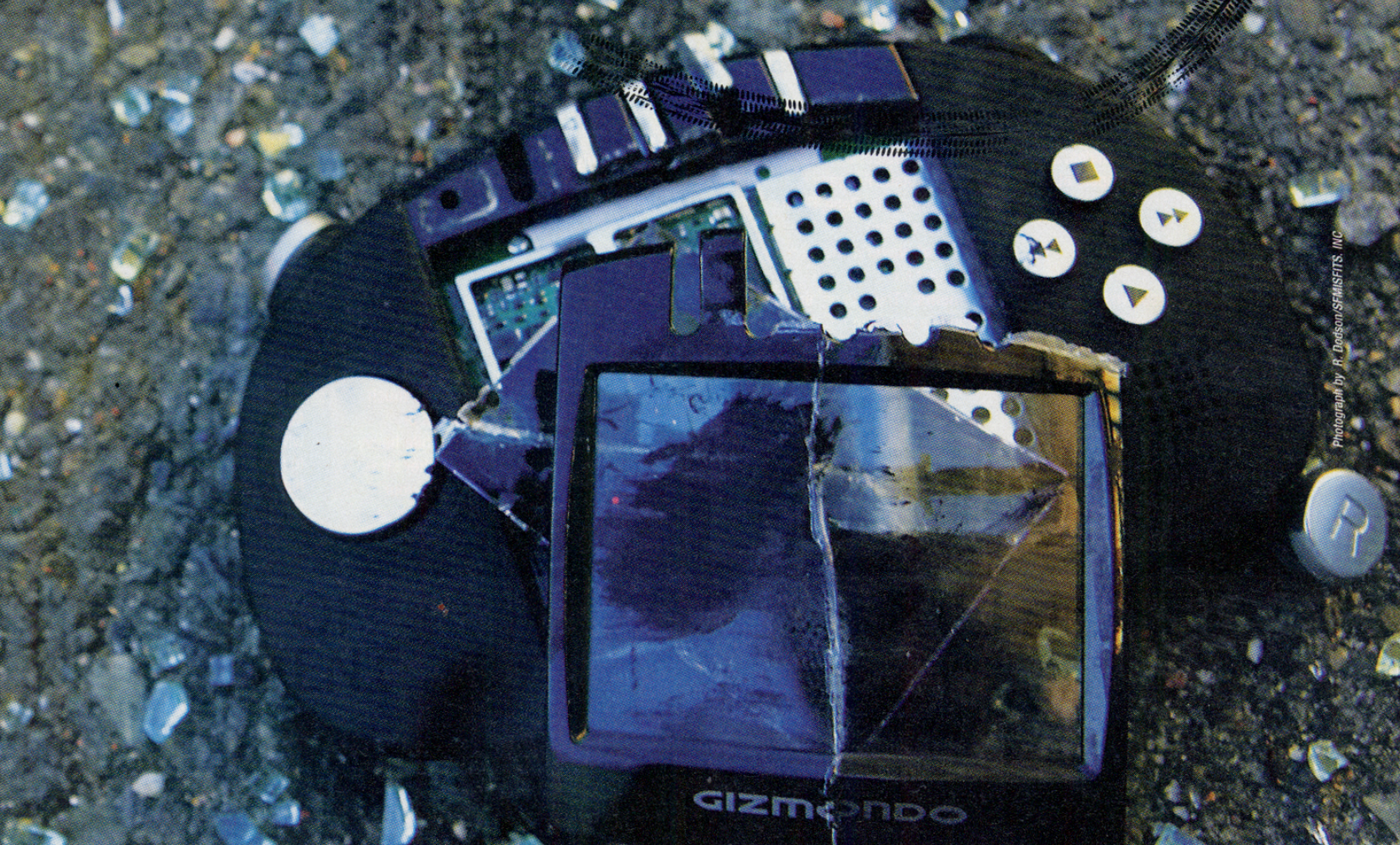
In theory, the Gizmondo was a handheld that would also play video and MP3s, have global-positioning capabilities, feature a digital camera, and offer text messaging. In reality, it sucked. And with a history involving everything from the Swedish mob to phony Homeland Security credentials, the handheld saga quickly became gaming's biggest oddity. We follow the debris of the whole, twisted tale of the Gizmondo's rise and fall. Without the "rise" part.
February 2002
Floor Decor, a Florida flooring business, buys assets of a British wireless communications (or telematics) company. Soon afterward, the business is renamed Tiger Telematics.
Mid 2002 - early 2003
Tiger Telematics abandons the exhilarating world of flooring to focus on electronics. As development of the taco-shaped Gizmondo begins, Tiger Telematics' European branch is renamed Gizmondo Europe. Early reactions are guarded — is the idea of a killer handheld from a flooring company too good to be true? (The answer, as we'll soon find out: Yes. It is.)
Launch titles include the puzzle game Sticky Balls, with other games such as Mama, Can I Mow the Lawn and It's Mr. Pants on the way.
September 2004 - September 2005
Gizmondo posts losses in excess of $300 million. Where's all the money going? Game development, partially — Gizmondo claims everyone from EA to Microsoft is making games for the handheld. But the money's going elsewhere, too, like into $1.5 million salaries for Gizmondo execs like Tiger Telematics Chairman Carl Freer and executive officer Bo Stefan Eriksson. (Oddly, Freer's wife is paid over $150,000 for "public relations services," and money also goes to Northern Lights, an independent game studio owned by Freer and Eriksson.)
March 2005
Tiger Telematics throws a star-studded party for the Gizmondo's European launch. (Well, it's "star-studded" if you consider Sting and Mini-Me from Austin Powers stars.) In the Gizmondo's first three months, less than 5,000 units are sold, due to their high cost, blurry video, low-res pictures, clunky design, and games that really only stand out for their spectacularly bizarre names. The Gizmondo "certainly would have benefited from more development time, and more, if any, consumer testing," says James Beaven, who worked as Gizmondo's head of corporate communications. "If you consider 'consumer testing' as passing it around to a few kids you know, then yeah [the system had plenty]. If you consider rigorous testing as getting it out to different demographics and really looking at the device, then no."
September 2005
After several delays of the Gizmondo's U.S. release, word leaks that the company is developing a newer version of the device — one clearly based off of Sony's PSP — with a wider screen and streamlined features. Logic would dictate that this newer unit is the one that'll show up in the States. Logic loses again.
October 22, 2005
The Gizmondo launches in the United States. The price: an astounding $400. (Or gamers can opt for a S230 model that forces them to watch downloaded commercials several times a day.) Gizmondos can only be purchased online or at special mall kiosks in 12 U.S. cities. Launch titles include the puzzle game Sticky Balls, with other games such as Mama, Can I Mow the Lawn and It's Mr. Pants on the way.
Unfortunately, few outside the gaming press get to stare in open-mouthed wonder at this train wreck of a system and its library of ludicrously named games. "There was absolutely no day? Pretty easily, actually marketing whatsoever," Beaven notes. "I was constantly reiterating the need for marketing to the consumers who would be buying it, and that never happened."
Shortly after the U.S, launch, Freer and Eriksson leave Gizmondo. Freer's departure coincides with suspicions that he may have been benefiting from improper financial deals, while Eriksson bails after news breaks that he and two other Gizmondo employees are allegedly in the "Uppsala Mafia," a Swedish counterfeiting ring. Wait — Sweden has a mafia? Seriously?
February 2, 2006
After low sales and high operating costs wrap Gizmondo Europe in a knot of bankruptcy, the company finally takes a dirt nap. Accusations swirl that Gizmondo was merely a scam created to bilk investors. During the handheld's development, the executives' focus "wasn't on the product itself, but on other issues," Beaven remembers. "I can't speculate as to what those issues were, but they weren't focused on bringing out a console."
Looking back on his time with Gizmondo, Beaven says, "It was like 18 months of being on some sort of PR Candid Camera. You kept waiting for someone to jump out and say 'It's all a joke! We aren't really launching a console! We aren't really paying ourselves multimillion-dollar salaries!' But it wasn't. There was no camera."
February 21, 2000
Apparently not content with Gizmondo's crash and burn, Eriksson totals his Ferrari Enzo on California's Pacific Coast Highway. The car is one of only 399 ever made and worth a million dollars. Nearly tripling the speed limit at 162 miles per hour, the Ferrari spins out of control and is sheared in half by a pole. Eriksson, with a .09 percent blood alcohol level, is legally drunk but not seriously hurt, and insists he wasn't driving. He instead blames the crash on a mysterious German man named "Dietrich."
Despite a police search, Dietrich is never found. Amongst other weird occurrences at the crash site, Eriksson whips out an official-looking I.D. card and tells police that he's in charge of a Homeland Security antiterrorism police unit. A fully loaded clip from a Glock handgun is also found nearby. And it gets weirder.
April 8, 2006
Eriksson is arrested at his Bel Air home and nailed with embezzlement, drunk-driving, weapons, and — in what's sure to become a punch line — grand-theft-auto charges. (Surprisingly, the embezzlement charges come not from Gizmondo's tangled finances, but rather from Eriksson's auto collection — he has almost $4 million worth of cars that were illegally brought to the U.S., despite the fact that he was only leasing them from British financial institutions. Oh, and he was late on the car payments to boot.) Los Angeles prosecutors also claim that the elusive "Dietrich" doesn't exist, and that a handgun found in Eriksson's home is illegal. Bail is set at $5.5 million (prosecutors believe Eriksson to be a flight risk) as Eriksson pleads not guilty. If convicted, he could face a sentence of 14 years.
"It made me chuckle," Beaven says of the arrest. "Considering how much money they took out of Gizmondo, you wouldn't think stealing some of the most desirable cars in the world and moving to a place with the highest concentration of media reportage was such a great idea."
April 26, 2006
L.A. County deputies arrest Freer on charges of illegally buying firearms. They allege he used his credentials from Eriksson's antiterrorism unit to buy the guns. Turns out the unit is actually the security wing of a nearby transit authority that provides bus rides to the elderly. No word on whether these buses use the Gizmondo's GPS capabilities.
Additional reporting by Darren Gladstone.