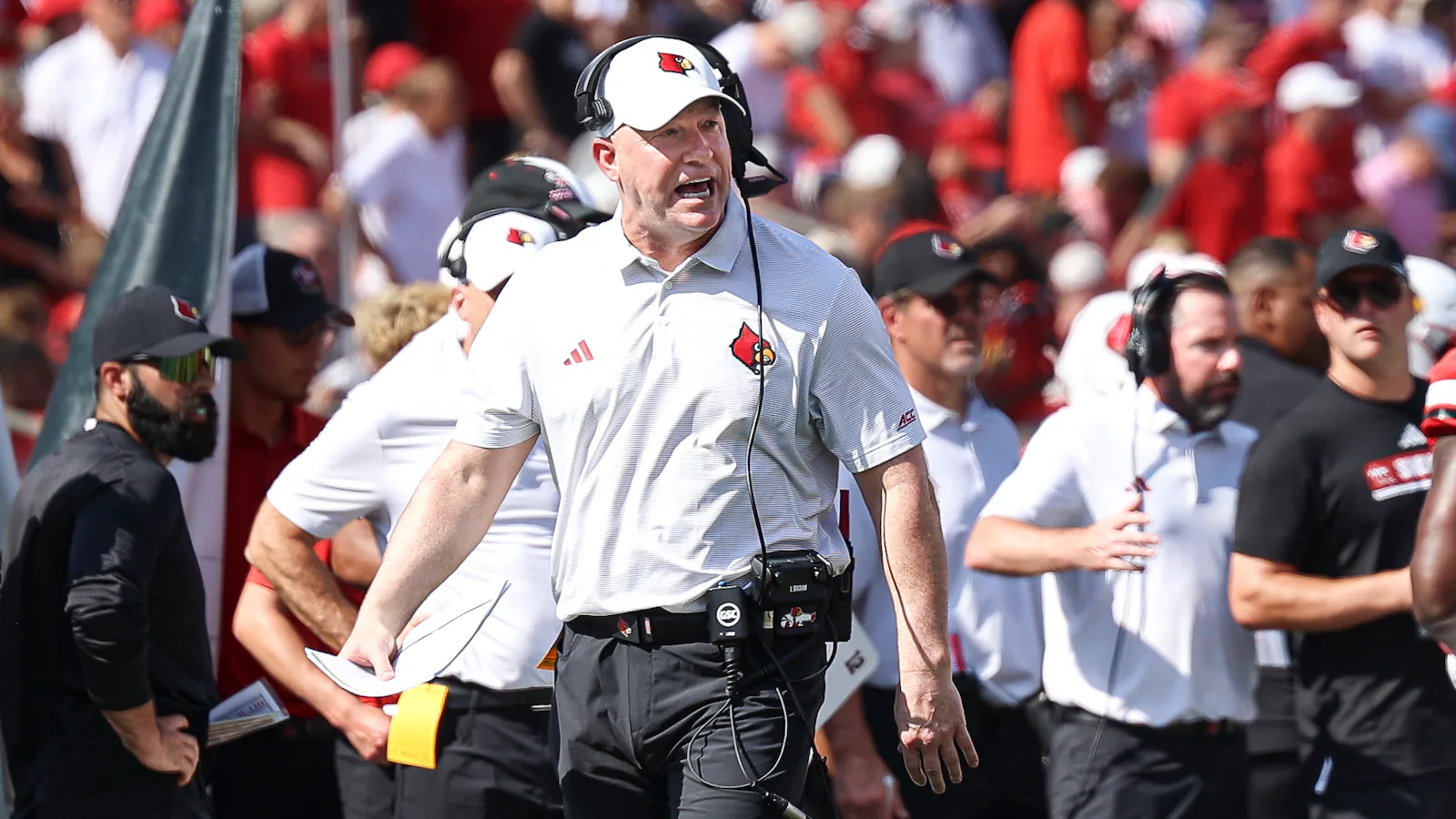
LOUISVILLE, Ky. (WDRB+WAVE) — Jeff Brohm has found a way to make Louisville’s defensive statistics look pretty good. All he has to do is take away three plays a game.
Unfortunately, the other team gets to keep the points.
Against Stanford on Saturday, Louisville allowed 81 yards rushing, stopped the Cardinal on 14 of 16 third downs and forced two turnovers. It also gave up touchdown passes of 41, 75 and 40 yards.
Stanford quarterback Davis Warren completed 23 passes for 270 yards. Six of those completions accounted for 221 yards. The other 17 produced 49.
Two weeks earlier, Syracuse had six completions for 191 yards, plus runs of 39 and 20 yards.
The Cardinals have developed a peculiar defensive personality. They can make an offense look like it’s moving a piano up a flight of stairs. Then, without warning, they open the elevator.
Brohm spent part of his Monday news conference on it.
“You go back to the Syracuse game and gave up three big plays,” he said. “If you take away those, you know, for the most part we did a pretty solid job. You go to this past game, gave up three really big plays.”
The trouble is, you can’t take them away. And there have been enough of them now that they can’t be written off as accidents.
Brohm said each of Stanford’s big plays came from one player missing his assignment. That’s how defense works. It takes 11 men to play it, and one to leave the gate open.
On the 75-yarder, tight end Aiden Black went in motion and nobody went with him. On the last one, Stanford faced fourth-and-1. Louisville needed to keep the Cardinal from gaining a yard. Micah Ford gained 40.
That tied the game at 24 early in the third quarter. Stanford couldn’t run the ball, couldn’t convert third downs and couldn’t sustain drives, and it was still tied.
Louisville scored the final 28 points and won 52-24. Isaac Brown scored four touchdowns. Tayon Holloway returned a fumble for another. Jabari Mack intercepted a pass. The defense shut Stanford out over the final 27 minutes.
Brohm said his defensive staff has spent three or four weeks on fundamentals and technique in “extraordinary detail.” He has also changed how the defense operates. Coaches in the booth work through adjustments while the offense has the ball, and there are longer conversations about the plan during the week. He isn’t putting all of it on the players.
“How can we clean that up? How can we help our guys clean that up? What can we do to put them in a better position to clean that up?” he said.
Those are fair questions, and some answers are showing up. Louisville’s second-half defense has been considerably better in recent weeks.
But improving isn’t the same as solving it. And there’s a danger in getting comfortable with the idea that a defense played well except for three plays.
Those plays aren’t exceptions to the performance. They’re part of it.
Louisville is 5-3, has won three straight and sits in third in the ACC standings heading into Saturday night’s game at Georgia Tech. The offense can score from anywhere. Isaac Brown’s speed makes pursuit angles a matter of wishful thinking. Lincoln Kienholz can run and throw, and even without leading receiver Lawayne McCoy, there are enough weapons to make defensive coordinators uncomfortable.
But Louisville has also lost three games by a combined nine points. Its margins haven’t been large, and it’s heading into a stretch of road games where giving away touchdowns gets expensive.
Nobody plays perfect defense, and Brohm doesn’t need it. But there’s a long way between perfect and a tight end running 75 yards alone.
In football, the scoreboard doesn’t care how many plays you got right.
It has an excellent memory for the ones you got wrong.