His father made it from Nigeria to the NBA, then built a basketball academy back home. Now Louisville’s 7-foot-2 freshman is beginning a journey of his own.
LOUISVILLE, Ky. (WDRB+WAVE) — Obinna Ekezie Jr. is 7 feet, 2 inches tall, which means he has to duck to get through some doorways, has never had much trouble being found in a crowd and probably hasn’t been comfortable in an airplane seat since he was 12.
He is 18 years old and weighs 240 pounds. He is from Lagos, Nigeria, by way of several American states, including Kentucky, where he once attended St. Raphael Catholic School. He is a freshman at the University of Louisville, where he is studying pre-engineering and trying to help the Cardinals win a national championship.
He also shoots three-pointers.
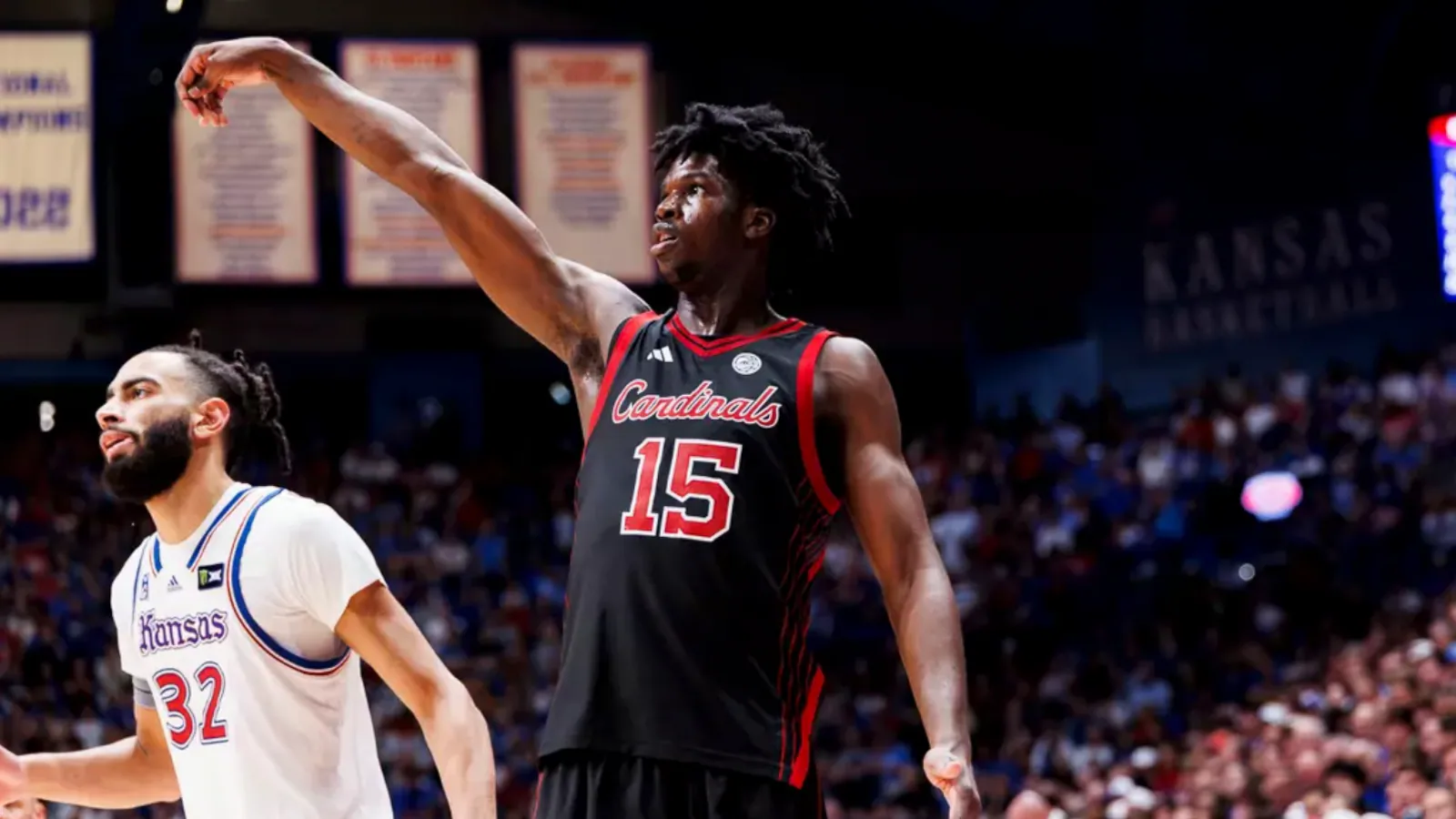
This last development came as something of a surprise to the people at Kansas last Wednesday night.
The Jayhawks were prepared for a 7-foot-2 center. They have seen a few of those over the years. Wilt Chamberlain once played there, after all. They know what to do with tall people.
But when Ekezie started launching three-pointers from the Missouri state line, the scouting report apparently needed an amendment.
He made four of six. He also blocked five shots, grabbed eight rebounds, scored 16 points and generally made himself a nuisance in Louisville’s 89-83 exhibition victory at Allen Fieldhouse.
The game didn’t count in the standings. But the basketball counted. The baskets were regulation height, the floor was regulation length, and the Kansas crowd was every bit as loud as advertised.
It was the kind of performance that can make an 18-year-old start believing his own publicity.
Ekezie seemed unmoved.
“I trust my work, honestly,” he said afterward. “I put so much work into working on my three over the summer. I’m really not surprised, honestly.”
He may have been the only person in the building who wasn’t.
Louisville assistant coach Sean Dixon admitted the performance surprised everybody. Not because the coaches didn’t know Ekezie could play, but because there is a difference between knowing a freshman has talent and watching him use it against Kansas in Allen Fieldhouse.
Especially a freshman who had been recovering from shoulder surgery and had only recently returned to full-contact basketball.
Ekezie was supposed to need time. He may still need time. But after Kansas, the timetable seems open to negotiation.
The story of Obinna Ekezie Jr. really begins with Obinna Ekezie Sr., who grew up in Nigeria and didn’t begin playing basketball seriously until he was 15.
There are places in America where a 15-year-old who hasn’t played basketball is considered hopelessly behind. In Nigeria, Ekezie Sr. was just getting started. He was inspired by Hakeem Olajuwon, another Nigerian who had discovered that being very tall and very good at basketball could be a lucrative combination.
Ekezie Sr. eventually made his way to Worcester Academy in Massachusetts. When he arrived in the United States in 1993, he had never played on a hardwood basketball court.
Think about that. It would be like trying to become a concert pianist after practicing on a kitchen table.
He learned quickly. Major college programs came calling. But the recruiting process ran into an obstacle that most college coaches never encounter.
His father.
The elder Ekezie’s father was a successful petroleum engineer and businessman in Nigeria, and he was not particularly impressed by basketball. He was impressed by education.
According to a 1998 Washington Post story, before he would let his son commit to Maryland, he wanted to speak with the university president and the deans of the engineering and business schools. Gary Williams recruited a lot of players in his time at Maryland. It’s safe to say he didn’t have to sell many of them to the dean of engineering.
Nearly three decades later, that engineer’s grandson is a pre-engineering student at Louisville. Some family priorities, apparently, get passed down.
Ekezie Sr. went to Maryland, majored in mechanical engineering, played for Williams and became an outstanding college center. The Vancouver Grizzlies selected him in the second round of the 1999 NBA draft.
He played for five NBA teams and later played professionally overseas.
Then he did something that might have been even more difficult than making the NBA. He became a successful businessman, helping establish Wakanow, a major online travel company in Nigeria.
Eventually, he turned his attention back to basketball. He remembered what it was like to grow up wanting to play a sport without having the facilities to learn it properly. So he built some.
In 2021, he opened OBN Academy in Lagos, a basketball development program with an indoor arena, training facilities and opportunities for young Nigerian players. A man who had never played on hardwood until he was a teenager had gone home and built a place where other teenagers could play on it every day.
There is a certain poetry to that, though the elder Ekezie probably wasn’t thinking about poetry when he was paying the construction bills. He was thinking about opportunity and about making sure the next generation had more of it than he did.
The younger Ekezie grew up around basketball. His father had played in the NBA. His father’s friends knew the game. There were coaches, trainers and facilities available to him. But he didn’t immediately settle on basketball. He played soccer, too.
This is understandable in Nigeria, where soccer is something close to a national religion. It is less understandable when you are growing toward 7 feet tall and have a father who played center in the NBA.
Basketball won out.
The younger Ekezie came to the United States and began moving through the basketball development system. One of his stops was Louisville. He attended St. Raphael Catholic School as an eighth grader, played basketball, made friends and got a taste of a city that takes the sport rather seriously.
He remembers it.
“I had a great time,” he said. “I had friends, I had great impact, had a great little middle school team. But, you know, just the community environment really pushed me to come here for sure.”
He also remembers the fans.
“Fans were incredibly intense about it,” he said.
That’s a polite way of putting it.
Louisville is a city where people can spend 45 minutes discussing whether the backup center is getting enough touches. They can remember a missed free throw from 1982 but sometimes forget where they parked the car. (Or maybe that’s just me).
Ekezie liked the place.
He eventually left for Prolific Prep in California, one of the country’s top basketball programs, and later attended Southeastern Prep in Florida. He became a five-star prospect and attracted the attention of major college programs.
When it came time to choose one, he decided to come back to Louisville. Living here before didn’t hurt. He knew the city. He knew the basketball tradition. He remembered his friends. He liked what Pat Kelsey was building. And he liked the idea of practicing every day against Flory Bidunga, one of the best young big men in the country.
Some players want to go where they can be the biggest fish in the pond. Ekezie wanted to go where there was another big fish.
“I’ve gotten so much better,” he said. “That’s kind of one of the reasons I wanted to come here, for sure, just to be able to compete and do that in practice every day. Because I know that playing against another guy that’s so good at the college level can get me so much better, so much faster.”
Louisville assistant coach John Andrzejek called Ekezie a “biomechanical marvel.”
This is not a phrase you hear often in basketball.
Andrzejek, who helped Florida win the national championship two seasons ago, said he had coached only a handful of players with Ekezie’s combination of size, strength, movement and length.
There are plenty of tall people in basketball. There aren’t many who can move like Ekezie. And there are fewer still who can move like that, protect the basket and step outside to make three-pointers.
Of course, there is a catch. He has the body of a grown man, but he is still learning how to use it against other grown men. He is also coming back from shoulder surgery that kept him out of full basketball activity for approximately six months. Kelsey said at media day that Ekezie had only recently been cleared to practice full court against other scholarship players.
The coach was preaching patience.
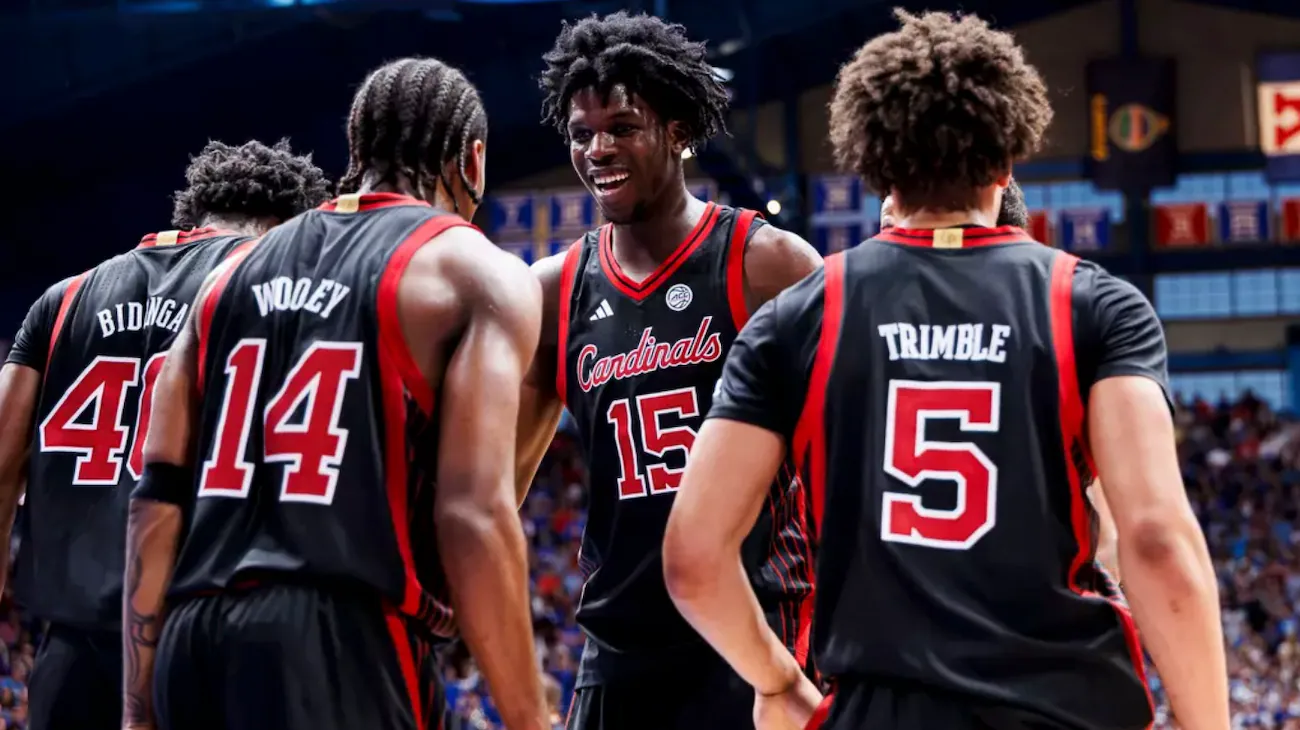
“You forget he’s 18,” Kelsey said. “When he walks in the gym ... you’re like, holy cow! He’s still 18 years old and he’s coming off a shoulder injury.”
Kelsey wanted people to understand that there would be growing pains.
Then Ekezie went to Kansas and made four three-pointers.
Coaches have a difficult enough time managing expectations without their freshmen going around doing things like that.
Ekezie is not what you might expect from someone his size. Off the court, Kelsey calls him a gentle giant. Dixon calls him a humble giant. They are apparently running out of adjectives and have settled on the noun.
Kelsey says Ekezie is bright, thoughtful, kindhearted and popular with his teammates. After the Kansas game, the coach said the locker room was almost as happy about Ekezie’s performance as Ekezie himself.
“Those guys just root for him,” Kelsey said.
When I asked Ekezie what he expected from himself this season, he didn’t promise 20 points a game or a place on an All-America team.
“I’m expecting of myself to just come out every game playing the hardest possible, controlling what I can control, and trusting the process,” he said.
He talked about rebounding. Energy. Intensity.
“Some games you might not shoot the ball the best. Some games you might be on fire,” he said. “But staying consistent with stuff that you can control every game is kind of what I want to bring here.”
His father knows how difficult the road can be.
He knows that talent gets you noticed but doesn’t necessarily get you anywhere. He knows what it is to leave home, adjust to a new country, learn a new game and try to make a living playing it.
He knows there are plenty of 7-footers who never become very good basketball players. And he knows that a promising freshman is still a long way from becoming a finished product.
The younger Ekezie listens.
“He’s played in my position in the NBA,” he said. “So, you know, him just teaching me ... how to approach things, how to stay level-headed, how to keep improving.”
Then he said something that may be worth remembering as this season unfolds.
“I haven’t reached where I want to reach.”
No, he hasn’t.
There will be games when he looks like an 18-year-old freshman. There will be mistakes, fouls and turnovers, and nights when the ball doesn’t go in.
But he has played one college exhibition game, made four three-pointers against Kansas, blocked five shots and given Louisville fans a glimpse of what might be coming.