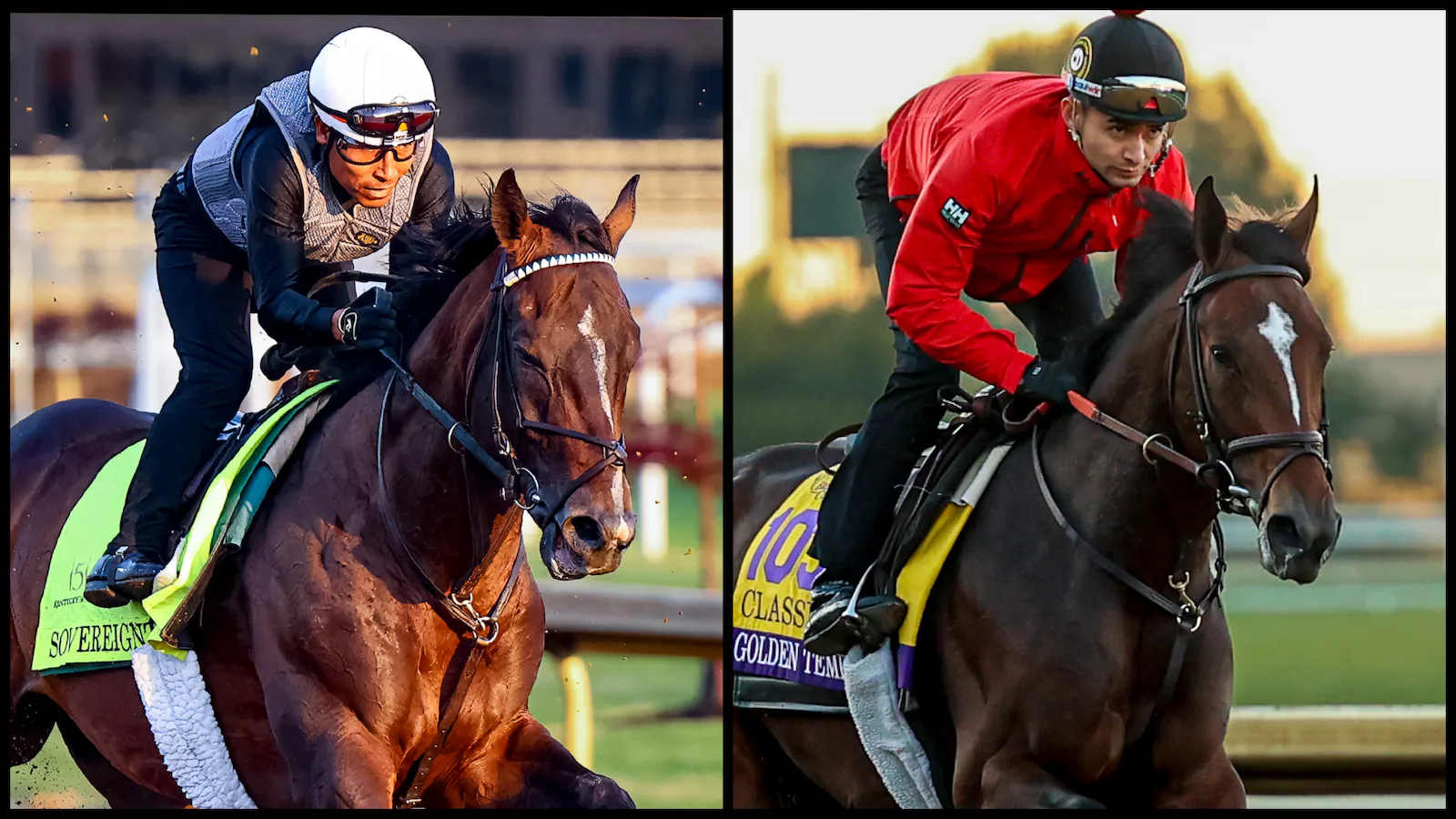
Golden Tempo and Sovereignty will meet in Saturday’s Breeders’ Cup Classic, a reminder of when the Kentucky Derby was the beginning of a rivalry instead of the end of a conversation.
LEXINGTON, Ky. (WDRB+WAVE) — There was a time when winning the Kentucky Derby didn’t mean you were excused from racing against the other horses who had won it.
You had to keep showing up.
Exterminator won the Derby in 1918. Paul Jones won it in 1920. They met 10 times. Ten. They saw more of each other than some married couples.
That was before winning the Kentucky Derby meant a fast track to early retirement and a lifetime of ceremonial appearances. They won the Derby. They kept on racing.
Times change.
Saturday at Keeneland, the $7 million Breeders’ Cup Classic will feature something that once was commonplace and now approaches an archaeological discovery.
Two Kentucky Derby winners in the same race.
Golden Tempo won the Derby this year. Sovereignty won it last year. Both are entered in the Classic.
According to Churchill Downs’ historical records, Derby winners have faced each other 43 times. The most recent meeting listed was in 1991, when Unbridled finished third and Strike the Gold fifth in the Breeders’ Cup Classic.
That was 35 years ago.
In the intervening years, the Kentucky Derby has produced plenty of champions, plenty of millionaires and plenty of breeding prospects. What it hasn’t produced very often is a chance to watch two of its winners settle an argument on the racetrack.
Saturday, racing gets one. And neither Derby winner is even favored.
That distinction belongs to Japan’s Forever Young, the defending Classic champion, who has earned more than $32 million. Sovereignty is the second choice at 5-2. Golden Tempo is 5-1.
But the odds board has never been particularly good at measuring celebrity.
Ask Cherie DeVaux.
She trains Golden Tempo, who won the Kentucky Derby in May and made her the first woman ever to train its winner. She also trains Englishman, a colt of such exceptional ability that DeVaux has wondered whether she’ll ever encounter another quite like him.
Englishman has talent. Golden Tempo has a following. Englishman can run like the wind. Golden Tempo can make grown people cry.
DeVaux has seen it happen.
People have come to the barn and cried when they saw the horse. Some have cried when they met her.
The Kentucky Derby does that to people. It’s the one horse race in America that can make a thoroughbred famous in two minutes.
“A lot of people don’t even know who Englishman is outside of the racing community, but everybody knows who Golden Tempo is,” DeVaux said.
That’s the Derby. It creates celebrities whether the horses are interested in celebrity or not. And for a long time, racing was pretty good at putting those celebrities in the same place at the same time.
Consider Exterminator. He was the kind of horse who apparently considered retirement a character flaw. He raced 100 times, winning 50. He met other Kentucky Derby winners 15 times. Ten of those meetings were against Paul Jones, whom he finished ahead of seven times despite carrying more weight in every encounter.
After a while, Paul Jones must have wondered whether Exterminator was following him.
In 1918, three consecutive Derby winners — George Smith, Omar Khayyam and Exterminator — finished first, second and third in the Bowie Handicap at Pimlico.
Three Derby winners in one race. The practice continued well into the modern era.
In 1972, Canonero II, winner of the 1971 Derby, beat Riva Ridge, winner of the 1972 edition, by a neck in the Stymie Handicap at Belmont Park.
A year later, Riva Ridge met his own stablemate, Secretariat, in the Marlboro Cup. Secretariat won in world-record time.
Then came Seattle Slew and Affirmed.
Seattle Slew had won the Triple Crown undefeated in 1977. Affirmed won it in 1978, surviving three famous battles with Alydar.
Two Triple Crown winners, two horses who had already accomplished everything American racing could ask of them. So naturally, they raced each other.
Seattle Slew beat Affirmed by three lengths in the Marlboro Cup.
A month later, they tried it again in the Jockey Club Gold Cup. Seattle Slew lost an extraordinary stretch duel to Exceller. Affirmed finished fifth.
In 1979, Affirmed returned to the Gold Cup and defeated Spectacular Bid, that year’s Derby winner.
The last great example was Ferdinand and Alysheba.
Ferdinand won the 1986 Derby with Bill Shoemaker. Alysheba won the 1987 Derby with Chris McCarron. When they met in the 1987 Breeders’ Cup Classic, Ferdinand won by a nose.
They met three more times the following year. Alysheba finished ahead of Ferdinand in all three.
They had a rivalry. They didn’t need somebody to invent one. They kept showing up until one developed.
These days, a champion has another formidable destination: the breeding shed. Trainers and owners are more selective about where and when their horses run.
There are good reasons for some of that.
DeVaux, for example, skipped the Preakness with Golden Tempo because she believed he needed time to develop. Bill Mott did the same with Sovereignty one year earlier.
Goldent Tempo, like Sovereignty, won the Belmont Stakes. He then finished third in the Travers and has continued to mature.
“He’s a horse that’s very much improving every start,” she said. “We just kind of point him to races. We’re very deliberate.”
You can’t argue with the results, or the business.
But something has been lost along the way.
The Derby still makes stars. It just doesn’t always give the public many chances to watch those stars compete against each other.
Saturday offers one. Golden Tempo is three. Sovereignty is four.
History gives the older horse a slight edge. In the 43 previous meetings of Derby winners recorded by Churchill Downs, the older horse finished ahead 24 times.
Sovereignty also has the better résumé. He won the Derby, Belmont and Travers last year, added the Whitney this summer and was named Horse of the Year.
His trainer, Bill Mott, has been watching Golden Tempo with considerable interest.
“After I watched the Derby and the Belmont, I said, ‘Well, he looks to me to be the best three-year-old in the country,’” Mott said.
He called Golden Tempo “a real horse” and “a horse to be reckoned with.”
But Mott has a Derby winner of his own.
“We just hope that we’re more mature and more seasoned and better than him on the day,” he said.
Golden Tempo is still improving, according to his trainer, and will need to improve again to beat him.
Then there’s Forever Young, who has won major races around the world and is trying to join Tiznow as the only two-time winners of the Breeders’ Cup Classic.
Nobody is holding this race so Golden Tempo and Sovereignty can exchange compliments. There are seven horses entered, and all seven are trying to win.
Golden Tempo will need a strong pace to set up his late run. The scratch of Magnitude removed one of the horses expected to help provide it.
Sovereignty will need to reproduce the form that made him one of the best horses in the country.
Forever Young will need to do what he’s been doing for much of his career, which is make very good horses look slightly less good.
DeVaux understands the significance of having two Derby winners in the same race.
“There’s going to be a lot of people interested and invested in the race because of having the two Kentucky Derby champions in the race,” she said.
People who don’t follow racing every day will recognize both names.
They’ll tune in because they remember the roses. They’ll watch because they want to see which Derby winner is better.
And they may never get another chance.
Sovereignty is expected to retire after Saturday. The breeding shed has been waiting for him all year. Golden Tempo is expected to race again next year.
In another era, this might have been the beginning of a rivalry. Today, it could be the whole rivalry.
Exterminator and Paul Jones got 10 races to settle their differences. Ferdinand and Alysheba got four.
Golden Tempo and Sovereignty may get just one.
Better make it count.