CRAWFORD | Hughes wins the Juvenile. Now comes the longest 75 miles in horse racing.
Bob Baffert has won seven Breeders’ Cup Juveniles. None of his previous six winners went on to win the Kentucky Derby. His latest candidate has six months to try to change that.
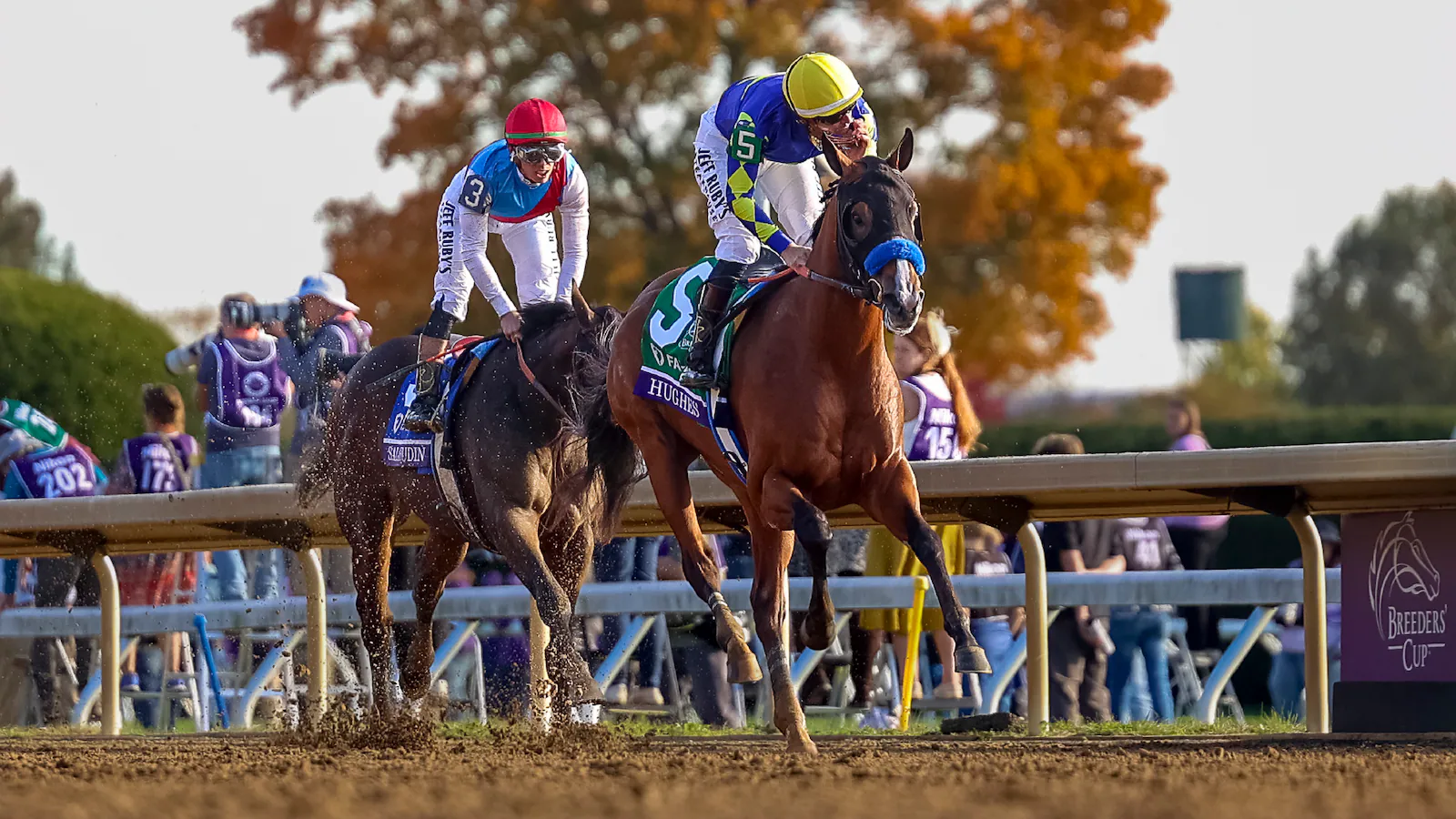
LEXINGTON, Ky. (WDRB+WAVE) — There are about 75 miles between the winner’s circle at Keeneland and the winner’s circle at Churchill Downs.
You can drive it in an hour and a half. You can fly it in about 20 minutes. A good horse could probably cover the distance in a couple of days if somebody were foolish enough to ask him.
But try getting a Breeders’ Cup Juvenile winner from one winner’s circle to the other.
Only two horses have done it. Street Sense won the Juvenile and came back to win the 2007 Kentucky Derby. Nyquist did it in 2016.
The Breeders’ Cup has been around since 1984. That’s 42 years of trying to identify the next Kentucky Derby winner, and the Juvenile has been right twice.
The weather forecast is more dependable.
Friday at Keeneland, a colt named Hughes took his place at the head of the class. He won the $2 million Juvenile by 2¼ lengths, ran 1 1/16 miles in 1:42.27 and gave Bob Baffert his seventh victory in the race.
Hughes is now five for five. He’s won three straight Grade 1 races. His first four victories came by a combined 24½ lengths.
At this point, the only thing he hasn’t done is lose.
That can be a problem. Sometimes you don’t know what you’ve got until somebody comes along and tries to take it away.
Baffert knows this. He’s won six Kentucky Derbies, and had a seventh taken away after Medina Spirit tested positive for a prohibited medication. He’s won seven Juveniles and enough major races to fill a trophy case the size of a small shopping center. Friday’s victory was his 22nd in the Breeders’ Cup, tying Aidan O’Brien for the all-time record.
O’Brien had broken the tie one race earlier. He held the record by himself for about the length of a commercial break.
But Baffert wasn’t thinking about records. He was thinking about a horse who had spent the year making the competition look like it had missed the starting bell. Hughes had never really been challenged. Baffert could tell you how fast he was. He couldn’t tell you what would happen if another horse decided to make a race of it.
Flavien Prat had Hughes close to the lead through a half-mile in 46.65 seconds. The colt had gotten a little too eager on the first turn, Prat said, and needed to settle before making his move. Then, approaching the stretch, somebody volunteered to test him.
It was Coach Pope, trained by Kenny McPeek. People in Lexington had to appreciate the name. For a moment, they might even have appreciated the effort. Coach Pope came up alongside, and Baffert leaned forward to see what would happen.
“He’d never been battle tested,” Baffert said. “You never know how they’re going to respond. Today at the quarter pole, I thought, well, we’re going to find out what he’s made of.”
He found out quickly.
“When a horse came to him, he just caught another gear,” Baffert said. “You like to see that.”
Hughes took off. Coach Pope went backward. American History came along for second, and Baffert’s other horse, Salahudin, finished third.
Baffert discovered that his colt could do something besides run fast when nobody was bothering him. He could run faster when somebody did.
“He’s just a really superior 2-year-old,” Baffert said.
He said everyone who gets off Hughes compares him to a cheetah.
“He skips over the ground and he comes back and he never takes a deep breath,” he said.
Cheetahs, it should be noted, aren’t known for going a mile and a quarter.
And there’s a difference between being the best 2-year-old in October and being the best 3-year-old in May.
It’s roughly 75 miles.
Ask Arazi.
In 1991, Arazi came to Churchill Downs for the Breeders’ Cup Juvenile and put on a performance that made grown men talk about him as though he were a combination of Secretariat and a low-flying aircraft. He was 14th early, went around the field as if the other horses were standing still and won by five lengths.
People were ready to hand him the next year’s Kentucky Derby on the spot. They made him the favorite. He finished eighth.
A horse can cover a lot of ground in six months. So can everybody else’s.
Then there’s Mine That Bird. He finished dead last in the 2008 Juvenile, 12th of 12. If you’d been looking for a future Derby winner that afternoon, you would have walked right past him on your way to the parking lot.
Six months later, he won the Kentucky Derby at 50-1.
Spend a Buck and Alysheba finished third in their Juveniles before winning the Derby. Sea Hero finished seventh.
In 42 years, 109 Juvenile runners have gone on to start in the Kentucky Derby. Six won. Nine finished second. Nine finished third.
It’s a useful race if you’re looking for a Derby horse. It’s less useful if you’re trying to figure out which one.
And Baffert, of all people, ought to know. Before Friday, he had won the Juvenile six times. Vindication. Midshipman. New Year’s Day. Game Winner. Corniche. Citizen Bull.
Not one won the Kentucky Derby. Game Winner finished fifth in 2019. Citizen Bull was 15th last year. The others never reached the starting gate.
Baffert’s Derby winners came from somewhere else. American Pharoah didn’t run in the Juvenile. Justify didn’t run at all as a 2-year-old.
Maybe this time will be different.
Hughes has the pedigree. He’s a son of Into Mischief, whose offspring include Derby winners Authentic, Mandaloun and Sovereignty. He has the trainer. He has the speed. He has the undefeated record.
And he has owners who have spent a good deal of money trying to buy exactly this kind of horse.
Tom Ryan, who helped put together the group that owned Authentic, founded Front Row Club this year. The operation works with Baffert and bloodstock agent Donato Lanni to find promising young colts.
The idea is to buy horses who can win the Kentucky Derby. It’s a simple plan, apart from the part where you have to win the Kentucky Derby.
Ryan also gave Hughes his name. The colt is named for Jack Hughes, the New Jersey Devils star who scored the overtime goal against Canada to win Olympic hockey gold for the United States earlier this year. Ryan named the horse the night after the game. His wife is a Hughes, which raised the stakes a little.
“All of a sudden, I had family pressure, the Jack Hughes pressure,” Ryan said. “It’s worked out incredibly well.”
Jack Hughes lost teeth in the gold-medal game. His namesake took his first real punch Friday and came away with all of his.
Baffert is already looking ahead. He liked Salahudin, who might be better at longer distances. Todd Pletcher thought runner-up American History could have finished closer with a cleaner trip. And Kenny McPeek believes Coach Pope still has some learning to do.
The horses Hughes beat Friday might be considerably better by next spring.
“Those four colts were really good colts, and we’re going to be hearing a lot about them,” Baffert said. “I think the 2-year-old crop is really strong this year. It should be exciting hopefully next spring.”
It should.
The Derby always is, particularly for people who don’t have a horse in it. For those who do, it’s six months of worrying about everything from a sore ankle to a missed workout to the possibility that somebody else’s horse has improved more than yours.
Hughes, meanwhile, doesn’t seem to worry about much. Baffert said that when the colt gets a big lead, he sometimes starts looking around. Six or seven lengths in front, and he’s taking in the scenery. Friday, Coach Pope made sure he didn’t have much time for that.
“Today it was pedal to the metal,” Baffert said.
There are worse habits. Hughes has won everything put in front of him.
But October isn’t May.
Street Sense made the trip. Nyquist made it.
Six times before Friday, Bob Baffert stood in the Juvenile winner’s circle and started planning for May.
Now he’s got Hughes.
He knows exactly how far those 75 miles can be.