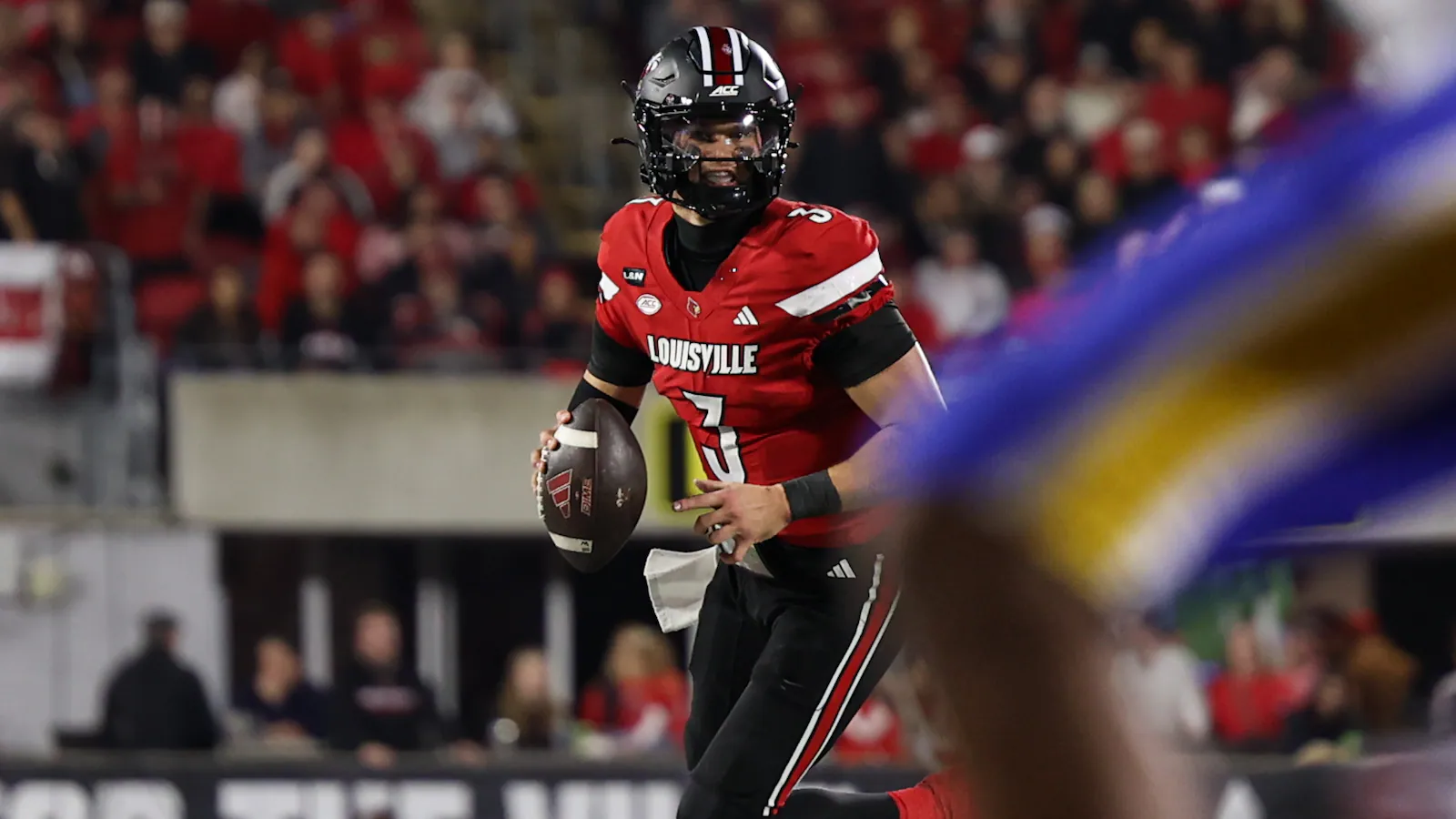
Lincoln Kienholz threw five touchdown passes, Louisville scored 28 unanswered second-half points and the Cardinals rolled past Pittsburgh for their sixth straight victory heading into Kentucky week.
LOUISVILLE, Ky. (WDRB+WAVE) — For 30 minutes Saturday night, Louisville and Pittsburgh played a football game that occasionally resembled a rehearsal for one.
There were fumbles. Interceptions. Missed field goals. Penalties. Replay reviews. Officials spent so much time at the monitor they should have been credited with time of possession.
Pittsburgh’s defense spent much of the first half chasing Lincoln Kienholz around L&N Stadium. Louisville’s offense spent much of it running backward.
At halftime, the Cardinals had 14 points, zero net rushing yards and a four-point lead over a Pittsburgh team playing with backup quarterbacks.
Then somebody apparently reminded Louisville that it was supposed to be the better team.
The Cardinals scored 28 unanswered points in the second half, Kienholz finished with five touchdown passes, and No. 23 Louisville turned an evening of early frustration into a 42-10 victory that sent Jeff Brohm’s team into its rivalry meeting with Kentucky riding six consecutive wins.
The final score suggested a mismatch. For the first half, the game suggested a misunderstanding.
Louisville had 160 yards of offense before halftime, all of them officially credited to passing. Its rushing total stood at zero, thanks in part to sacks that wiped out gains on the ground. Pittsburgh’s pressure had Kienholz scrambling for answers, and the Cardinals had trouble sustaining drives.
Kienholz was sacked twice, intercepted once and lost a fumble that Pittsburgh returned for its only touchdown.
Carson Hilbert missed field goals from 44 and 46 yards. The Cardinals converted four of 11 third downs.
Pitt wasn’t exactly covering itself in glory, either. The Panthers had 89 yards of offense, three turnovers and seven penalties before halftime. Their offense had managed only a field goal, and that came as time expired.
It was 14-10, and neither team had much reason to frame the first-half statistics.
Brohm knew what had gone wrong. Pittsburgh’s attacking defense was creating negative plays, putting Louisville behind schedule and making it difficult to sustain possessions.
“When you can create negative plays and push the offense back, your chances of getting off the field are very good,” Brohm said.
The halftime adjustments were straightforward enough: eliminate some of those losses, take more shots downfield and find enough running room to make Pittsburgh respect the ground game.
“We were able to pop some runs at least a little bit to keep them honest,” Brohm said.
But there was a significant difference between the two teams.
Pittsburgh’s offense was struggling to establish anything against Louisville’s defense. The Panthers were relying on backup quarterbacks Holden Geriner and Corey Dailey, and Louisville wasn’t making life any easier for them.
The Cardinals held Pitt to 150 yards for the game, including just 48 rushing. The Panthers converted only two of 13 third downs, committed four turnovers and never scored an offensive touchdown.
Yes, Pittsburgh was shorthanded at quarterback. But Louisville’s defense deserves credit for making sure the Panthers never found a way around that problem.
Brohm said he’s become more directly involved in correcting the problems that plagued Louisville earlier in the season, from penalties and turnovers to defensive breakdowns. He’s taken a greater hand in scripting opposing offenses for practice, trying to challenge his defense before Saturday rather than discovering its weaknesses during the game.
He also pointed to improved communication, better execution and a deeper defensive rotation that has helped the Cardinals limit the explosive plays that hurt them earlier in the season.
The defense kept the game under control while Louisville’s offense tried to remember how to play football.
Then the second half began, and the difference was startling.
Louisville gained 237 yards of second-half offense before the final kneel-downs, including 88 on the ground. Kienholz completed all nine of his passes for 149 yards and three touchdowns.
Nine attempts. Nine completions. Three touchdowns.
For a quarterback who had spent the first half looking at Pittsburgh defenders coming from every direction, it was quite a turnaround.
“It’s tough as a quarterback when you see all this stuff in your face,” Brohm said. “So it wasn’t his best first half, but he still played hard. And then he came out in the second half and was outstanding.”
Brohm credited Kienholz’s work ethic, toughness and willingness to be coached.
“Lincoln really stepped up today,” he said. “Played a great second half.”
Tre Richardson caught eight passes for 114 yards and two touchdowns. Lawayne McCoy added five receptions for 63 yards and two scores. Treyshun Hurry caught the other touchdown pass.
Kienholz finished 25-of-41 for 309 yards, five touchdowns and one interception.
The change showed up on third down, where Louisville went 4-of-11 before halftime and 4-of-4 after it. It showed up at the end, too, when the Cardinals closed their scoring with a 15-play, 68-yard touchdown drive that ate 10 minutes, 16 seconds and finished with Keyjuan Brown’s 1-yard run.
Kienholz had thrown five touchdown passes, one short of the school record, but he was happy to let the running game finish the job.
“Honestly, I loved it,” he said. “Just being able to give the O-line and running back ... that opportunity to just go ... destroy them. And that’s exactly what they did.”
The offense that couldn’t sustain anything for 30 minutes spent the next 30 deciding when the game would end.
Six weeks ago, Louisville was 2-3, its early expectations were fading, and the questions about where this season was headed were getting louder.
Now the Cardinals are 8-3, nationally ranked and riding six straight victories.
Defensive back Ben Perry said the turnaround has been driven in part by a message from Coach Ivy at the beginning of November.
“Remember November,” Perry recalled Ivy telling the team. “You want to be remembered in November. It’s not about how you start. It’s all about how you finish.”
The message has stuck, particularly with a defense that spent the early part of the season giving up too many big plays and has since become one of Louisville’s greatest strengths.
Perry said the players have grown closer, embraced the work required to improve and developed a greater sense of responsibility to one another.
Brohm sees the same thing. He described an unselfish group that has continued working through losses and hasn’t allowed its recent success to become a reason to relax.
Saturday offered evidence of both the progress and the problems that remain.
Pittsburgh’s pressure exposed vulnerabilities in Louisville’s protection. The first-half rushing numbers were distorted by losses in the backfield. Two turnovers, two missed field goals and a succession of stalled drives kept a game competitive that probably shouldn’t have been.
Those are not the kinds of mistakes Brohm will want to carry into next week’s meeting with Kentucky.
But the Cardinals also showed something important. They didn’t let a rough first half become a full-game disaster. Their defense never let Pittsburgh establish a meaningful offensive threat. Their quarterback recovered from a rough start to produce one of his best statistical performances. And their offense finished the night controlling the football and the scoreboard.
With Miami and Wake Forest winning, Louisville cannot play in the ACC Championship game.
Still, next comes Kentucky, a team headed in the opposite direction. The Wildcats started 7-1 and climbed into the College Football Playoff rankings, but three consecutive losses have turned Will Stein’s promising first season into a test of how much momentum he can salvage.
The rivals will arrive at their annual meeting having spent the past six weeks traveling in opposite directions.
The Cardinals have spent those six weeks rescuing a season that appeared to be slipping away.
Saturday night, they spent 30 minutes making a mess, then 30 minutes cleaning it up.
Next week, against Kentucky, they might not have 30 minutes to waste.