CRAWFORD | Kentucky made the shots. Indiana knew how to win in 90-76 victory.
The Wildcats shot 54 percent, but Darian DeVries’ Hoosiers had the defensive answers, depth and toughness to claim a 90-76 rivalry victory.
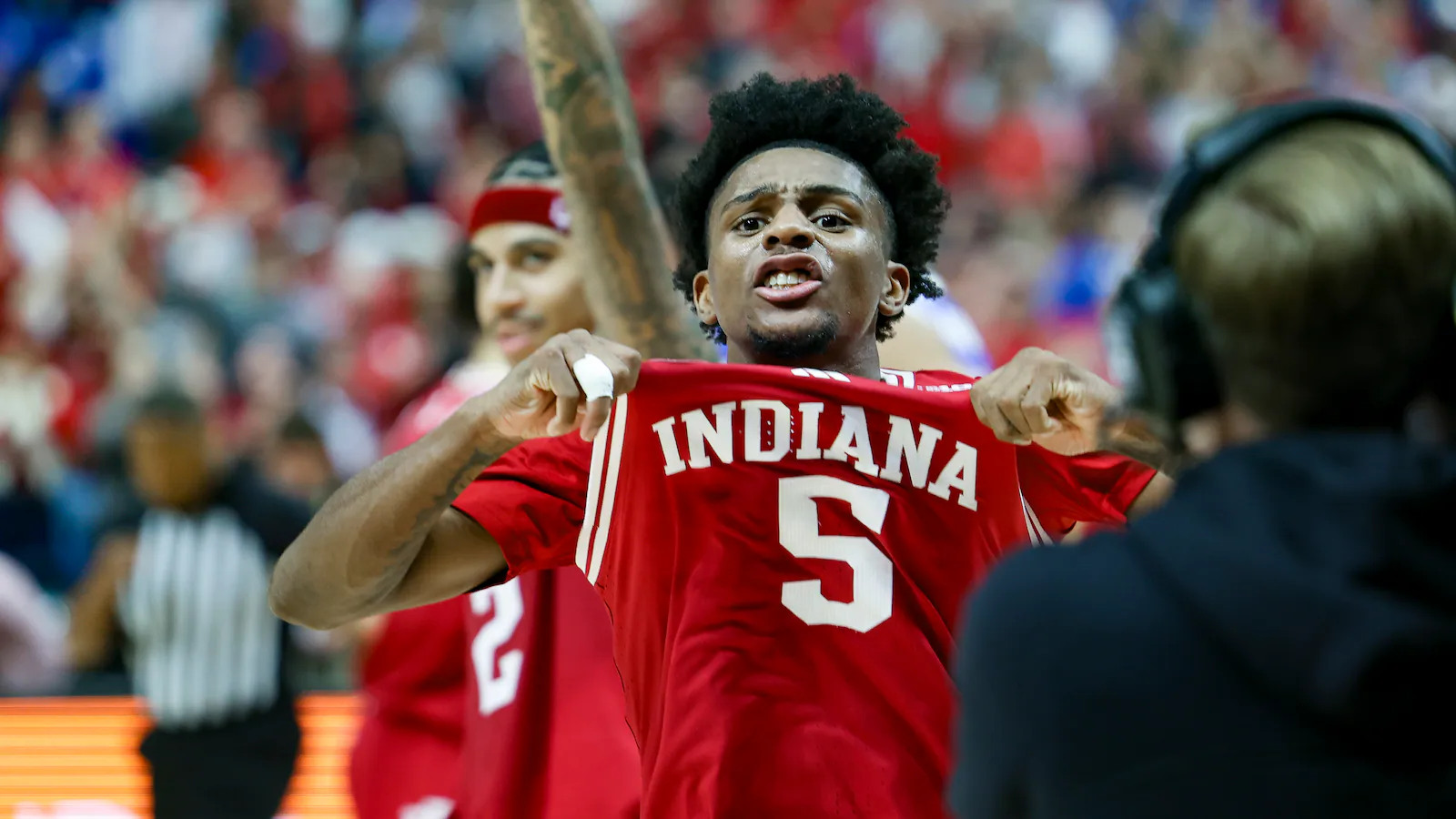
INDIANAPOLIS (WDRB+WAVE) — Kentucky spent Friday night demonstrating that there are ways to lose a basketball game while shooting 54 percent.
Quite a few ways, as it turned out.
You can foul three-point shooters. You can give up offensive rebounds. You can let the other team score 33 points off its bench while yours contributes four. You can make enough mistakes that the other team spends much of the second half shooting free throws instead of field goals.
Or you can do all of the above, which is what Kentucky tried against Indiana in Lucas Oil Stadium.
But that doesn’t tell the whole story. Not even close.
Because Indiana didn’t just benefit from Kentucky’s mistakes. The Hoosiers made their own opportunities. They defended, rebounded, attacked and adjusted. They found ways to score when their shots weren’t falling, and ways to keep Kentucky from scoring when its shots were.
The Wildcats had the better shooting percentages. Indiana had the better basketball team, at least for this particular 40 minutes.
And for Darian DeVries, in his second season trying to restore Indiana basketball to something resembling its old standing, this was the kind of victory that suggests his program is learning how to win.
Not just when the shots fall. When they don’t.
For a while, Milan Momcilovic looked capable of winning the game by himself.
Kentucky clearly came in determined to get its Iowa State transfer more involved. Momcilovic, the second-highest-paid player in college basketball, had been used on just 14.6 percent of the Wildcats’ possessions coming into the game.
For that kind of money, you’d think they might at least let him touch the merchandise.
They did Friday. Kentucky went to him on its first possession, and kept going.
Momcilovic, who led Division I in three-point shooting percentage last season, scored 22 points in the first half. He made eight of 10 shots, including five of six from three-point range.
“We unloaded the the whole playbook on him, and and you know, and he was he was really good, man,” Pope said. “He was on a tear in the first half, like it was really fun to watch, and he put us in a great position in the game. I don’t think it’s probably practical for us to expect him to do that every half, every game, but he’s finding his way into being a dominant performer.”
Indiana led by 11 with 4:54 remaining before halftime. Then Momcilovic took over, making three three-pointers during Kentucky’s closing surge, including two in 21 seconds that tied the game at 45.
Zoom Diallo hit a jumper with eight seconds left, and Kentucky went to the locker room leading 47-45.
The Wildcats had led for eight seconds in the first half.
The last eight.
It was an extraordinary offensive performance, and it seemed to offer Kentucky a blueprint: Get Momcilovic the basketball. Let him shoot it. Repeat until Indiana surrenders.
Darian DeVries had another idea.
In the second half, Indiana practically assigned a personal bodyguard to Momcilovic. Wherever he went, a Hoosier went with him. Kentucky ran him off screens, used him as a screener, tried popping him to the perimeter. Indiana refused to leave.
The Hoosiers were willing to play four-on-four against everybody else. They just weren’t going to let Momcilovic beat them again.
But DeVries’ adjustment went beyond simply chasing one shooter.
He moved Indiana’s defensive pressure farther up the floor, forcing Kentucky to initiate its offense from greater distances. He brought his big men higher to defend the Wildcats’ off-ball screening actions, giving his perimeter defenders more opportunity to recover.
“It was really just more the physicality and the pickup point of our defense,” DeVries said.
“They started switching more,” he said. “They took the big fella out, I think, a lot more, and kind of more at the level of the screen instead of a drop coverage.”
But Momcilovic also recognized that Indiana’s defensive adjustment was only part of the problem.
“We just couldn’t finish possessions, so we couldn’t get out in transition,” he said. “We couldn’t get going. We didn’t really have a rhythm there in the second half, and they did.”
Twelve minutes into the second half, he had attempted only two three-pointers. Both missed. He finished with 28 points, but only six came after halftime.
Kentucky’s offense, which had produced 47 first-half points, managed just 29 in the second.
Pope said even when Indiana denied him shots, his movement created opportunities for others.
“We were a little stuck in the second half,” Pope said. “We went to a counter action twice in a row, and he essentially earned us two straight layups away from the ball.”
But those opportunities weren’t nearly enough.
DeVries had changed the terms of the game. Pope’s team never quite figured out how to change them back.
And while Indiana was solving one problem on the defensive end, it was creating plenty of problems for Kentucky at the other.
But Indiana wasn’t merely waiting around for donations. The Hoosiers were aggressive, getting downhill, attacking the offensive glass and making Kentucky defend possession after possession.
DeVries said getting to the free-throw line had been a priority since the offseason.
“Last year all we did was watch other people shoot free throws,” he said. “So it’s like, we’re going to do that this year.”
Friday, Indiana did the watching from the other end.
The Hoosiers made 23 of 26 free throws in the second half. Kentucky attempted six.
For the game, Indiana made 28 free throws. Kentucky made three.
Kentucky actually made seven more field goals than Indiana, 33-26. The Wildcats shot 54.1 percent from the floor, compared with Indiana’s 39.7 percent.
And lost by 14.
Somewhere, James Naismith is looking for the fine print.
Pope didn’t dispute the reason for the disparity. His team had committed 12 shooting fouls, including those four against three-point shooters.
“We weren’t disciplined enough or tough enough tonight to finish a possession legally,” Pope said.
But Indiana’s advantages went beyond the foul line.
The Hoosiers won the battle of second-chance points, 18-9, and points off turnovers, 16-4. They grabbed 14 offensive rebounds to Kentucky’s six. Their bench outscored Kentucky’s 33-4.
DeVries said the rebounding was particularly significant because Indiana had just faced another long, athletic team in Arkansas earlier in the week.
“To have two games like that with a very long and athletic Arkansas team, then tonight a very tall Kentucky team, to continue to be a force on the glass was really the difference in the games,” he said.
And Indiana had the personnel to do it.
Kentucky had the game’s most spectacular offensive player in Momcilovic. Indiana had its own expensive talent in Aiden Sherrell, the second-highest-paid player in the game.
Sherrell didn’t match Momcilovic’s 28 points. But he contributed in more ways.
The 6-foot-10 sophomore scored 16 points, made four of six three-pointers, grabbed seven rebounds and led Indiana in blocked shots. He could stretch Kentucky’s defense on one possession and protect the basket on the next.
“He can do so much for you,” DeVries said. “You can post him. You can stretch it. Even defensively, he can guard one through five.”
DeVries said Sherrell has made significant strides in recent weeks and is becoming more comfortable in Indiana’s system.
“I think he’s really starting to get comfortable in what we’re doing and how that works for him,” DeVries said. “And the guys are figuring out how to utilize him a little bit, too.”
Then there was Bryce Lindsay, who came off the bench to lead Indiana with 20 points. Darren Harris and Markus Burton added 15 each.
But the depth story went beyond scoring.
DeVries singled out the energy provided by Sam Yigitoglu, Trevor Manhertz and Trent Sisley, particularly their defensive activity and offensive rebounding.
He said Indiana was able to keep rotating fresh players into the game while maintaining its physicality.
“I thought eventually it just kind of wore into them a little bit,” DeVries said. “We were able to play with a little more energy, a little more physicality, just from top to bottom.”
That’s a significant development for a program trying to build an identity.
Indiana didn’t have to depend on one player being extraordinary. It had enough players doing enough things well.
And when Kentucky made its last push, the Hoosiers had already done enough to withstand it.
The Wildcats eventually discovered they could score inside. They outscored Indiana 36-24 in the paint and attacked the basket late, cutting a 17-point deficit to 11 with 3:26 remaining.
Indiana looked tired. Its offense had gone more than three minutes without a field goal. DeVries called timeout.
But the Hoosiers had built their lead with defense, offensive rebounds and trips to the foul line. They weren’t about to give it back.
The final margin was 14.
For Kentucky, it was another frustrating night in a season that has offered too many of them. Pope has offensive talent. He has a dangerous shooter in Momcilovic, a capable playmaker in Diallo and a promising interior presence in Moreno.
But his team is still learning how to finish defensive possessions, and how to impose its will when an opponent changes the terms of the game.
Pope acknowledged as much afterward.
“This is a space we’ve been living in for the last couple weeks, talking about finishing possessions,” he said. “If we get to the point where we finish possessions, especially in those two areas, we have a chance to be a really good team.”
He also gave Indiana considerable credit.
“They found a way to have a really good balance on their team,” Pope said. “They’re big and physical and really athletic, and they shoot it terrific.”
This was supposed to be a measuring-stick game between two proud programs trying to find their way back toward the top of college basketball.
It was also a reminder of what college basketball loses when traditional rivalries disappear.
The crowd at Lucas Oil Stadium brought the energy of an old-fashioned Kentucky-Indiana showdown, the kind that used to be a regular part of the sport’s calendar.
DeVries, whose team had played at Madison Square Garden earlier in the week, said his players were impressed by the atmosphere.
“I would love to keep it going,” he said of the rivalry. “I think it’s great for college basketball.”
And for Indiana, the game provided something more substantial than nostalgia.
DeVries inherited a program with a magnificent basketball history and a recent habit of falling short of it. The Hoosiers have spent years trying to recover the consistency, toughness and identity that once made Indiana one of the sport’s defining programs.
One November victory doesn’t restore all of that.
But beating Kentucky by 14 on a night when the Wildcats shot 54 percent is a pretty good place to start.
Indiana didn’t have the best shooter on the floor. It didn’t have the best shooting percentage. It didn’t have a player score 28 points.
What it had was a team that could adjust when things weren’t going its way, get production from its bench, win the rebounding battles that mattered and find points when its offense wasn’t producing baskets.
Kentucky made the shots.
Indiana made the winning plays.
And for a program trying to find its way back, that might be the more important accomplishment.