With signs that read “Stop Blasphemy” and “Reparation,” accusations of sacrilege
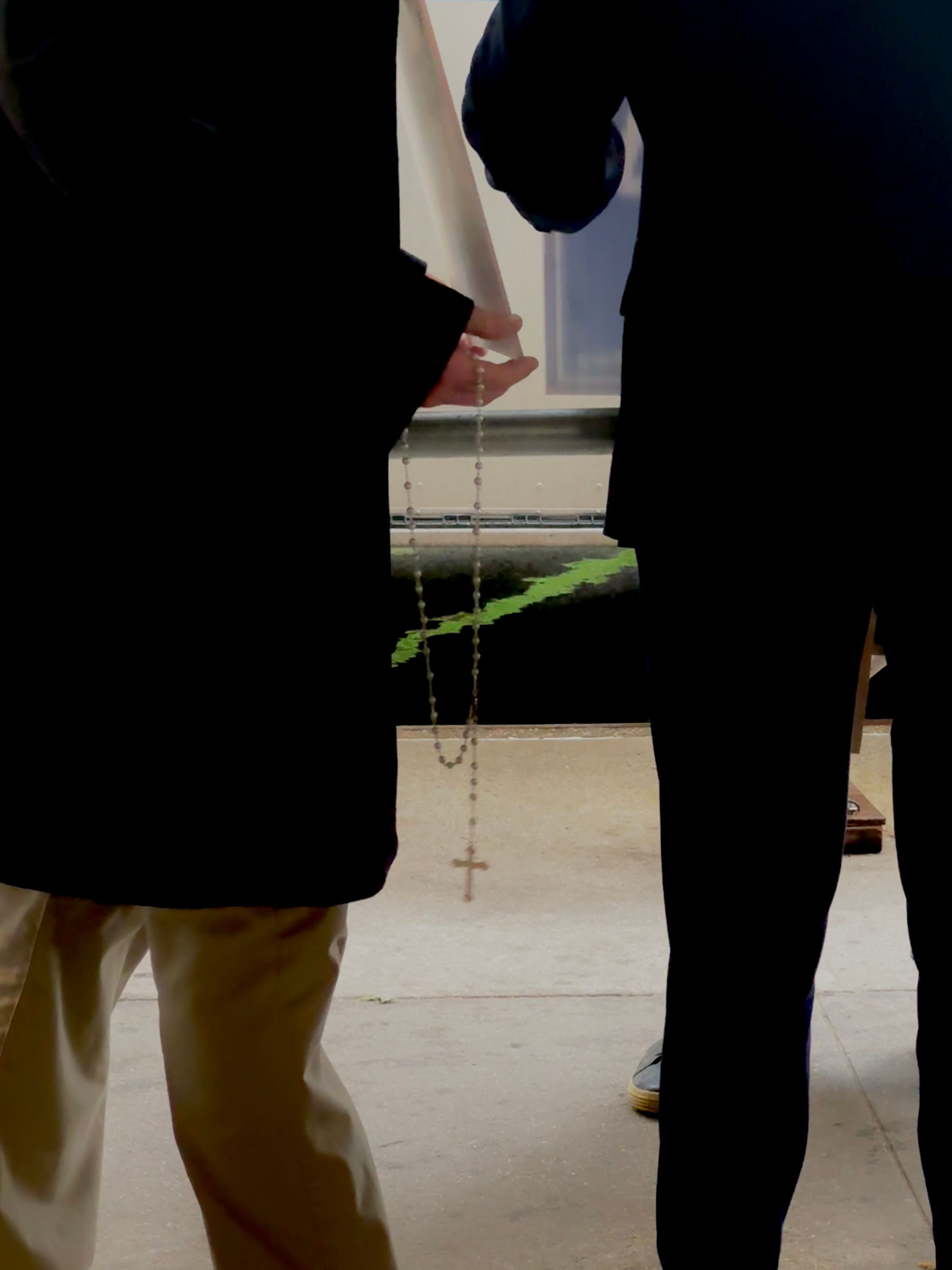
filled the air outside of AMC Lincoln Square on Sunday, May 4th, as about 20 protesters braved the pouring rain to denounce the screening of the 1999 comedy Dogma.
While simultaneously trying to stay dry under their shared umbrellas, four of the protesters held a large banner that read: “We vehemently protest the Sacrilege against the Blessed Virgin Mary happening here!” Another protester waved the organization’s flag, which was almost as high as the traffic lights above them. A group of four were playing bagpipes and trumpets while chanting prayers, and others across the street were holding signs directly in front of the theater’s entrance.
“The content of the film is highly sacrilegious and blasphemous,” said John Ritchie, the group’s spokesperson, in an interview, as chants and trumpets played loudly in the background. “It attacks the Virgin Mary, God, the Catholic faith, and the mass in the most vulgar and vile ways.”
The members of Ritchie’s group, the American Society for the Defense of Tradition, Family, and Property, (TFP) wore long beige trench coats, red sashes with the organization’s logo (a lion with a cross on its chest) pinned on their left shoulders, and held rosaries, some playing loud bagpipes and trumpets while others were chanting prayers.
TFP is an organization concerned with what its members claim are moral crises in modern culture that threaten the Catholic faith. Some of their other campaigns include “In Defense of the Unborn” and “Traditional Marriage Crusade.” The group was founded in 1971 and claims to have over 120,000 active members. Its website says the TFP is “on the front lines of the Culture War…defending the values of tradition, family and private ownership.”
For the movie’s 25th anniversary, Dogma has begun its national “Resurrection Tour,” with new 4k high definition quality, exclusive bonus content, and Q&A screenings hosted by the movie’s director, Kevin Smith.
Dogma is a religious satire about two fallen angels (played by Ben Affleck and Matt Damon) who discover a loophole that could allow them to return to Heaven after being cast out by God. A group of unassuming heroes decide to band together and stop this from happening, including Salma Hayak, Linda Fiorentino, and Chris Rock.
“Art should uplift the soul…It should favor the most noble parts of our being and favor virtue,” said Ritchie. “When they take what is sacred and drag it through the mud, that’s where it gets even worse. It’s a direct attack against God.”
Denis, a security guard who patrolled the scene, shared his impression of the protests. “The music, the flags, the dress– it looks like a cult of idiots who have nothing else to do on a Sunday afternoon than just making noises,” he said. “People are actually working during the weekdays to pay rent, to pay taxes…If you want to protest, find a place, find the time, but not on somebody else's time.”
The protest drew attention from bystanders– some laughed and took pictures, while others approached the protesters directly. Jan, a lawyer from the Czech Republic, engaged in a conversation with one of the protesters, which he said he initially approached from a point of curiosity. “When I was a teenager, actually, this was aired,” he said. “When that movie was in my country, nobody would consider that problematic or blasphemous or anything of that sort.”
“What’s your objective? Like, do you want the movie banned?” Jan asked a protestor, who replied that he did want the movie to stop airing.
“The protest is “interfering with other people’s rights” to watch the film,” said Jan. “Not everyone believes in God,” he added.
“The point that I wanted to give them as my feedback was that while I have nothing against Christianity, I will speak against the Christians who want to stifle other people's freedoms,” said Jan. “I don't think they fully understood it.”
“They said this is a Christian country,” he said. “If the Christian dogma rests on ten commandments of which two and a half are banned in the United States, then you will be hard pressed to make a case that the U.S. is a Christian country.”
Jan said their conversation ended peacefully: “In the end, we discovered that we actually agree with each other. But I didn't change my position and they changed theirs.” He said that the protesters were focused on praying for the people who are going to see the movie or don’t object to it. “Ok, well that's actually nice of you,” he said to them. “Insofar as that is your mission here, then… go on and I'll be on my way.”
Denis, who is originally from Belarus, said that the protests reminded him of why he values American freedoms. “I know what it’s like to live under pressure, where you cannot say or do anything. I know the good quality of having freedom and democracy.”
Smith, the film’s director, received over 400,000 pieces of hate mail and three bona-fide death-threats from dissatisfied viewers, Entertainment Weekly reported. It was also one of Smith’s most successful films, generating $44 million in ticket sales.
Many groups, including TFP, criticized the movie during its original screening. In an article published in 2000, just one year after the movie’s release, TFP urged protesters to send postcards to Sony Pictures Entertainment and the movie’s producing studio, Columbia Tristar Home Video. Postcards told producers that “they will be responsible for spreading blasphemy to homes all across America and for advancing a culture in which the Catholic faith is wrongly ridiculed and scorned.”
On the movie’s release day, Kevin Smith went undercover as a protestor for Dogma, and was even interviewed by a local news station who didn’t know he was the director.
“I don’t think it stands for anything positive,” said Smith. When the news anchor asked Smith what he thought the movie stood for, he replied “I don’t know, but I’ve been told not good.”
Fordham University film professor James Jennewein agreed with Smith’s choice to use religious themes in his movie. “Filmmaking is an art,” said Jennewein. “Whenever the artist is at work they need to be one hundred percent free to do and say whatever they want.”