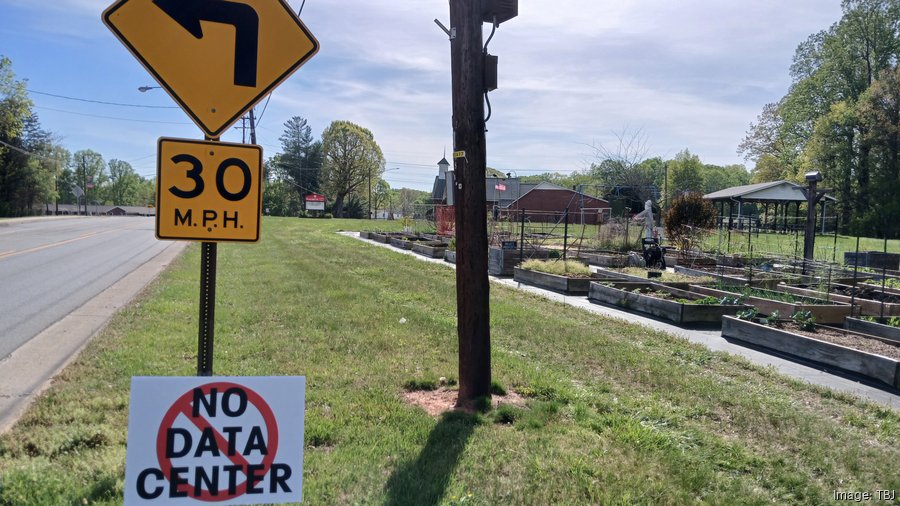
After decades of watching the economic mainstays of tobacco, textiles and furniture wane, rural areas of the Triad are facing a decision on whether to embrace an emerging industrial trend: large data centers driven by the rise of artificial intelligence, online commerce and entertainment.
The combination of power availability, relatively low-cost land, and state incentives launched when the industry was new has drawn projects that are underway or announced in Madison, Walnut Cove and Rural Hall.
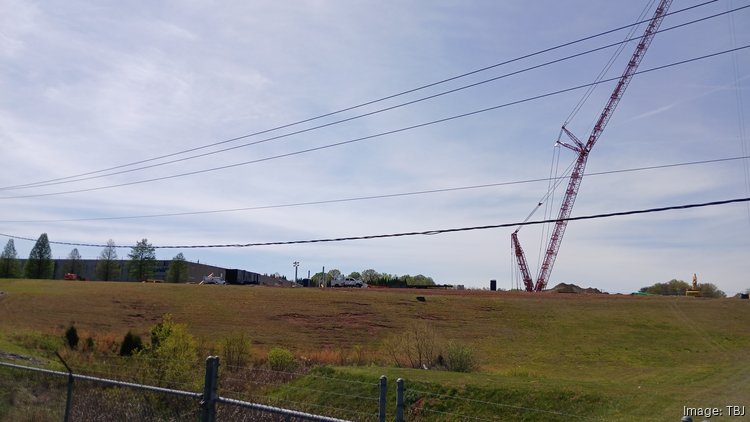
White Fiber is building a 40-megawatt center in a 1 million-square-foot building the Rockingham town of Madison that was formerly a Unifi fiber plant. The company has secured a capacity agreement for 99 megawatts of electric power for the center.
The Madison project is the furthest along of five data centers that have been proposed in the Triad. Two of the other four face at least some local opposition; the other two seemed to have stalled.
In Rural Hall, Charlotte’s Drox Group has filed plans for a data center of 1.3 million square feet known as Project Iron Spur. The Forsyth County/Winston-Salem planning board is scheduled to consider the proposal for May 14. Neighboring Rural Hall’s town council, which has no jurisdiction over the site but whose town hall is within sight of the location, has adopted a resolution opposing it.
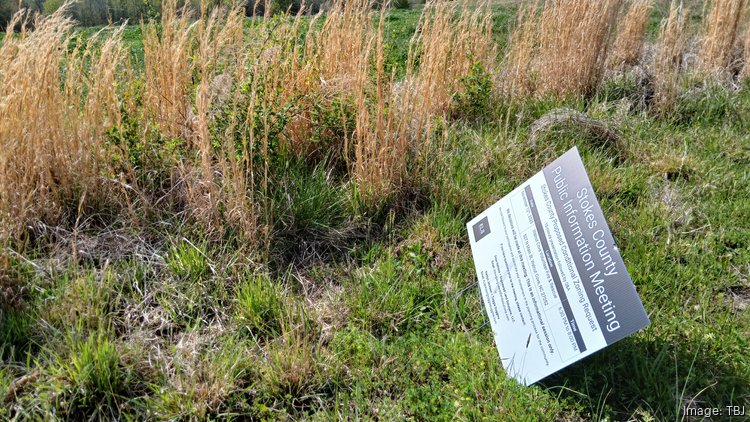
In Walnut Cove, Project Delta faces even stronger opposition. Triad developer David Couch and Charlotte-based Engineered Land Solutions have proposed a $10 to $20 billion data center on an 1,800-acre site in southern Stokes County. After opponents filed a procedural based legal challenge, county commissioners undid their January land-use actions facilitating the project, but the developers say they intend to resubmit.
In Guilford County, two announced data centers of different scale are also still in the works, though delayed.
For the rural communities especially, there's robust debate about the benefits and risks of data centers. Each community is wrestling with questions asked more and more across the country and in North Carolina:
Are giant data centers going to become an economic driver in rural areas?
Is the lure of a greatly expanded tax base and at least some jobs worth the risk of environmental harm and strain on infrastructure?
Are they simply what has to happen with the rise of AI, streaming and online commerce?
“Every time you're on a virtual call, every time you check your smartphone, every time you're on your laptop or your computer, you're interacting with a data center of some sort, for the most part,” said Gordon Dolven, data center research director at CBRE, the national commercial real estate company based in Dallas.
Why now, why here?
Data centers aren’t new to the Triad. American Express, for example, has had a major back-office center in the Rock Creek area of Whitsett since 2012.Announced back in 2010, the nearly 500,000-square-foot center was hailed then as an economic development victory, as it was expected to employ 150 and total more than $400 million of investment.
What’s new these days is the scale of centers and technological improvements that expand where large facilities can be, Dolven said.
Five to 10 years ago, developers of large data facilities were limited to places where multiple data gateways converged. A rule of thumb was they could go only 25 miles outside an urban metro area where there was an internet exchange point where carriers’ traffic would intersect. Technology has advanced, and that’s not true anymore.
The other change is power demand. Not that long ago 10 or 15 megawatts would be adequate to run and cool servers.
“But nowadays, people are building 500-megawatt or 1-gigawatt campuses, which means it's not as easy to procure 500 megawatts as it was to tap into an existing substation that the utility had built already in the neighborhood where these data centers used to cluster.”
Power demand is a major issue for the companies and communities.
The Drox proposal at Rural Hall is on a site adjacent to a Duke Energy substation, with high-voltage transmission lines in place. The Walnut Cove site is within 4 miles of Duke Energy’s Belews Creek generating station. WhiteFiber's site is already served by power because Unifi needed large amounts to run its yarn machinery, but WhiteFiber is seeking more and would pay more to Unifi for the site if it can be arranged by Duke Energy.
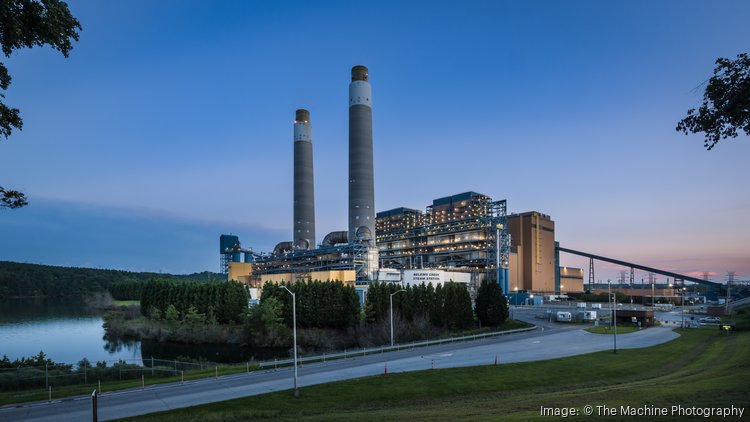
The rise of data centers are part of moves by power providers to build capacity. Duke Energy, the dominant power supplier in North Carolina, has requested a rate increase, which is under review by the N.C. Utilities Commission. The company says its contracts with large customers like data centers have provisions requiring them to pay the costs of delivering their service.
Large sites are needed, too. A ratio commonly cited in the industry is at most 3 megawatts worth of operations can go on an acre, though more realistically it’s a one-to-one ratio, Dolven said.
“So if we're talking about 500 megawatts, we're still talking about hundreds of acres. Even on that three-to-one conversion level, not many industrial sites are built upon needing or requiring hundreds of acres.”
Financing, too, has evolved, from historically venture capital groups to today’s mix of private equity, sovereign-wealth funds and infrastructure funds, asset managers, insurance and financial-services companies, Dolven added.
Government decisions have a role. Northern Virginia’s vaunted data-center corridor exists largely because that’s where the federal government began building its internal internet decades ago, Dolven said. The Covid-19 pandemic and its uptick in data usage was also a factor.
North Carolina also is among a handful of states that offers specific incentives for data center development, Dolven noted.
Under a 2006 law and amended in 2015, North Carolina may grant sales-tax exemptions to qualifying equipment at data centers and on electricity used at them.

Role of state policy
Gov. Josh Stein has called for re-examination of the exemption. An April 6 memo from the state Commerce Department said the agency has issued 37 written eligibility determinations but noted that companies are not required to report the value of their investments beyond the initial proposal or of the value of the exemption on a regular basis.
An energy policy task force, however, used data that is available, such as national industry reports, to put the annual exemptions at $20 million for the electricity and $25 million to $37 million on replacement equipment.
The task force further estimated that if the projected 6,300 megawatt pipeline of potential data projects in the state happen, developers would receive collectively $1.5 billion to $2.3 billion in exemptions purchased during construction. Once operating, they’d get $160 million on power and $205 million to $308 million on equipment replacements.
Other states the memo cited as having similar exemptions are Virginia, Georgia, Iowa, Ohio and Illinois.
Requirements vary: North Carolina requires a $75 million investment; Illinois asks the most, $250 million. North Carolina, Iowa and Ohio don’t require any new jobs; Virginia, Georgia and Illinois do. Illinois requires the building to be carbon neutral or certified under green-building standards.
At a meeting of the energy policy task force, Stein said the policy was put in place when data centers were new, but “those days are long gone.”
Boon to tax base or an unfair burden?
Developers and those who question data centers are making their respective cases.
Project Delta promises to be a good neighbor in Stokes County.
“The counties that are the right fit for a data center have a specific combination of available land, power infrastructure and fiber optic connectivity, and those infrastructure assets can be converted into significant annual tax revenue,” said Drew Nations, founder and CEO of Engineered Land Solutions, the Charlotte-based company shepherding Project Delta, in an emailed statement.
“Project Delta is a prime example of what it looks like when those pieces of their existing infrastructure come together - land, transmission lines, Belews Creek Power Station, and several existing fiber lines. We're committed to being a good neighbor in Stokes County and delivering on this opportunity in a responsible way with enforceable conditions on our development."
Anne Harvey David, chief counsel for environmental justice at the Southern Coalition for Social Justice, one of the plaintiff organizations in the suit over Stokes County’s handling of Project Delta, said the legal action was intended to ensure the request got proper and meaningful consideration.
Beyond that, though, in her view communities need time to consider these massive and long-term investments. She noted that a provision inserted into a Hurricane Helene relief bill in the General Assembly this year, Senate Bill 382, could make it hard for local governments to regulate hyperscale data centers. It requires localities to get the permission of affected land owners if a local action would downzone or newly forbid existing uses.
She suggests a moratorium to give localities time to research and study data centers.
“It's just on such an unprecedented scale, with so many unknowns, including a bunch of unknown unknowns, that a one-year moratorium to study the effects and the potential implications seems generally like a well thought-through policy effort, particularly in light of the prohibition in Senate Bill 382.”