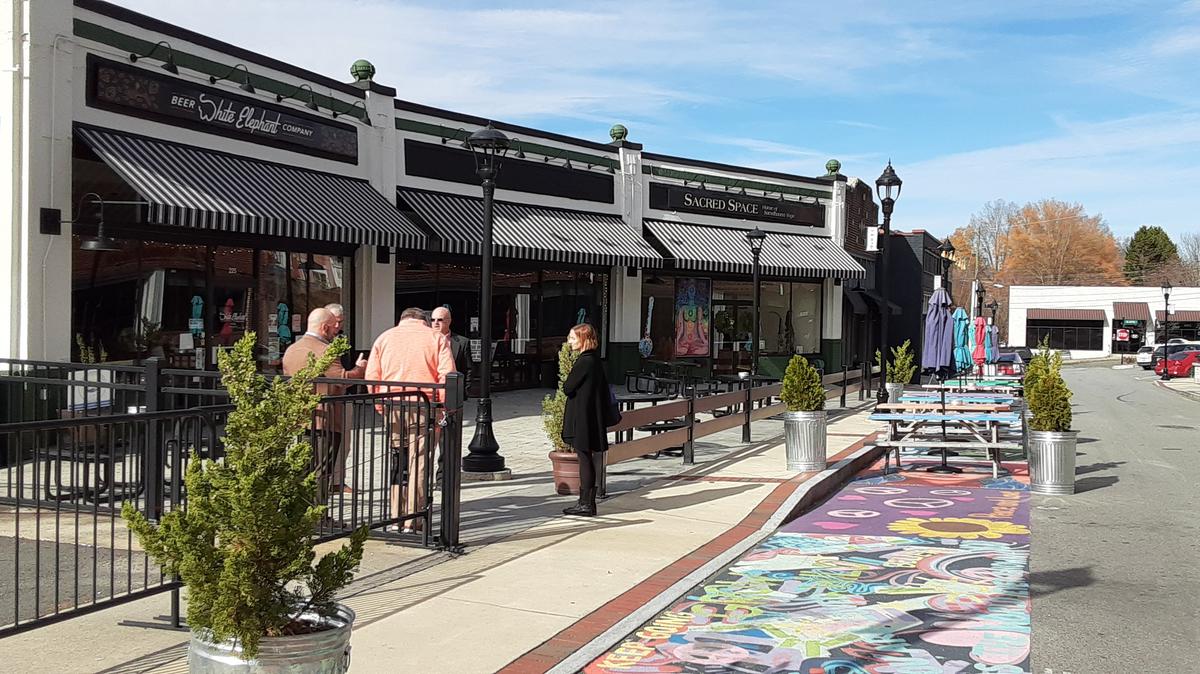
The story is familiar in the Carolina Piedmont: A town grows up around a mill that makes textiles, cigarettes or furniture. The community thrives, people have jobs, they invest in the place and do business with one another; they raise families. It’s home.
Then the economy evolves, technology gets outdated, the mill cuts back and then closes, and the once-proud community is left with an outdated hulk or a sad, vacant hole in the middle of town, as well as a hollowed-out local economy and tax base.
The young people can’t wait to leave for not just job prospects but some excitement and optimism, not to mention more people of their generation.
But what if that looming hulk still has good bones, and the town still has plenty of what at least some of those young people are seeking: authenticity, something real — something that reminds them of home.
You’d have a place like Mount Airy, where it turns out “home” can also be good business.
About 10 years after the start of a renewed push of downtown redevelopment, the Surry County community appears to be thriving. Private investments estimated at nearly $34 million, plus historic tax credits, have helped boost the tax base of the downtown improvement district 55% to $55 million in 10 years.
According to Mount Airy Downtown (MAD), the not-for-profit that oversees redevelopment, in nine years there have been 96 façade improvements, 37 building rehabilitations completed, 26 public improvement projects, 43 businesses created, 17 business expansions, a current occupancy rate of 96 percent, and 90 new housing units.
Now, Mount Airy is entering a new phase. In July, the city got a $2 million state grant toward site preparation and property acquisition for the next phase of redevelopment downtown. And the city has chosen a developer with a plan to redevelop the remaining major part of the former Spencer’s textile mill. Sunhouse Development of Cary has signed a franchise agreement for a Marriott Tribute hotel, and the city hopes to turn an adjacent former car dealership and related buildings into a convention center along with meeting and community space for locals.
What is it about Mount Airy’s efforts that made it work? And what can other Piedmont communities learn about turning their historical assets into a new and better place to come back home to? In a nutshell, it means leveraging authenticity to your advantage.
Taking a chance in the restaurant business
Ask Katie Stevens what she likes about her hometown, and she’ll mention the free old-time music jams at the historic Earle Theater every Thursday evening. She recalls going with her grandparents, and now takes her own children.
February will mark the fifth year for Mi Casa on Main, the restaurant she and husband Christopher opened with her father, Gregg Knight. They survived the shutdowns of the first Covid-19 pandemic wave in early 2020 by adapting to take-out.
Now, they’re embarking on a new concept: a craft cocktail bar that’s less late-night drinking establishment and more a place people can gather and enjoy one another’s company in a welcoming setting. It also can tap into the momentum of downtown’s nightlife district where neighbors include a new microbrewery and a yoga studio. Mount Airy had set aside the block in the late summer of 2020 to open up more outdoor space to help food and beverage establishments make it through. It was before social districts took hold on a wide scale across North Carolina.
“We really just want a gathering point where people slow down, get off their phone, interact with each other and might play a card game, or might just sit and relax and talk, so we're just excited to offer that atmosphere.”
Stevens admits to being one of those who at a younger age couldn’t imagine staying in her little hometown. But not now.
“I think growing up you know we all had that urge to leave, to leave, to leave — and then we all come back. … I have so many friends that are doing the same at this point. When it comes to raising a family or settling down or wanting the slower pace, everybody seems to be coming back. We're still keeping that Southern hospitality and that Mayberry feel with it. It's a beautiful place to live in.”
The take-away for other towns she sees is to adapt but recognize what the place has to offer and build on it.
“You’ve definitely got to change and adapt, but then that doesn't mean you have to lose everything about the old way of doing things.”
Jump in and take charge
Living in Mount Airy was going to be temporary while Lizzie Morrison's husband finished graduate school in Winston-Salem, but she put her arts background – she majored in painting in college – to work with the local arts council. There, she adapted an idea from other communities and organized a project of auctioning off sculptural guitars, banjos and fiddles throughout downtown, and a series of murals downtown.
"Public space became something that was really intriguing to me, and then realizing that that was, in fact, an economic development tool,” Morrison says.
Morrison signed on to lead MAD, a non-profit that contracts with the city to operate the municipal service district, which collects special taxes toward improving downtown.
The city had already started on rehabbing downtown. The first major project was Renfro Lofts, a complex of owner-occupied condominiums in the former Renfro textile mill building, in 2004. It showed on a large scale that historic buildings could be readapted.
"But it also gave people the opportunity to live downtown. We started shifting the nature of the district from being strictly commercial to also being more like a neighborhood,” Morrison says.
Attention then turned to Spencer’s Mill, a 10-acre mill complex that once had 22 buildings. It had started as a tobacco plant but was repurposed for textiles. At its peak, more than 2,000 people worked there. Operations gradually diminished until it closed completely in 2007. It sat vacant for seven years, until it was auctioned off.
Gene Rees, who grew up in the family haberdashery business, bought the smaller tract and developed it into the Spencer’s Lofts condominiums. The city bought the larger tract and sold parts off to a developer who transformed them into 65 market-rate apartments known as Spencer’s Mill. It was completed in 2020.
In 2020, the city formally asked MAD to take over managing the Spencer’s redevelopment.
That was important, because the work had become bogged down, and turning management over to an outside organization helped distance the project from the political realm.
Now it’s the second phase of the Spencer’s property redevelopment that Morrison is shepherding as executive director, along with the MAD board. In 2020, MAD sought proposals; so what that Covid was bearing down.
“We thought, well, 'What’s the harm in having a failed RFP? I mean, we might as well try.'”
A complete proposal came in, and MAD went with it. In January, Sunhouse got the second of three needed rounds of approval from the National Park Service on its application for historic tax credits; it amounts to a green light to go ahead. Such credits can be crucial in making rehabs economically viable, as rehabbing can cost substantially more than new construction in many cases.
"In order to save these historic structures, luckily, the National Park Service has a 20% income tax credit incentive, and then the state has a 40% mill tax credit specific to these old vacant mill buildings,” Morrison said. “The state prioritizes that they wanted these mills to not be torn down, but to be adapted and reused into something vibrant.”
The hotel is planned for a 50,000-square-foot former mill building with an attached 6,500-square-foot building known as the Cube.
In addition to the hotel and conference center, the plan calls for a covered multipurpose pavilion for things like farmers markets, concerts and community events, and a splash pad, sculpture garden and event lawn.
”That’s really to build upon downtown being a second neighborhood for the whole community, but a first neighborhood for the residents that live downtown,” Morrison said.
More broadly, the downtown plan also now includes streetscape improvements and identifying opportunity sites, particularly for attracting investment in workforce-rate housing, Morrison said.
What’s some advice for other places? Morrison says this: Identify assets, which might be buildings, nature, or simply people. She praises the North Carolina Main Street Program for expertise and assistance.
And don’t rely on events. “Those events might be successful in downtown for a day. But they’re not going to sustain the downtown on a daily basis.”
Finally, be patient and persistent. Focus on neither the relative few skeptics or cheerleaders, but on the middle majority and listen to what they value and aspire to, Morrison suggests. In Mount Airy’s case, one desire is continuing to tap interest in TV nostalgia but seeing the broader appeal behind the trend.
"Even if you don't necessarily watch the Andy Griffith Show, generally people understand that ‘Mayberry' means small town America … I hope that what we're doing is helping them to associate Mount Airy with small town America and being this place that feels not rushed, but unique and telling its own story, and is a diverse place with eclectic art and people beyond the Andy Griffith Show association.”
Good buildings recruit good businesses
Gene Rees grew up in the haberdashery business, in a store his father started in 1946. But by the time he started his career, Mount Airy had seen better days. It had lost anchor stores like Belk, Penney’s and Roses; from some four drugstores there was none. Large parts of blocks were vacant. Redevelopment efforts had started in the 1980s, and a consultant had helped find direction toward an entertainment district, but there was much to do.
The city had established the downtown service district; the money was first used to add parking. The city rejoined the N.C. Main Street program in 2013, with Morrison as the first MAD director. Downtown has benefited from focusing first on having good building stock, Rees said.
“Downtowns are first built by having buildings that support the types of businesses you want,” Rees said. “Good buildings recruit good businesses. Bad buildings recruit marginal businesses."
Historic tax credits can help close the gap between rehab costs and what can be earned in rents, Rees said, but relying on private investment has proven best.
"We believe in a large dose of private money and a small dose of public money. We think that private investment requires someone to stay with their investment. If they make a big investment in a building or buildings, likely they're not going to walk away from you."
Rees credits having the service district and strong leadership from Morrison, “a rock star,” in his words, along with a supportive city government with sound commercial code enforcement to maintain buildings. It also helped to figure out how to properly cluster uses: For example, apartments over retail spaces sounds good, but residents’ parking needs might crowd out potential customers.
"We're mindful of that to make sure that our residential focus is not on our main drag of Main Street, but that our residential focus is on side streets where it doesn't impact the parking for the commercial businesses.”
Above all, in Rees’ view, it takes property owners with a long-term view and patience because historical rehabilitation can be complicated and slow.
"Apathy in a town is the one thing that you just can't overcome. If you have property owners who are apathetic about their town, they're not willing to invest for years beyond their years, then the town's going to have challenges, and it probably won't have successful future.”
New space for new ways of working
A Mount Airy native, Mike Brannock built a career in commercial banking in major Southeastern cities before settling in Charlotte. In 2011, he joined WorkForce Unlimited, a staffing company founded by his mother, Teresa Lewis, as chief financial officer. Brannock, who has served as CEO of WorkForce Unlimited since 2014, still lives in Charlotte but spends two or three days a week in Mount Airy.
WorkfForce occupies only a portion of a building at 190 Virginia St. where Brannock is building a new co-working space planned in response to post-Covid need for work flexibility. He said he knows many mid- and late-career people who’ve moved for lifestyle reasons, and understands that talented people increasingly value work flexibility. He's investing just over $2 million in the purchase and renovations of the building.
"Co-working is kind of the essence of flexibility. You can be there long term, you can be there for a few hours or for a day. Or, you know, if you're traveling for work and you're going to be in Mount Airy a few days out of the month, then you've got a place that you can hang your hat and call it your workplace.”
It’s also tied to Mount Airy’s downtown residential and restaurant action.
"The pubs and and breweries … all of that stuff really speaks to building community and bringing folks together," Brannock said. "And I think co-working space is absolutely an appropriate element that fits into building a community around where you eat and drink and where you live and where you work.”
It’s also a prime time to take advantage of trends away from big, expensive cities and to being close to recreational amenities like mountains, wineries and a more relaxed pace. The hotel, too, will be a draw, Brannock predicted.
"When you look at peer towns that are in the 10,000-25,000 population range or even maybe upwards of 40,000 in population, it puts me in a unique position to really be able to draw conventions and groups for events that peer cities or peer towns won't be able to do because they don't have the resources and infrastructure that we will have at that point. So I absolutely think it is a form of economic development."
Monday, February 27, 2023
Bizwomen Mentoring Monday 2023
Women-to-women MENTORING! A powerful and impactful event that you will not want to miss! Make connections and gain valuable industry knowledge from local businesswomen at Mentoring Monday.
Register now
Deadline: Monday, May 15, 2023
Family Business Awards 2023
Nominate a family-owned Triad business!
Submit a Nomination