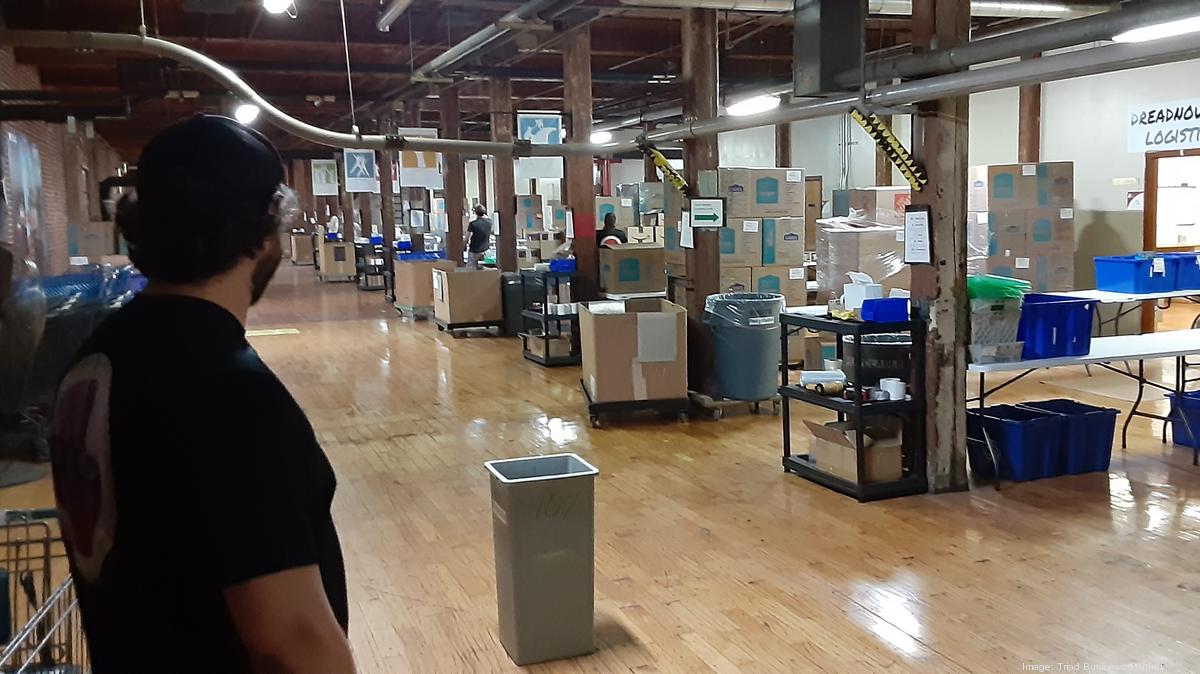
Where once cartons of cigarettes would have been stacked on the still-shiny hardwood floors now stand shelves lined with Lego boxed sets wrapped tightly in glistening clear plastic.
The air has a tangy tobacco scent as workers pick the boxes off the shelf, click their bar-code readers, and place them in their rolling color-coded bins.
There’s a floor and a bin color for each size: One, with blue bins for small packages the size of a brick. Larger boxes, which go into white bins, are a floor down. It makes for much simpler and efficient picking, packing and shipping.
Efficiencies like this are easy to spot throughout the giant million square feet of a cigarette factory in Reidsville that has changed hands in recent decades from American Tobacco to Commonwealth Brands to Imperial Tobacco. Artifacts reflect its history: closed conveyors that look like ventilation ducts for moving tobacco and other raw materials and finished product from one building to another. Parts and tool rooms for keeping the machinery going with in-house repairs. A multistory vertical conveyor looking like a giant corkscrew to easily move goods from the top floors down to the basement shipping level.
The elegance of e-commerce, one of the region’s 21st century’s growth industries, making use of the industrial efficiency of the 19th and 20th is not lost on Evans Richards, who recently showed off the place to a reporter. Richards and his business partners bought the former cigarette factory this past spring and are turning it into a hub of e-commerce and third-party fulfillment.
They are taking advantage of the legacy left behind.
“The amount of efficiency and money the tobacco company put into this facility: we are benefiting from it in insane ways,” Richards said. “They had 130 years to figure out how to make it efficient, and they did a good job doing so.”
Back in action
The million-square-foot complex, whose address is 301 N. Scales St., was bought in May by Talon B LLC for about $5 million, according to Rockingham County property records.
It’s known for its brick smokestack with the famous logo of the Lucky Strike brand of cigarettes. It’s what’s left after ITG Brands, a subsidiary of British Imperial Brands, closed operations there in late 2019 and early 2020. But parts date from the late 19th century. It was once part of American Tobacco Co., the North Carolina-bred corporation known for iconic Bull Durham tobacco and Lucky Strike cigarettes.
Talon is a wholly owned subsidiary of Ascendency Ventures LLC. The principals of Ascendency are also the principals of reVend, a direct-to-consumer third-party fulfillment provider; eVend, a direct-to-consumer marketplace; and Dreadnought Logistics, a specialized motor carrier. Richards is the CEO of reVend and managing partner of Ascendency Ventures.
Ascendency has so far invested around $8.5 million with the amounts beyond the purchase going to improvements, equipment, and buying several properties in the Triad to help workers who moved find housing, according to Richards.
It won’t all happen immediately, Richards said, but if it goes as planned, the complex will employ 100 to 120 people, at an average hourly pay of $17 to $21.
That won’t replace the payroll of the cigarette factory at its late 20th century peak of some 1,000 workers — it had only about a tenth of that when it closed nearly three years ago. But the payroll represents a toehold in a growth industry, and it keeps the complex in productive use.
Rockingham County has had successes recently in economic development, with Nestle Purina taking over the former Miller-Coors Eden operation, and Belgian Ontex Group opening south of Stokesdale, among other new and expanding employers.
Reidsville has made made gains, too, and moved away from dependance on one industry.
In recent years it gained a site for Pella Windows, and a variety of manufacturers including frozen-entrees maker Dorada Foods, engineered-components maker Henniges Automotive, Mauser Packaging, hygiene products company Albaad, packaging company Amcor, and industrial-equipment company Sanritsu Logistics. Even so, its economic indicators lag behind the county and state.
The U.S. Census Bureau puts Reidsville’s median household income at $35,802, compared to $45,697 for Rockingham County, and $56,642 for North Carolina. In Reidsville, the Census Bureau says 23.5% percent of residents are in poverty, compared to about 13% for Rockingham County and the whole state.
But getting the former cigarette factory back in use is about more than jobs. The complex dominates the northern end of the town’s skyline and takes up the entirety of a double city block. It could have sat empty and deteriorated, noted Leigh Cockram, director of economic development and tourism for Rockingham County.
“That's a strategic piece of property and a historic property in the city of Reidsville,” Cockram said. “We all feel very fortunate that they were interested in the building and were able to buy it and not have that building sit on the market for years.
“They see value in the building, and want to be a part of keeping that building as an anchor piece in Reidsville. They are very mindful of wanting to help revitalize and give life back to that space.”
From tobacco to toys
In parts of the complex, a tobacco scent remains. The wooden floors in many parts look nearly new, shining like a basketball court.
The site consists of three main buildings, Richards said. One section of about 450,000 is occupied by reVend, which was originally located in central Virginia and had three warehouses there.
Warehouse Republic, a third-party logistics company from California specializing in palletized storage, is occupying about 220,000, and cloud-storage provider Lucky Storage expects to use about 10,000 square feet when done with its build-out.
An industry specialist has the remaining cigarette equipment on the market.
How that and some outlying parts will be used are to be determined, but Richards said there’s been interest from concerns who could use features such as the complex’s own natural-gas boilers, two electrical substations, and rail siding.
But for someone in e-commerce, it’s just about ideal.
ReVend is a fulfillment and third-party logistics company, Richards said. It works in direct-to-consumer orders: If you buy certain goods on Amazon, reVend fulfills the order. A worker takes the item from the shelves in Reidsville, puts it in a rolling bin with similarly sized items, and they’re gathered and shipped.
The largest client of reVend is West End Toys, which carries out online fulfillment primarily for small, mom-and-pop toy stores too small to do it themselves. The products are both toys in the usual sense, but many are for the collectible market.
Quality control is essential: Not only must the products and their packaging be in prime condition; there can’t be mistakes that would send a collector who ordered a $500 Lego set the mass-market $50 package instead.
Warehouse Republic does much the same, but in the business-to-business realm. It and reVend work together: If reVend gets a business-to-business order, it sends it to Warehouse Republic; if Warehouse Republic gets a consumer order, it has reVend carry it out.
“For example, if they need to do direct-to-consumer shipments, they can just flow them up to reVend we can take care of them for them. If we need to do b2b work, we can flow that downstream to Warehouse Republic, and they can take care of that.”
“Really what we've been trying to build this facility into is a thriving e-commerce ecosystem.”
Toys are on the higher, lower-ceilinged floors, but a part of the complex consists of tall storerooms big enough for multilevel shelving of the kind common in recently built logistics operations.
Location was key
The location is excellent, too, Richards said. Being near Piedmont Triad International Airport and its giant FedEx sorting facility is a huge asset, Richards said. Also helping is being near the U.S. Postal Service’s Triad facilities. Richards credits it as one of the largest and most efficient packaging processing facilities in the Postal Service.
“That is huge for direct-to-consumer shipper like us. They are truly one of the better package processing USPS plants.”
ReVend doesn’t do the volume that would justify the extensive automated equipment seen in many modern logistics facilities, Richards explained.
He credits the former owners with maintaining it very well.
“We inherited a building that, though it might be old, is actually in incredibly good condition. And pretty much we just had to clean the tobacco dust out and set up our unique operations here and it's very functional. Even with its age, it's very functional.”
The complex is an amalgamation of buildings. The oldest was built in 1892; the youngest a century later, Richards said. As the owners look ahead to how to use the facility, they know that the iconic smokestack will stay. It’s 210 feet high, and even if the new owners wanted to remove the Lucky Strike logo, that would be a project. It’s not painted, but a mosaic, with the lettering in white bricks.
More to do, but …
Getting operations up and running wasn’t easy. Inventory had to be moved from the Richmond area, and it took months of planning to get the internal logistics down. E-commerce work began in June. There’s a lot more to do, but the busy pre-Christmas season is coming soon, and some projects will have to wait, including getting the vertical conveyor back in action. It’ll need some oil and basic maintenance, but Richards expects it’ll be in use sometime after the seasonal rush and is another huge asset of the legacy left by tobacco.
“They were sorting it by carton type; we'll sort it by ZIP code when it makes it to the basement. But it has the functionality of what we need for the conveyor system, which is crazy.
“And that's something that is allowing us to scale, and will allow us to hire more people quicker, because for us organically to install something like that would have been $10 million plus, which we probably would not have chosen to do for years to come. But having that in this facility already allows us to scale our direct-to-consumer volumes significantly from the get go.”
TIMELINE: FROM TOBACCO TO TOYS
A selective history of the journey of a tobacco factory built 130 years ago now serving as an e-commerce distribution hub.
- 1870s: Brothers Frank and S.C. Penn establish the F.R. Penn Tobacco Co. to make chewing and smoking tobacco after Frank moves from Patrick County, Virginia. Chewing plug brands included Penn’s Natural Leaf and Penn’s Red Jay, and smoking brands included Gold Crumbs and Queen Quality.
- 1892: The first building at the current Reidsville site is built.
- 1911: American Tobacco of Durham acquired F.R. Penn as it absorbed other tobacco makers until forced to give up certain subsidiaries under federal anti-trust law; Penn in Reidsville was retained.
- 1916: Frank Penn’s son, Charles A. Penn, who had worked with his father, became vice president of manufacturing at American Tobacco and developed a blend of tobacco for Lucky Strike, which had originated with another company, and persuaded company leaders to build a new factory in his hometown of Reidsville. Penn is credited with boosting advertising for the brand and with originating its advertising slogan “It’s toasted,” a reference to heat-curing tobacco leaves. He enlarged the Reidsville plant, which became the principal site of production for American Tobacco.
- 1995: Brown and Williamson Tobacco, founded in Winston-Salem but now part of London-based British American Tobacco, acquires the Reidsville plant.
- 1996: Brown and Williamson sells the Reidsville plant to Commonwealth Brands as part of an antitrust settlement over Brown and Williamson’s acquisition of American Tobacco.
- 2007: Imperial Tobacco of London buys Commonwealth Brands.
- 2015: Imperial creates ITG Brands as it adds cigarette brands to Commonwealth.
- 2018: ITG Brands announces plans to close its Reidsville plant and move production to Greensboro by early 2020.
- 2022: Ascendency Ventures, through a subsidiary entity, buys the former plant. E-commerce activities, including the picking, packing and redistribution of toys and collectibles, in May and begins operations the following month.