They’re called “clamshells.” They’re the clear-plastic often standing between us and our newly purchased electronics. Sometimes annoyingly hard to open, they serve the seller’s purpose of protecting their product yet allowing it to be displayed for sale.
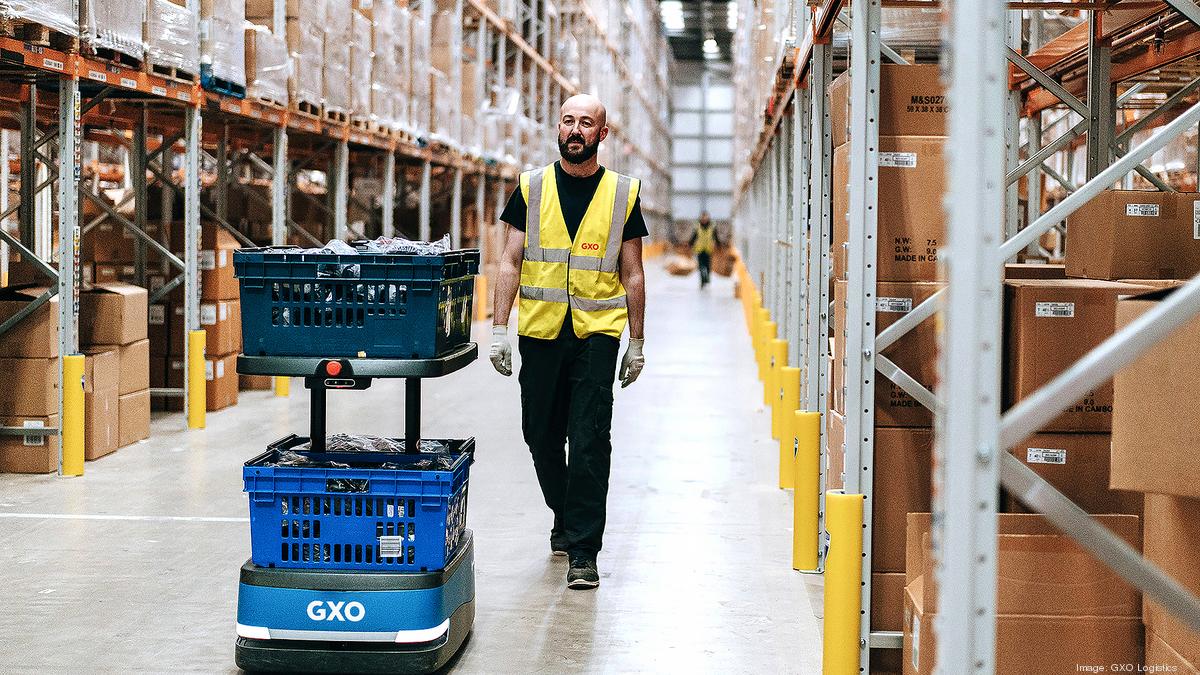
The issue for Kidde at its distribution center in Graham was that some of its smoke detectors were coming from Asia in clamshell packages labeled and priced for a previous season of the retail year. And the clamshells themselves took up more space than necessary in shipping boxes. This was pointed out by GXO, the company hired to improve how Kidde moved and tracked its goods.
“What we showed them were two things: One is you don't put it in those clam shells in Asia. You can stack it better in a container so you can put more on a ship and you can save money on shipping,” said Bill Fraine, chief commercial officer for GXO. “And then once you get them here, we can put everything in a clamshell very quickly at the end of the month or the end of the quarter. So we will always have it priced correctly, always have it labeled correctly, and you won't have all this stuff hanging around."
Shipping and logistics are hardly new to the Triad. It’s long benefitted from geographic luck: precisely at the mid-point of the densely populated Eastern Seaboard but also a half-day’s truck trip from the industrial heartland around the Great Lakes. It's linked to the rest of the country and the world in a network of interstates and other high-capacity highways hard to beat anywhere the in Southeast, and has major airports at hand and ocean terminals just a few hours away.
The combination contributed to building a significant shipping sector in the Triad supporting tobacco, textiles and furniture industries and their successors in automotive, health care and more recently electronics and semiconductors. Its infrastructure and location are why FedEx put one of its major overnight air cargo hubs at Piedmont Triad International Airport. It’s why there is a nearly constant stream of new distribution centers along Interstates 40, 85, 73, 74 and. 77, such as the North Carolina Commerce Park in Alamance County. And leftover industrial infrastructure combined with location and shipping services are why a group of Virginia investors last year bought a 100-year-old cigarette factory in Reidsville to establish a specialized third-party fulfillment center in Reidsville, repurposing old tobacco-handling equipment to 21st century consumer products like collectible Lego sets and movie posters.
The Triad’s logistics industry is plugged into trends driving its growth economy-wide. The job classified as logistician is expected to grow 28% in numbers nationally from 2021 to 2031, compared to a 5% growth for all occupations, according to the U.S. Bureau of labor Statistics’ Occupational Outlook Handbook.
High demand for jobs
“Previously, logistics and sourcing and all that might be more global, but because of the pandemic, I think many U.S. companies are looking for more local alternatives because time is of the essence even if it is a little bit more costly alternative,” says Vidyaranya Gargeya, head of the Department of Information Systems and Supply Chain Management in the University of North Carolina at Greensboro’s Bryan School of Business and Economics.
There are more than 150 majors in supply-chain management at UNC-G, Gargeya said.
“They are getting jobs in purchasing, materials management, logistics, sourcing, supply chain management, even project management, quality.”
But the industry also offers opportunities for people without bachelor’s or graduate degrees or in some cases community college study, Gargeya added. The training is typically done on the job or is transferred from other industries. However, the work isn't for everyone, Gargeya noted. Most of the jobs require being physically present. It also helps to have a good sense of time and how quickly particular tasks take, a desire to consistently do quality work, and an ability to track costs. It's a relatively rare combination, but it’s also why such workers are in demand at companies like FedEx, Gargeya added.
“Basically, they're saying you come in to work on the line of moving materials and stock and loading an aircraft,” Gargeya said. “‘While doing that, we will pay for your education to go to college,’ because they promote internally to a supervisory role, or analytics role or taking care of a database or something like that.”
Some 48,540 people work in transportation and materials handling occupations in the Greensboro-High Point, Winston-Salem and Burlington metro areas, excluding airline pilots and local and inter-city bus drivers, according to data maintained by the N.C. Department of Commerce and U.S. Bureau of Labor Statistics. That’s out of about 640,400 people on payrolls in the two areas.
Based on 2021 data, median annual pay was $41,210 across more than two-dozen occupational categories in the employment cluster, ranging from $61,480 for front-line supervisors in greater Winston-Salem to $31,240 for hand packers and packagers in Greensboro-High Point.
Logistician median pay as of 2021 was $77,030 a year, with typical entry-level education being a bachelor’s degree, according to the U.S Bureau of Labor Statistics.
GXO as one example
GXO is in that arena.
GXO began as New Breed Logistics of High Point. Acquired by Connecticut’s XPO Logistics in 2014, it was spun off in 2021 as GXO. Gargeya said he began studying it when it moved mail for the U.S. Postal Service and figured out how to profit from getting empty mail-shipping baskets and bags from Greensboro to where they were needed in cities like Boston and Washington.
GXO is a specialist in a relatively new industry: third-party logistics. It’s not a shipping company; it doesn’t own trucks, cargo planes or rail cars, and it’s not an agent lining up space on the next vehicle out of town.
Instead, GXO makes its money by improving efficiencies, taking over costly support work outside clients’ core competencies, and boosting sales or both enough to justify the price of its service.
One of its clients is aircraft giant Boeing, which in turn works with Bell Aviation on the Osprey military helicopter in Rocky Mount.
“We bring all parts in, we inventory all the parts, we then ship those parts to the line where they're working,” Fraine said. “And then we take the completed product, we ship the completed product out. So we're the supply chain of that site.”
If a company’s operation involves handling goods, GXO might be interested in doing it. It has taken over much of the returns operation for athletic shoe and clothing company Nike and for cell phones for Verizon. GXO steps in, receiving returned goods, cleaning or restoring them, and putting them back into the sales chain on behalf of the brand. It does the same for Verizon and returned cell phones, and for Boeing and its many aircraft parts so each company can focus on its core work.
“We're the ones who come in and say to Boeing to Nike, Verizon, 'look, you don't need to do any of that work. You guys go sell. Anytime a phone comes back, we'll take care of for you. We'll repair it or we'll get it refurbished. And we'll get it sent back into the market at least impact on the earth.'"
“We learn a lot and we're really good at it so we can be more efficient and we can be more effective than they could ever be on it … The amount of money that we charge Nike is a nit compared to the amount of value we get back to Nike.”
An extension of client's company
It can get granular to the level of planning where to build distribution centers. The difference between two sites might be small, but over years of mass merchandising, it adds up.
“We know that on average in this ZIP code or this location in this area, Kidde is selling this many smoke detectors,” Fraine said. “We share all that data back and then we sit down and we do business analytics with them and say, 'OK, here's how we're doing and how can we truck this differently to that point and save money. So you’re trucking one truck to Bethlehem, Pennsylvania and another one to Philadelphia; we've looked at this, and you can use one truck and truck it all' … Our role is to make our customer better. We kind of become part of my customer's company.”
For furniture seller IKEA, GXO suggested using a third party’s packaging machine designed to make shipping boxes closely proportioned to the goods inside. It saves packing material but also allows more product to fit on trucks and cargo planes.
“It looks like a big roll of cardboard,” Fraine said. “It knows the size of this thing and creates exactly the size box that would go around this. We reduce their air -- air on a truck, air on a plane: it costs you money.”
The varied roles in the company mean it’s a place where entry-level people can learn, build their skills sets and consistently take on new and higher paying roles and responsibilities, Fraine says. He offers himself as proof: A Boston native, he started with a startup with a strange name and business model that claimed it could ship anything anywhere overnight. Federal Express, now FedEx, did it by building a hub-and-spoke cargo network, and Fraine tagged along, being entrusted with increasingly larger operations in the Midwest and Plains and eventually landing, after a brief foray with a software company, with New Breed in Greensboro.
“In the industry, long-term trained employees are critical, because the better you are at something, the more that the aerospace or the retail companies want to do business with you,” Fraine said.
“You might come in as an hourly employee and four months later, you're what we call a lead: you’re leading, not managing, but leading the process with more people. You can work up through the company and find yourself in the roles where you can be a site leader, we would call it. You're running that site, and then you can transfer. You can go to take a bigger site in LA or somewhere. You really have a wide variety of jobs you can do and it's really about your ability to do it. … This is a job where you can make a great living and work your way through the business.”
Largest Triad Third-Party Logistics Firms
Ranked by Triad employees
| Rank | Business name | Triad employees |
|---|---|---|
| 1 | FedEx | 3,600 |
| 2 | UPS | 2,577 |
| 3 | Inmar Intelligence | 830 |
| View This List | ||
Largest Triad Trucking Companies
Ranked by Triad employees
| Rank | Business name | Triad employees |
|---|---|---|
| 1 | FedEx | 3,600 |
| 2 | Old Dominion Freight Line Inc. | 1,678 |
| 3 | Best Logistics Group | 650 |
| View This List | ||
Thursday, January 12, 2023
2023 North Carolina Economic Outlook
Join the three NC Business Journals for lunch and hear Domino's CEO, Russell Weiner interviewed by Dr. Nido Qubein, President of High Point University. A panel of local experts will share data you need to grow your business in 2023.
Register now
Deadline: Monday, April 3, 2023
Triad C-Suite Awards 2023
Triad Business Journal's awards program will honor CEOs, CFOs and COOs in the region for their performance, innovation and leadership.
Submit a Nomination