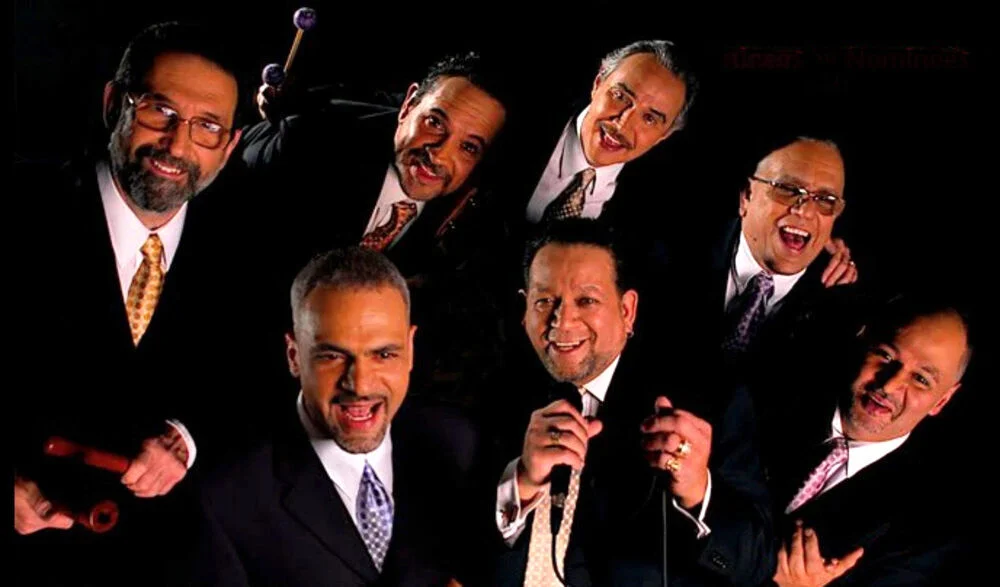

Musicians naturally evolve, but not many bands can go on hiatus for decades and return to an even greater popularity than they enjoyed in their day.
That’s what has happened for the New Swing Sextet, a New York-based salsa, jazz and pop band that will be performing a special gig at eBar on Saturday, July 8.
NSS began playing the New York City club scene in the mid 1960s and went on to record four albums under the Cotique label before breaking up in 1979. There was no intention to reunite, but approximately 15 years ago, an old friend asked them to play one night for an event in Spanish Harlem. They agreed, content to do a gig or two a year.
The band’s schedule picked up in 2003 when they met international DJ Henry Knowles, who convinced them that people around the globe wanted to hear the band’s sound. By 2005, NSS was at it full-time – and getting back into the groove, despite an entirely new musical landscape, wasn’t all that difficult.
“It’s been a wonderful run,” says George Rodriguez, the only original member who sings, plays vibes for the new edition of NSS, and is the official band historian. “We thought we would have to reinvent our sound to be relevant, but DJ Henry Knowles, who rediscovered us (and went on to manage the band), told us that no one was playing our style anymore.
“And that if we kept it as it was, it would essentially be fresh and different.”
That faith, to play what they knew, was a smart move. NSS has thrived and even had a Grammy nomination in 2009 in the Best Tropical Latin Album category for the appropriately titled “Back on the Streets…Taste of Spanish Harlem Vol. 2.”
The 2013 follow up “Yesterday, Today and Tomorrow” also received critical acclaim.
You might be interested in
It’s been an amazing rise given the band started over 50 years ago. In 1965, New York City was a hotbed for soulful, salsa musicians looking for a club to play in. It was in that talent-rich environment that the NSS got its start. Performing alongside legendary names like Tito Puente, Eddie Palmieri, the Joe Cuba Sextet, Johnny Pacheco and Ray Barreto, NSS built a reputation and a solid following into the 1970s.
“Almost all of the New York clubs featured live music and many venues had two or three bands a night,” says Rodriguez. “What a wonderful education we got and what a great fraternity of musicians that we enjoyed being a part of.”
It officially came to a halt in 1979. Rodriguez says two original members were lost in the Vietnam War and a third, lead vocalist Pete Ortiz, returned to his native Puerto Rico.
Harry Justiniano (vocals/bass), Angel Justiniano (vocals/congas) and Hector Ortiz (percussion) have been with NSS for over 45 years, while Conal Fowkes (keyboards), Orlando Ortiz (lead vocals) and Jimmy Figueroa (vocals/timbales) joined when the band was remade over a decade ago. There are indeed seven official members now and while they entertained the idea of changing the name to New Swing Septet, they joke that because they’re “old guys,” they simply forgot how to add.
The Guelph gig at eBar, a local salsa hotspot, is part of a three-stop trip to Canada, which includes performances in Toronto and Montreal. In fact, NSS’s first international trip ever was to Montreal in 2006, so despite having travelled the globe in the past decade, Rodriguez says that Canada holds a special place in their hearts.
“When we first got together again, DJ Gury Gury (Guelph local salsa DJ and a radio host on cfru.ca) reached out to us,” he says.
“We had met him at an event in 2008 in Chicago and he has been a friend, ally and supporter ever since.
“Canada has wonderful dancers, DJs and very knowledgeable and enthusiastic audiences. It was wonderful performing and partying with all of our friends here and we’re looking forward to our time in Montreal, Toronto and Guelph.”
To know there are places that appreciate the salsa sound and culture is important for Rodriguez. That environment they were originally accustomed in the 1960s is essentially no longer.
“The big difference between when we started performing in 1965 and now is how few venues exist, even in New York,” Rodriguez says. “When we started, there was live music on literally every block. It was a wonderful time to be a musician in New York City. Every neighbourhood had Latin dance halls and small clubs.”
And while they returned to the salsa scene with their original sound, Rodriguez says NSS is entering a new phase of their own. And he expects the music to grow.
“We’ve been back together in earnest for over 10 years and have recorded two new studio LPs,” he says.
“We’re working on a new studio album that will start showing an evolution.”