Last year broke pretty much every high-temperature record in the book. And on Friday, NASA and the National Oceanic and Atmospheric Administration confirmed the worst: 2023 was the hottest year in recorded history.
"The findings are astounding," said NOAA's chief scientist Sarah Kapnick during a press event on Friday. "2023 was an extraordinarily warm year."
NASA found that the global average temperature in 2023 was 1.17 degrees Celsius above the 1951-1980 baseline, beating out the previous record set in 2016 by 0.16 degrees. The last nine years have been the hottest nine years in the temperature record, which dates back to the mid-1800s.
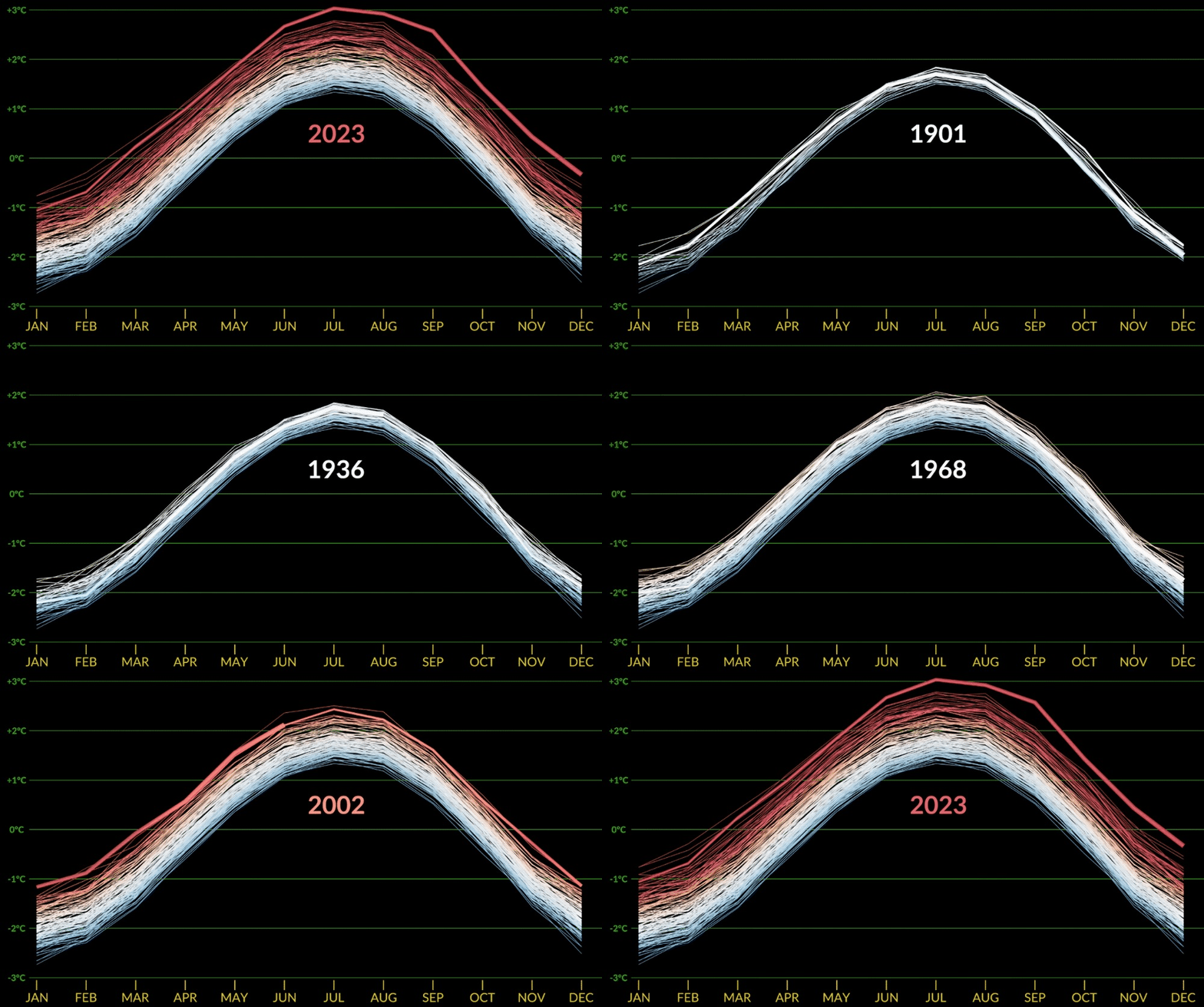
NOAA arrived at a slightly different temperature anomaly, at 1.18 degrees above a 1901-2000 baseline, again beating out 2016 by 0.15 degrees. In both cases, 2023's position atop the ignominious list of warmest years is secure and unquestionable.
Last year beat out the previous record "by a whopping origin point one five degrees Celsius," said NOAA's Russ Vose during the briefing. "That's really big. Most records are set on the order of a few hundredths of a degree. So this is a big jump."
Earlier this week, the European Union's Copernicus Climate Change Service reported similar results, and found that 2023 had surpassed previous records by a "large margin." The United Kingdom's Met Office agreed, reporting that the year was 1.46 degrees Celsius above pre-industrial levels.Though temperatures approached the 1.5-degree target set as an ambitious warming limit in the 2015 Paris Agreement, a single year would not be enough to eclipse the target. Instead, it is more concerned with long-term averages; scientists do think that it could be surpassed by the end of this decade, however, or by the early 2030s.

The truly extreme warming began in June, after which every month of the year set its own record as the warmest such month in history. Along with climate change (which some scientists say is accelerating), the arrival of El Niño — a warming weather system — in the summer helped push temperatures to those extremes. And with that weather pattern forecast to stay at least through the spring, 2024 could be even hotter. Vose said that NOAA's models suggest a one-in-three chance that this year will beat out 2023, though there is a 99% chance it will rank in the top five warmest years. He urged caution on such predictions, though — last year at this time, NOAA thought there was only a 7% chance that 2023 would top the warmest years list.
Looking back at the year now, as each passing month pushed the year's average up to and beyond previous records, shows how even with the best models the climate can continue to surprise us. "We're frankly astonished," said Gavin Schmidt, the director of NASA's Goddard Institute of Space Studies.
He pointed out that the record-breaking temperatures began earlier in the year than when El Niño's influence began to pick up, which upends expectations based on previous years. "That uncertainty... as a scientist is kind of exciting," he said. "But given that we're talking about the world's climate and ongoing climate change, it's also a little bit disconcerting."