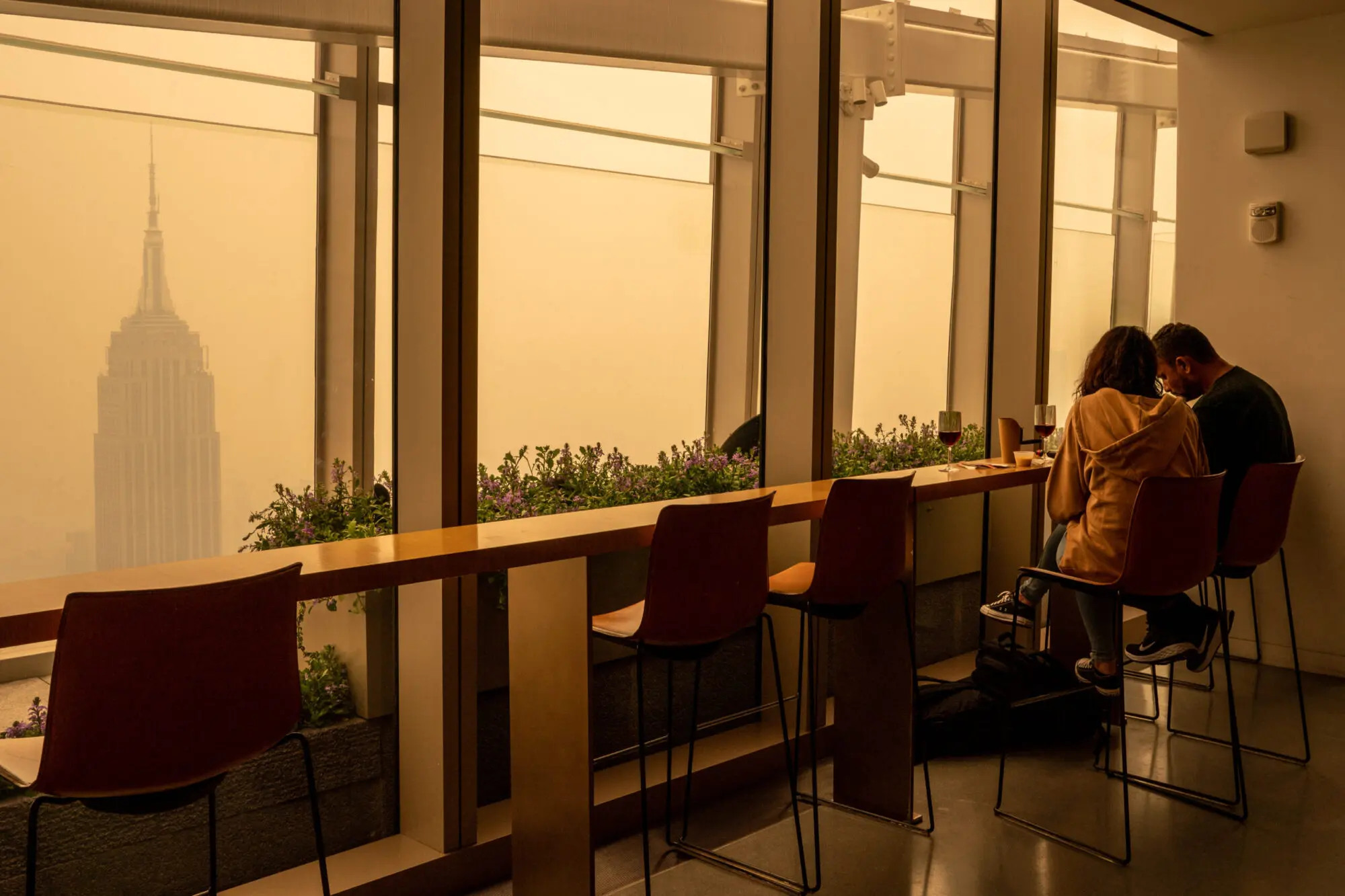
Air quality alerts blew up the phones of millions of Americans this week as wildfire smoke from enormous blazes in Canada drifted south and turned New York and Washington D.C. into some of the most polluted cities in the world.The public health advice was clear: Stay indoors if possible. But the inside of a house, or school, or office building isn’t totally isolated from the air outside, and the risk didn’t drop to zero once the door or window was closed.
The heightened attention to indoor air quality echoes concerns about ventilation and filtration of public buildings during the height of the COVID-19 pandemic – and the mixed progress in addressing the problem.
The Messenger spoke with Jonathan Levy, a professor and chair of Boston University’s department of environmental health, about how wildfire smoke can affect indoor air, what can be done about it, and what lessons the pandemic have offered when it comes to air we breathe inside.
This interview has been edited for length and clarity.
What's known about the impact of wildfire smoke on indoor air quality and how it can impact health?We know that wildfire smoke can infiltrate indoors just as a lot of particulate pollution can. And as we spend 90 percent of our time in indoor settings, this is the place where we're exposed to the bulk of wildfire smoke and any other outdoor-generated air pollution. Our homes, our offices or other buildings are really the places where we need to think about exposure to wildfire smoke and how we should try to best mitigate it.
In terms of the specific health impacts, is it much the same as what to expect outdoors, just on a different scale?It's pretty similar. You're being exposed to the same pollutants at maybe different levels in the indoor setting, but it's where you're spending the bulk of your time. So, certainly worried about respiratory health effects, especially among people who have asthma or chronic bronchitis, other respiratory diseases. People who have preexisting cardiovascular disease are certainly at heightened risk for heart attacks and other health effects.
How can people protect themselves inside when it is smoky outside? What are some of the measures that can be taken? If you have something like central air conditioning, running something with a MERV 13 filter, a more powerful filter, is helpful. Using a portable HEPA filter is also quite advantageous if you have one, especially if you don't have central air conditioning. That helps to clean the air quite well. Those systems are really designed for particulate pollution and smoke like this, so it really can be quite helpful. And then there's other smaller steps that you can take to try to reduce the amount of smoke that is infiltrating from the outdoors to the indoors.
Some of these measures sound a lot like what people were advocating for during the height of the pandemic. What did COVID tell us about the importance of indoor air quality and approaches to improve it?I think we recognized early on that COVID was transmitted through the air, usually indoor air because it was in the aerosol phase — that meant that it was basically traveling on very small particles that could linger in the air, and so ventilation and filtration were very important tools to get SARS-CoV-2 out of the air and reduce the risk of COVID transmission.
These wildfire smoke particles are also in the aerosol phase. That's one reason why they're able to travel thousands of miles and get from Quebec to New York City to Indiana. So the same tools and techniques that can remove the aerosols that we're dealing with for COVID can also remove these aerosols for wildfire smoke so again it's really important to have ventilation and filtration strategies in mind
What's your sense of how much progress there has been in the wake of the pandemic in terms of improving indoor air quality, maybe in schools or office buildings or other places where people do spend a lot of their time? Have there been significant steps to improve the situation?It's a really good question. There definitely has been heightened attention and there have been a number of places that have made investments to improve ventilation or filtration, in large part motivated by the pandemic. Places that made those investments will see a lot of different benefits — you're addressing wildfire smoke, there's a lot of separate evidence that shows better ventilated and cleaner air can improve children's cognition and work performance in school.
Hopefully, with tens of millions of people seeing extremely high wildfire smoke exposures, that elevates once again the importance of indoor air and helps people recognize that we do need to make systemic investments in healthier indoor environments.
What are the prospects looking ahead on these issues?There are certainly encouraging signs. There was the White House Summit on indoor air quality that occurred and that gave more relevance to the topic. CDC, ASHRAE [American Society of Heating, Refrigeration, and Air-Conditioning Engineers], and others have been talking about standards that are more health-based standards for indoor environments, and there's a lot that's happening at the state level to really enhance focus on indoor air quality and put structures in place to to ensure healthy indoor spaces. So I do think we're on a positive path.
I think we sometimes get susceptible to playing whack a mole and say ‘Let's deal with COVID. Now over here, let's deal with wildfires. Now, over here, let's deal with gas stoves.’ You could certainly imagine scenarios where people exclusively focus on indoor sources and try to put systems in place that really draw in outdoor air as quickly as possible, which is great if you're dealing with indoor sources, but lousy if you're dealing with wildfire smoke and so you need systems that are going to acknowledge the importance of both indoor and outdoor sources and can ideally perform adaptively.
That's interesting, that the response to COVID is not necessarily exactly the same as a response to wildfire smoke or other issues, that you can’t really just pick and choose.Exactly. We want healthy indoor spaces in our schools, homes, offices and elsewhere. And there are a lot of factors that could affect healthy indoor spaces: wildfire smoke, infectious diseases, mold, gas stoves — there's a long list. You don't want to solve two problems and create two other problems. You want to think across the board of how we make our indoor spaces — ideally by design, or where needed by retrofit — as healthy as possible.