The world’s backward slide on fossil fuel subsidies in one chart.

In late 2021, the countries of the world signed onto the Glasgow Climate Pact, a U.N.-sponsored agreement that listed as a goal the “phase-out of inefficient fossil fuel subsidies.” It was an acknowledgment that various flows of money have distorted the true cost of coal, oil, and gas and slowed the transition to clean energy.
More than a year later, the world is going backward. The International Energy Agency reported that subsidies for fossil fuel consumption doubled from 2021 to 2022, with the total last year topping out at over $1 trillion for the first time. An IEA analysis found that much of the subsidies “were not well targeted” to the world’s poorest or most vulnerable people. And though the subsidies did likely save some consumers money on energy bills, “they artificially maintained fossil fuels’ competitiveness versus low-emissions alternatives.”
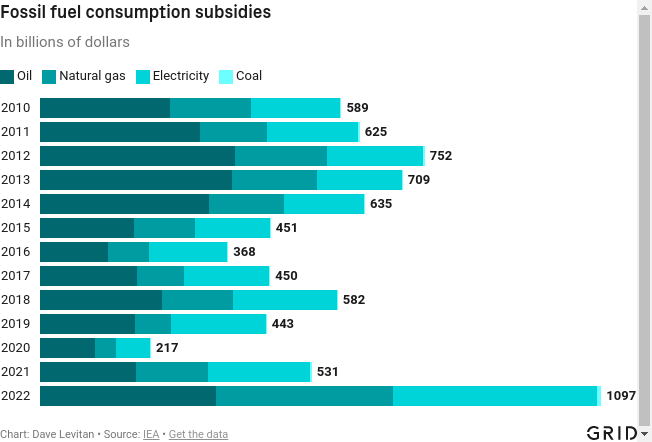
The skyrocketing subsidies are a direct result of the global energy market turmoil caused by Russia’s invasion of Ukraine, according to the IEA — turmoil that helped the oil industry soar along with those subsidies to enormous record profits. The desperate response to a crisis demonstrates the danger of continued reliance on fossil fuels and how more forward-thinking policy would make last year’s spike less likely in the future. “It is far better for governments to spend time and money on structural changes that bring down fossil fuel demand, rather than on emergency relief when fuel prices go up,” IEA analysts wrote.
Thanks to Lillian Barkley for copy editing this article.