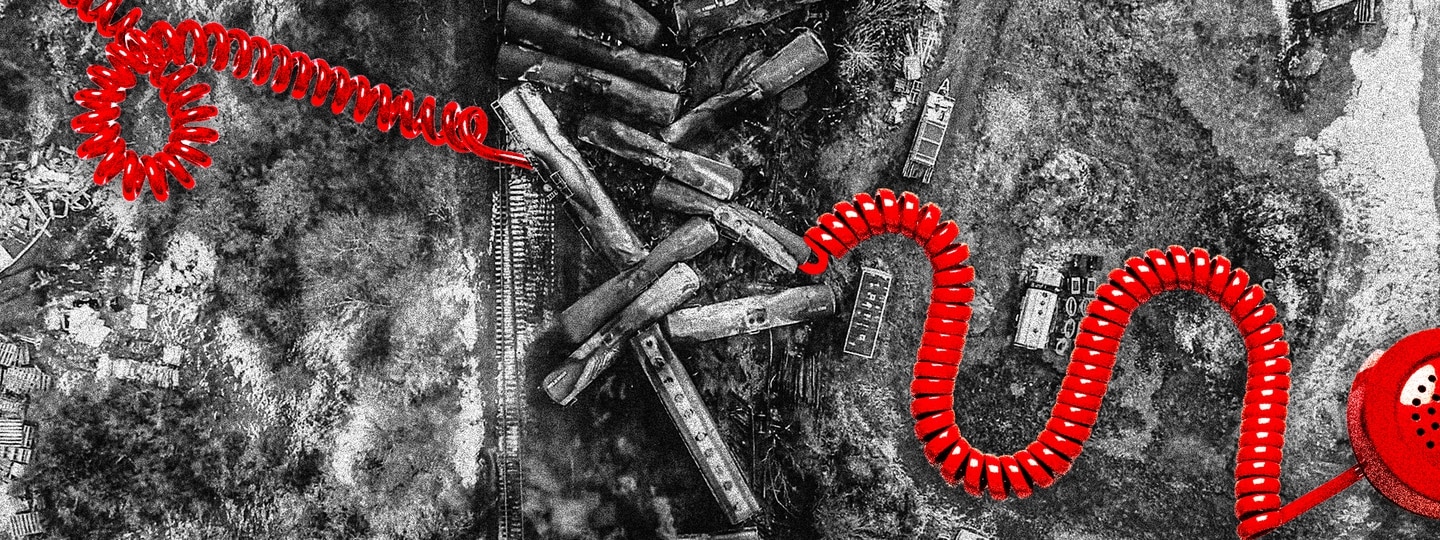
Call logs of train derailment hotline reveal confusion and unheeded early warnings from scientists about dioxin risk.

On Feb. 17, a woman called an Environmental Protection Agency hotline set up to help respond to the train derailment and chemical spill in East Palestine, Ohio. She reported that her son was sick — a croupy cough, a headache, his chest hurt, and he had a fever. They had been to the doctor, who could find no obvious cause.
“I mean the plume of smoke went right over our house and ever since then he has been sick,” the caller said, according to a transcription of a voicemail she left with the hotline. She reported getting in touch with a toxicologist working with Norfolk Southern, the rail company responsible for the derailment, but to no avail.
“That was a joke,” she said. “They are just trying to push it under the rug. I am hoping you aren’t going to do the same …. I’m concerned about his health. I’d like some answers and cooperation.”
The call is one of more than 250 that Ohio residents, scientists and even a member of Congress’ staff placed to the federal hotline starting about a week after the derailment Feb. 3 — looking for answers about the derailment, subsequent chemical spill and dramatic controlled burn of vinyl chloride. Grid obtained a log of calls from Feb. 8-21 through a Freedom of Information Act request. Together they show the cost of the confused and slow response in raw human terms.
The call log includes dozens of people worried about themselves or family members, records many reports of chemical sheens or residues in ponds or pastures, and demonstrates that several experts and others urgently wondered why no one was testing for dangerous dioxins — weeks before the EPA mandated such testing. Even the offices of elected officials checked in, struggling to find information on testing or other issues weeks after the derailment.
On Feb. 17, a full two weeks after the crash, Manny Burton called the hotline. Burton is a legislative correspondent in the office of U.S. Rep. Chris Deluzio, a Democrat representing the Pennsylvania counties just across the border from the derailment site. He told the EPA operator that they had been “getting the run around [sic]” when trying to get in touch with the Pennsylvania Department of Environmental Protection, according to the hotline operator’s notes. “The Congressman’s office would like someone to call them back,” the operator noted. Apparently, the PA DEP did eventually get in touch.
In a few cases, the calls were coming from inside the house — other EPA numbers apparently dialing into the hotline for unknown reasons. “This is an EPA number for Columbus field office,” the operator noted on one Feb. 18 call. “Not sure why they called but the EPA guy on the other end seemed confused.”
With the EPA, Norfolk Southern, and the East Palestine area now moving into what will likely be a prolonged period of cleanup and remediation, the documents show a confusing and chaotic start, with many gaps in messaging and potentially public safety.
An atmosphere of fear
A woman who lived about 10 miles from the crash site called the hotline Feb. 21. She reported driving to work early in the morning after the controlled vinyl chloride burn and said she had developed a rash. She tried to go to the clinic set up in East Palestine, but staff there told her she couldn’t be seen because she lived outside the evacuation zone, a one- by two-mile area crossing the Ohio-Pennsylvania border where residents had been told to leave when the crash and controlled burn took place. She tried the health department, poison control, and “all available resources” before being handed off to the EPA hotline. She “is frustrated and feels passed around to different agencies and hotlines without help,” the operator noted.
A person from Beaver County, Pennsylvania, called Feb. 16 and said his wife had seen a doctor three times already, with no luck determining the cause of her symptoms, which began Feb. 10. They were concerned because they had been in the direct path of the smoke. (Beaver County’s northwest corner is just across the border from East Palestine, about one mile away.) Another woman, 12 miles from the site, called to ask if the water was safe to bathe her son. “He has cancer,” she reported.
There is a clear sense of confusion throughout the hotline’s records. A business owner in East Palestine reported that after throwing a rock into the creek next to their building, “a sheen comes right to the surface.” According to the EPA operator’s notes, the caller saw a big divide between what was happening outside and what residents were being told: “He is concerned that officials are taking samples in hazmat suits however no one has commuicated [sic] to the commuity [sic] and local businesses about what the contaminants are and what precautions people should be taking.”
A caller who lived eight miles from the derailment site said the early news coverage of the event had been “horrible,” and they didn’t originally know that anything released or burned was toxic. She smelled chemicals, and soon began feeling sick. She asked the hotline what to do, because “it’s been over a week?”
One caller from just outside the evacuation zone, on Feb. 20, “became angry/argumentative,” according to the EPA operator’s notes. The caller lamented the conflicting information about water issues and testing. A caller from nearby Sharon, Pennsylvania, whose family was experiencing headaches and nausea, reported calling many other numbers first; there was not, the caller said, “adequate resources or help.”
A number of calls came from farther away — 25, 40, 50 miles from the site, or even farther. They too were scared, confused and concerned with the initial lack of transparency. Some called out of concern for family that lived closer to East Palestine, like one caller from Jupiter, Florida, whose daughter and grandchild lived close by the crash. Another came from Wisconsin, where a caller said they received pet food from an East Palestine warehouse — should they be worried about using it?
Even health professionals seemed to be in the dark at times. A nurse called in with questions because the doctor she worked with wanted to run tests on a patient showing relevant symptoms, but the doctor was unsure of what tests would be appropriate. The operator noted the nurse was “looking for guidance.”
Experts and officials look for answers
Grid’s FOIA request covered calls made to the hotline from its inception up until the time the request was fulfilled. The documents EPA produced cover a period from Feb. 8-21 with the bulk of the calls made from Feb. 14 through 21. Only a few calls are logged for dates before that, suggesting the hotline number wasn’t well-publicized early on. The EPA told Grid that after Feb. 22, the Federal Emergency Management Agency took over the hotline’s operations.
Aside from the concerned and potentially ill residents, other callers included companies that make air or water filters offering to help, professors and experts on testing trying to understand what was happening on the ground, and federal officials. Someone listed as being from the “Health and Human Service Administration for Strategic sSrvice [sic] and Response” — most likely from the Department of Health and Human Services Administration for Strategic Preparedness and Response — called Feb. 15. They were looking for information on how the testing and cleanup were being performed.
A professor from Duke University called to find out more about EPA’s use of SUMMA canister testing, a type of container used to sample air, as well as some other technical details of the ongoing air quality monitoring.
Other experts also chimed in on a particular gap in testing that was only filled weeks later — monitoring for the cancer-causing chemicals known as dioxins.
“It’s impossible for there to not be dioxin”
A caller on Feb. 16 said they used to work in the vinyl and PVC industry and wanted to flag their concern over the lack of testing for dioxins. The EPA says dioxins are highly toxic, and “can cause cancer, reproductive and developmental problems, damage to the immune system, and can interfere with hormones.” Experts were worried that the controlled burn of the vinyl chloride the weekend of the crash, which produced the dramatic toxic plumes over East Palestine, would have produced and spread dioxins.
Another caller Feb. 16 said they used to work at EPA and for a public health department, and they were worried that the reports of rashes and headaches were due to dioxin poisoning. They asked if the EPA was testing for the chemicals. The EPA operator’s notes again showed the lack of a cohesive response: “Another question on if EPA is testing for dioxine [sic], and if not why not — need answer to this question.”
An expert with the Union of Concerned Scientists also flagged the issue. He told the operator he had been on hundreds of dioxin sites in his career, and that “it’s impossible for there to not be dioxin.”
By Feb. 21, the operators’ confusion as to how to respond seems to have been cleared up. When another caller raised the question of dioxin testing, the operator “let him know it’s on the EPA’s radar at a high level and is being considered.”
The EPA directed Norfolk Southern to begin testing for dioxins 10 days later, on March 2.
Anger and conspiracies
Based on the records Grid obtained, the EPA hotline operators appeared to do their best with at times limited information. They consistently directed people to available resources online, provided phone numbers of health departments or other relevant agencies, and researched information and conducted callbacks when necessary. Unsurprisingly given the way the issue rapidly became a political and conspiracy flashpoint, they also were subjected to some irate and at times irrational callers.
One “very angry lady” who said she worked with vinyl chloride before claimed that 100 percent of East Palestine residents were now doomed to get cancer. Another from New Orleans “thinks EPA dropped the ball” and threatened a hunger strike to call attention to the issue. A “very angry” and “slightly threatening” caller wanted to know why Norfolk Southern was allowed to carry dangerous chemicals at all. Another caller simply “yelled for 90 seconds and hung up.” The EPA operator made a note: “No further action needed.”
The idea of a cover-up, pervasive in the early days after the accident, did make it into the call log. A woman calling from “East Strasburg, PA” — likely East Stroudsburg, a town near the state’s eastern border with New Jersey, more than 300 miles from the site — said her eyes were irritated and that it was all a cover-up. “This is Chernobyl but at least the Russian government can help its own people,” she told the operator, adding that if “the town were full of illegal immigrants then the government would be doing something.” Even then, the operator was able to calm her down some, and showed her some helpful data and websites.
Most often, though, the call log shows a local population scared for their families’ and animals’ health, without clear direction of how to address the problem. On Feb. 17, a woman called upset that being just outside “that magic one-mile radius” meant she couldn’t have her house and farm tested. “I know I have toxic particulates in my attic and I was up there and coughing uncontrollably,” she said, according to a transcribed voicemail, adding that the toxic plume had shifted in her direction soon after the burn and that she didn’t know how to arrange testing. “I’m at my wits’ end.”