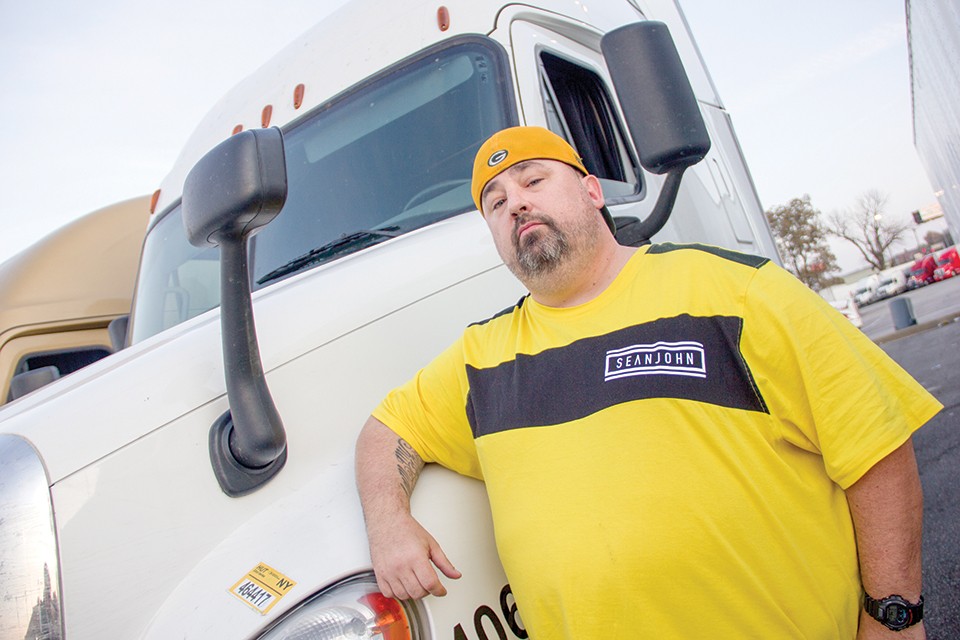
Anthony Greene knows when he isn't wanted. Seated behind the wheel of a hulking tractor-trailer on a recent Sunday afternoon, the 45-year-old trucker looms above an expanse of parking lot behind a Love's Travel Stop near downtown St. Louis. Back in the summer of 2018, it was in gas stations like just like this where he started showing up to livestream "exposures" of sexual predators.
Greene and his group, Truckers Against Predators, or TAP, are among a new generation of predator hunters in the United States. And starting last year, it was his mission of justice — not just a large Facebook following — that won him sustained media attention. It also attracted no small infamy from local police departments.
"In St. Louis, unfortunately, we won't even call the police now. They treat us like we're criminals," Greene complains. "In Yuma (Arizona), they treated us like we were frigging rock stars."
In November 2018, the gleaming white cab of Greene's truck hurtled across the country on its way to the West Coast, passing through Texas, New Mexico and, most notably, near Yuma. It was there that Greene sprung a sting operation on Matthew Sanchez.
Sanchez thought he was meeting a thirteen-year-old girl at a Love's gas station. Instead, as captured on Greene's livestream, the 30-year-old with a patchy beard and pink T-shirt walked out of the convenience store to find the six-foot-four, 300-pound goateed trucker filming him on a smartphone.
Even on the grainy Facebook livestream, Sanchez's eyes are wide, white and terrified. Greene keeps the camera running.
"Hey, Matt," the trucker says. "You want to have a conversation with me? Who are you trying to meet up here?"
"A friend," Sanchez says.
"A friend?" repeats Greene. Sanchez looks sick. Greene's voice is entirely calm.
"Listen to me, man," he says. "Everything is going to a whole lot smoother for you —"
"If I just leave?" Sanchez says hopefully.
"If you're just honest," Greene rumbles. "The police are going to be involved either way."
It's the sort of scene that played out dozens of times on NBC's To Catch a Predator. Here, of course, there's no film crew, no house, no Chris Hansen. There are also, in fact, no cops on the way.
Sanchez tries to talk his way out, reaching for the oldest defense in the book. "Hey, she told me she was 21." Greene isn't having it. He tells the deflated Sanchez that he's seen every text, every photo he's ever sent TAP's decoy.
After a few more rounds of interrogation, Sanchez clams up. He gets in a cab and leaves the gas station. But then something else happens, and for Greene, something entirely unplanned for. That night, Sanchez went home, dialed 911 and turned himself in.
Sanchez's arrest marked the high point of Greene's career as a predator hunter. Today, recounting that story during an interview conducted inside the cab of his truck, Greene heaps praise on the Yuma Police Department, which announced the arrest on Facebook one day later, even crediting Truckers Against Predators by name.
Sanchez may never have communicated with an actual child, but he'd committed an actual crime.
"I just don't have any remorse for these people," Greene says. "I kind of want them to feel how a child feels — scared. It's maybe a little twisted, but I want them to feel that fear."
In July 2019, Sanchez pleaded guilty to a felony charge of "Luring a minor for sexual exploitation." A judge sentenced him to five years in prison. He will have to register as a sex offender.
For Greene and TAP, it was a huge moment. It was the group's first conviction.
"We're really pumped about that, rejuvenated, and we're still getting a lot of press," Greene says. Indeed, in the past two years, coverage of TAP has appeared in virtually every local TV station and newspaper (including Riverfront Times) in both Missouri and Arizona. In October, Greene was interviewed for an episode of Inside Edition. He says he was recently flown out to shoot a soon-to-be-aired episode of Dr. Phil.
Greene is in the midst of rebuilding TAP. He paused his livestreaming ambushes earlier this year, which he blames on a bacterial infection in his leg that kept him bedridden and off the road for months. In late 2018, he had the largest Facebook following of any U.S. predator hunter group. Now he's hoping to leverage his page's popularity for a comeback.
Despite the Sanchez case and dozens of busts under his belt, Greene's work has never led to a second conviction. In Missouri, that's no accident. In the past year, police departments in St. Louis city and county have repeatedly disavowed any relationship to TAP — rebukes that followed videos in which Greene told targets that he was working alongside police partners. Greene admits now that he's been told "flat out" that any TAP case in St. Louis City is, prosecutorially speaking, dead on arrival.
Greene argues that it doesn't have to be that way, and he claims the impasse is costing the police workable cases. "If we're getting arrests and convictions in other states, then the problem is obviously not us; it's how the laws are written here," he says. As evidence, he claims he recently called a detective in Greene County, Missouri, with evidence he'd collected from a decoy.
"I told him I had three guys in his area," Greene says. "He told me, 'We don't work with vigilante groups.' They didn't even want the information."
Police, though, aren't shy about their views on Greene. Law enforcement officials in St. Louis, St. Charles and Jefferson County say they want nothing to do with his citizen's crusade, no matter how well-intentioned. St. Louis County's prosecutor refused to bring charges even after Bridgeton police arrested two of Greene's sting targets in December 2018. A man facing solicitation charges in Franklin County had his case dropped after a new prosecutor took office in January. And it wasn't just prosecutors. In July 2018, a lieutenant with the Jefferson County Sheriff's Office submitted a report describing his refusal to respond to one of Greene's sting operations.
The lieutenant concluded his report, "We did not get exposed on Facebook Live for Greene's pleasure."
However, across the country, the citizen-led predator hunter movement continues to gain traction. More than a decade after To Catch a Predator introduced America to the dramatic world of internet predators and staged ambushes, the genre has exploded across Facebook, generating viral stories and fresh media coverage with each uploaded video and arrest.
There are dozens of active groups in the United States alone, and similar predator hunters in the United Kingdom have operated aggressively, and productively — evidence provided by hunter groups was used to prosecute more than 250 suspected abusers in 2018, the BBC reported. While charges and convictions are slowly accumulating across America, police in Missouri remain overwhelmingly uninterested.
But if you cross the Mississippi, about an hour's drive into Illinois, the hunt has never been more active.

Page 2 of 4

Kyle Swanson, the founder of KTS Predator Hunters, watched from inside a parked car as his target entered a Walmart in Fayette County, Illinois. It was after 11 p.m. on August 1, 2019.
Swanson is a broad-shouldered former Army veteran with a cherubic smile and a beard that he tends with a small comb during the livestreams. On that particular night, he wielded two phones, one for livestreaming to Facebook, the other for keeping contact with his decoy, who in real life is a 36-year-old mom from a small town in Missouri.
That night, however, she was texting with Christopher Cox, a 23-year-old from Vandalia who thought she was a fourteen-year-old girl. In reality, the decoy was watching the livestream and updating Swanson on their target's movements. Cox was walking into a trap.
After he entered the store, Swanson and a second predator hunter made their first move. They confronted the driver of the truck, which had dropped Cox off at the entrance, prompting the driver to peel out of the parking lot in a hurry.
There's no formality in Swanson. As Swanson filmed, Cox, a slight figure wearing a black T-shirt and jeans, emerged from the Walmart. Swanson got straight to the point, all while keeping the camera trained on his target.
"You here to meet a fourteen-year-old?" Swanson asks.
Like Sanchez, the shock of that question seems to root Cox to the ground. Cox also seemed to share a similar impulse for self-incrimination, and his very first response is to blurt out, 'I didn't know she was fourteen.'"
"Yeah?" Swanson huffed. "You've been talking to me the whole time, so nice try. Your ride's already gone. You're not going anywhere right now."
Swanson was incorrect. Cox launched himself into a dead sprint, flashing across the floodlight-illuminated parking lot toward a block of retails stores. In seconds, he'd vanished into the night. Swanson and his partner returned to their truck and drove around for several fruitless minutes as they tried to pick up the trail of their quarry, even peering inside a dumpster behind a Cricket Wireless. Cox wasn't in the dumpster. He was gone.
Cox's escape lasted a just few days. Within hours KTS' video had been shared hundreds of times, and it quickly racked up thousands of views. KTS' fans shared screenshots of Cox — whom Swanson had dubbed "The Runner" — and created their own posts and community alerts.
In a rural Illinois county, that sort of info tends to make waves. And that's how the incident came to the attention of Fayette County State's Attorney Joshua Morrison.
Morrison, in an interview, says he "immediately recognized" Cox's name and photos. Which made sense. Court records show that Cox had spent the previous five years in and out of trouble. In 2016, he'd pleaded guilty in a Fayette County court to felony aggravated domestic battery and was sentenced to four years in prison.
After recognizing Cox from previous cases, Morrison says he reached out to KTS, which provided Cox's chatlogs as evidence. The prosecutor was impressed. A detective subpoenaed Cox's phone and checked its messages, finding them just as damning as those gathered by KTS' decoys. Morrison says Cox hadn't just arranged to meet in the Walmart: He had tried to send an Uber to pick up the person he thought was a fourteen-year-old. He had used his own sister's credit card to order the ride.
"Everything KTS told me seemed to be correct," Morrison says, seated in his office on the second floor of the Fayette County courthouse. He notes the skill of the KTS decoys, who "make it very clear that they are fourteen" during the chats. That's the key to bringing charges.
"As long as the person acknowledges that at some point in there, 'I understand you're fourteen,' and they don't have a problem and they continue — the law allows Illinois to prosecute for just exactly that."
For Morrison, the August bust of Cox began a productive partnership between KTS and Fayette County. Two weeks later, Swanson filmed as Fayette officers handcuffed Kyle Upchurch in the electronics section inside the same Walmart where they'd met Cox. On August 30, Fayette police arrested a third KTS target, Joshua Corbin, who had sent hundreds of messages to KTS' decoy, believing he was talking to two underage teen girls.
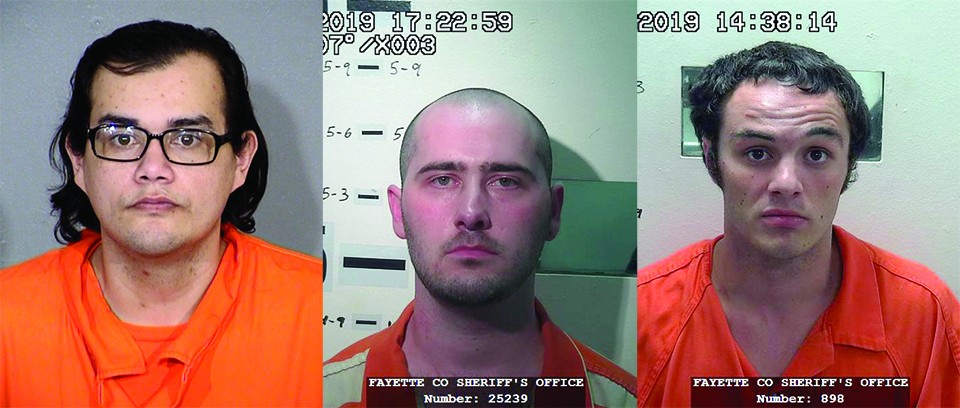
By November, all three targets had pleaded guilty to indecent solicitation of a child, which by Illinois law mandates registration as a sex offender. Cox was sentenced to four years in prison. Upchurch — who was already a registered sex offender for aggravated sexual abuse of a fifteen-year-old in 2013 — got five years. Corbin, who had no criminal history, was sentenced to two years' probation.
The three cases were KTS' first convictions, but also the first known cases undertaken by a St. Louis-area predator hunting group in Illinois.
Morrison wasn't shy about linking his office's work with the predator hunters. In a Facebook post announcing the sentencing, his office described the investigations as "a joint effort between multiple law enforcement agencies and the KTS Predator Hunters."
Still, Morrison acknowledges that predator hunter groups aren't widely embraced on his side of the thin blue line. He doesn't see them as vigilantes, but is careful to separate their work for his own.
"They don't work for me, I don't tell them what to do," he says. "If they tell me 'Hey, we're going to do this thing in your town,' I can't tell them not to. My attitude is to prosecute people for breaking the law. If you bring me a good enough case, I'm going to do that."
For Morrison, part of the problem is the scale of cybercrime. Even in a rural Illinois county, he says the presence of online predators "is so pervasive that the police couldn't possibly catch everybody that's doing it."
Morrison has heard the critiques of the groups before, but he compares the predator hunters' role to that of a citizen's arrest or evidence gathered by traditional eyewitness testimony. And his office didn't simply submit KTS' video as evidence. That's what detectives and subpoenas are for.
Still, he admits that groups like KTS raise "a tough question" for law enforcement. On one other hand, predator hunting groups are taking enormous risks to ambush desperate men late at night. Then again, there are now fewer adults in Fayette County willing to do the sorts of things Cox, Upchurch and Corbin wanted to do when they thought they were talking to children.
"Who catches them is not as important as preventing them doing bad things to a child," Morrison says. "If it has the effect of chilling this kind of behavior in my county, I'm all for that."
Page 3 of 4
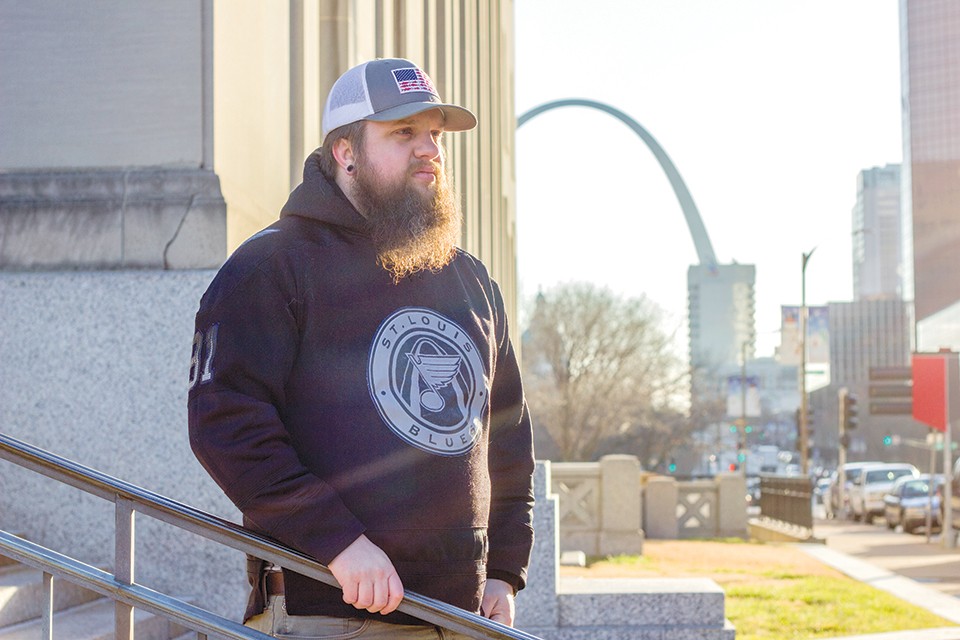
Kyle Swanson didn't set out to be a predator hunter. A Metro East native, Swanson returned home in 2015 after serving in the Army, which included a deployment in Iraq. To pass the time back home, he started making low-stakes internet prank videos, often targeting Craigslist sellers — "stupid stuff," he says, like trying to hire a house-painter as a face paint artist for a child's birthday — and, of course, uploading the results to YouTube.
For Swanson, the pranks and video production served as a practice run for KTS, which has seen its profile rise in 2019. Sometimes, he says, followers of his page will stop him in grocery stores to say thank you. His fans call him a hero.
"I don't mind it, but that's not what I'm in it for," Swanson says during an interview last month. "If someone wants to call me a vigilante, so be it. Batman was a vigilante, and we all love Batman, right?"
He laughs, because it's a joke, but there's still a truth there, especially when it comes to internet predator hunters.
Back in 2004, a group known as Perverted-Justice was already deploying decoys to AOL chatrooms to expose the predators and refer cases to police. It was this work that became the basis for NBC's hit show To Catch a Predator — that is, until it was cancelled in 2007 after NBC was sued by the family of an assistant district attorney who had committed suicide after messaging with a Perverted-Justice decoy posing as a thirteen-year-old boy.
Swanson says he's not worried about a similar fate for KTS. In fact, when he and two other partners founded the group, the name was supposed to be an abbreviation of their first initials — but one partner dropped out after an ambushed target threatened to sue. After that, Swanson just changed the meaning of the name, which now stands for "Keep Them Safe."
And Swanson certainly doesn't need NBC to produce video. Between YouTube and Facebook, KTS can produce and publish new stings quicker than it took To Catch a Predator host Chris Hansen to say his famous opening line, "Why don't you take a seat over here?"
Still, running a 30,000-member Facebook group has its own challenges. During Swanson's interview with RFT, he pauses to tend to a flood of notifications on his phone.
"You see how it is?" he says, scrolling through the messages from the KTS Facebook pages and updates from his decoys. "I'll log on to MeetMe, and I'd get like 300 messages within the first minute, even if it says I'm fourteen. We have guys messaging us 'Is your mom home?' and then they start getting into it."
For Swanson, the journey to predator hunting started in December 2018, when a friend confided in him that a guy had been harassing her online and sending dick pics. She asked Swanson to use his internet prank abilities for good, to perhaps persuade (or troll) the harasser into leaving her alone. Swanson said sure, and, on a lark, he decided to claim to be fourteen, "just to see what he says."
According to Swanson, the guy didn't mind at all. The sexual messages and pictures kept arriving, and Swanson decided it was beyond the scope of any sort of prank. He went to the cops.
"They ended up arresting the guy, and he didn't end up getting any charges," he says. "It made me wonder, how many more people are out there like this?"
But there's no formal guide to predator hunting, and Swanson concedes that his early busts weren't always well-planned. He had been inspired by another internet prankster-turned-predator hunter named Shane Coyle, who gained popularity through his use of an unsettlingly realistic impersonation to mimic the voice of a young girl over the phone.
Swanson didn't go that far. And he didn't need to, thanks to a network of unseen decoys who, it could be argued, are more literally predator hunters than Swanson or Greene or Hansen.
Indeed, one could say that Swanson and Greene aren't actually playing Batman in this scenario. Compared to the decoys, they're the sidekicks.
Whether conducted by police or a citizen group, the role of the decoy requires a special kind of resilience. Whitney, a KTS decoy who asked RFT not to print her last name, recalls that her first target for Truckers Against Predators was a man from California. He'd kept talking to her even after she told him that she was "going to be thirteen."
He had even offered to buy her a bus ticket.
"He was straight to the point, 'I'm going to ... '"
Whitney trails off, because, after all, what these men often say they're going to do is monstrous. Their messages run the gamut, at times suggestive and flirty, others sexually graphic and specific to the setting and scenario. And the messages don't stop. That first man who messaged Whitney about the bus ticket? More than a year later, he's still checking in, seeing if she'd be around if he came through St. Louis on a business trip.
"He's planning on building a life with this child who essentially hasn't even turned thirteen yet," she says. "How do you respond to that? It's not normal small-talk conversation."
And even though she's spent more than a year volunteering as a decoy, first for Truckers Against Predators, and now at KTS Predator Hunters, she still doesn't like the term "hunters."
"I don't feel like we are hunting these men," she says. "I feel like we are conducting investigations of potential predators and eventually we expose them. I feel like that has a negative connotation. We're not bounty hunters. We don't find you, you come to us."
That argument is key, and Whitney insists she's never made the first move to message someone or introduced sex in a conversation with a target.
In any case, according to a sampling of chatlogs KTS and other groups have shared to Facebook, it's the targets that do most of the talking — and they are surprisingly self-aware. A screenshot of one text exchange, posted by a different Missouri predator group, featured a 42-year-old man texting "You're going to get me in trouble" and "I don't want to go jail" — but it didn't stop him from trying to arrange a meeting with a decoy posing as a fourteen-year-old.
"A few will give you a lecture, and then come back and continue talking to you. Those are the scariest ones," Whitney says. "It's like they think they won't get in trouble because they told you not to do this, but they continue to progress the conversation to get to that level."
It was the TAP bust of Matthew Sanchez in Whitney's home state of Arizona that motivated her to reply to one of Anthony Greene's Facebook posts seeking decoys. Now at KTS, she often works cases alongside a second decoy, Angel (who also asked to be referred to only by her first name).
Like Whitney, Angel joined the cause after seeing a video of a TAP bust. She had recognized the man in the footage as someone she'd gone to high school with, someone with whom she once been "pretty close."
"It made me realize that it could be anyone," she says. "Around where I live, I've talked to a guy online that thinks I'm a twelve-year-old, and I'll see him around, just an average Joe. It's a surreal thing."
Generally, though, the work of a decoy is done at a distance. But for the stings to become convictions, the evidence has to stand up in court to the counter-claim of entrapment. To ensure there's no confusion, Angel says, decoys aim to disclose their "age" within the first five messages.
Where it's been tested, the evidence has indeed stood up. Angel's evidence is noted in the indictments for the three convictions in Fayette County. She and Whitney tell RFT that they worked in close contact with the detectives in the weeks leading up to the busts.
And so far, the stings engineered by Swanson and KTS have borne out the group's central argument: That these men are not innocently indulging in catfishing or role play, but attempting to develop a relationship that's predicated on sexual interest. There's nothing pretend, after all, about trying to send an Uber to pick up a thirteen-year-old.
Often, decoys work in pairs, which provides a break from the emotionally draining work. Both Angel and Whitney are moms, their kids not much younger than those they pretend to be on OkCupid or KIK. Tisha, who works as decoy for Truckers Against Predators, says she can't help but think about her own kids, or who might be messaging her sixteen-year-old daughter.
"I don't think it's a fantasy," Tisha says. "I don't think it's a sickness. I think that it's opportunity, for a lot of them."
Page 4 of 4
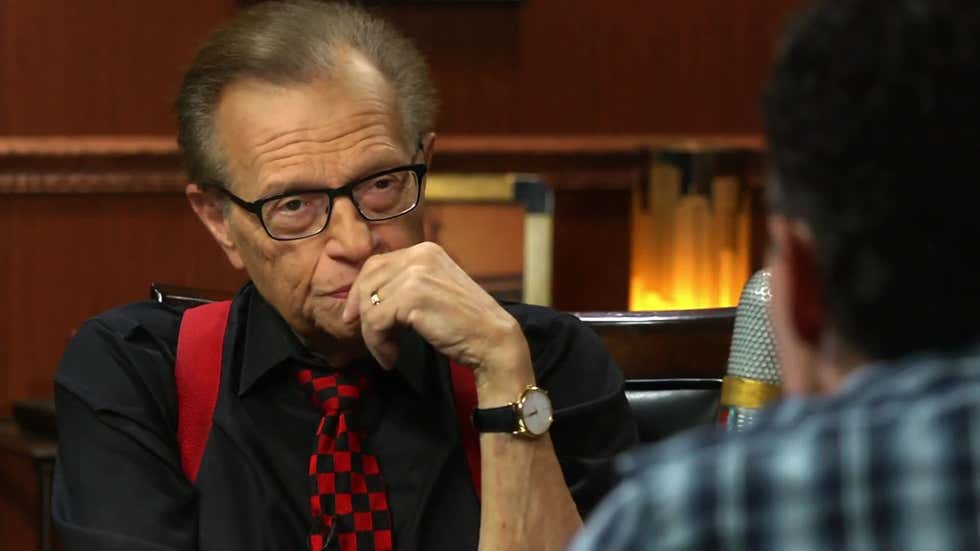
For twenty years, Adam Kavanaugh's hunt for sexual predators has resulted in numerous arrests and convictions. That tends to happen when you're a detective for the St. Louis County Police Department.
And while Kavanaugh is not unsympathetic to their motivations, he makes it clear in an interview with RFT that he sees predator hunter groups, especially that of Anthony Greene and TAP, as worse than ineffective. They just get in the way.
"These guys are doing it for shock value," Kavanaugh charges. "You won't ever see an undercover video where police are confronting people on open parking lots and calling them pedophiles."
Kavanaugh says he's run out of patience with the predator hunting movement. He's repulsed by the on-camera shaming, which he argues undermines the hunters' claims to professionalism. He doesn't like their decoys and distrusts the evidence produced in chatlogs. He notes that anything submitted by the predator hunters, whether chatlogs or video, is just begging for a competent defense attorney to pick apart.
He doesn't like the chaos produced by the collision of police and citizen investigations, such as the incident where, he claims, a police hotline call about a thirteen-year-old girl "prostituting online" turned out to be an adult TAP decoy.
"We were getting emergency subpoenas, trying to find this person," Kavanaugh says. "The last thing on Earth we need is a bunch of people running around saying they're twelve years old."
Then again, that's exactly what's happening in Illinois. When asked about the cooperation between KTS and Fayette County, Kavanaugh is unsparing.
"I disagree with what Illinois is doing, that's my personal opinion," he says, though he later clarifies that he's not familiar with KTS or Kyle Swanson and can't speak to the particular cases.
Still, he adds, Illinois is working against the impressions of St. Louis law enforcement.
"We've tried this with TAP," he points out, "and that fell apart."
Kavanaugh isn't the only member of law enforcement soured on the presence of predator hunters. In a statement to RFT, the Missouri Internet Crimes Against Children Task Force said that its member departments — which include St. Louis city, St. Louis County and St. Charles — are "prohibited from utilizing private citizens to proactively seek out investigative persons of interest."
But for all the complaints, the facts remain. Missouri's predator hunting community is growing. While Greene plans his comeback, in Springfield, a relatively new group known as 417 Predator Hunters has notched more than a dozen sting operations in November alone.
And KTS continues to stage ambushes in Illinois and Missouri. That included a June 22, 2019, sting of a married X-ray technician named Kyle Green, who, in a remarkable turn of events, had already been busted that previous December in a sting conducted by the FBI and investigated by St. Louis County Police — with none other than detective Kavanaugh playing decoy.
"Every once in a while, they'll run into a bad guy, like real bad guys," Kavanaugh admits, though he can't help but note that while KTS' video exposed a predator, it didn't result in any additional charges. Pending trial, Green is facing years in federal prison not because of an embarrassing Facebook video, but because of policework and federal prosecutors.
Kavanaugh insists his objections aren't just sore feelings over who gets to bust the bad guys. He suggests that predator hunters are missing the big picture and that their dramatic sting videos and Facebook groups are actually reaching two audiences: Those who cheer the punishment and spectacle of justice, and predators themselves.
"These guys are paranoid to begin with," Kavanaugh says. "When one of these To Catch a Predator idiots goes out and puts it out over Facebook, of course then our other people disappear."
Kavanaugh says he can already tell something has changed in the landscape. He talks about cybercrime in terms of "ebb and flow," the way that months go by without a bust, and then a burst of activity, like a stretch in November where police made three arrests in a single week. He's certain the predators are watching the hunters, and it feels similar, he claims, to the changes that followed the airing of To Catch a Predator in 2004. Online, these men have become more wary, more skeptical, more demanding — and more afraid of what's lurking behind the message app.
These days, when a potential target snaps that Kavanaugh isn't what he says he is, they don't always accuse him of being a cop before exiting the chat.
"I've had plenty of bad guys tell me 'Nice try, TAP,'" Kavanaugh says, "and then they get away."