With the Indy 500 postponed until August, it’s been an unusually quiet spring in Indianapolis.
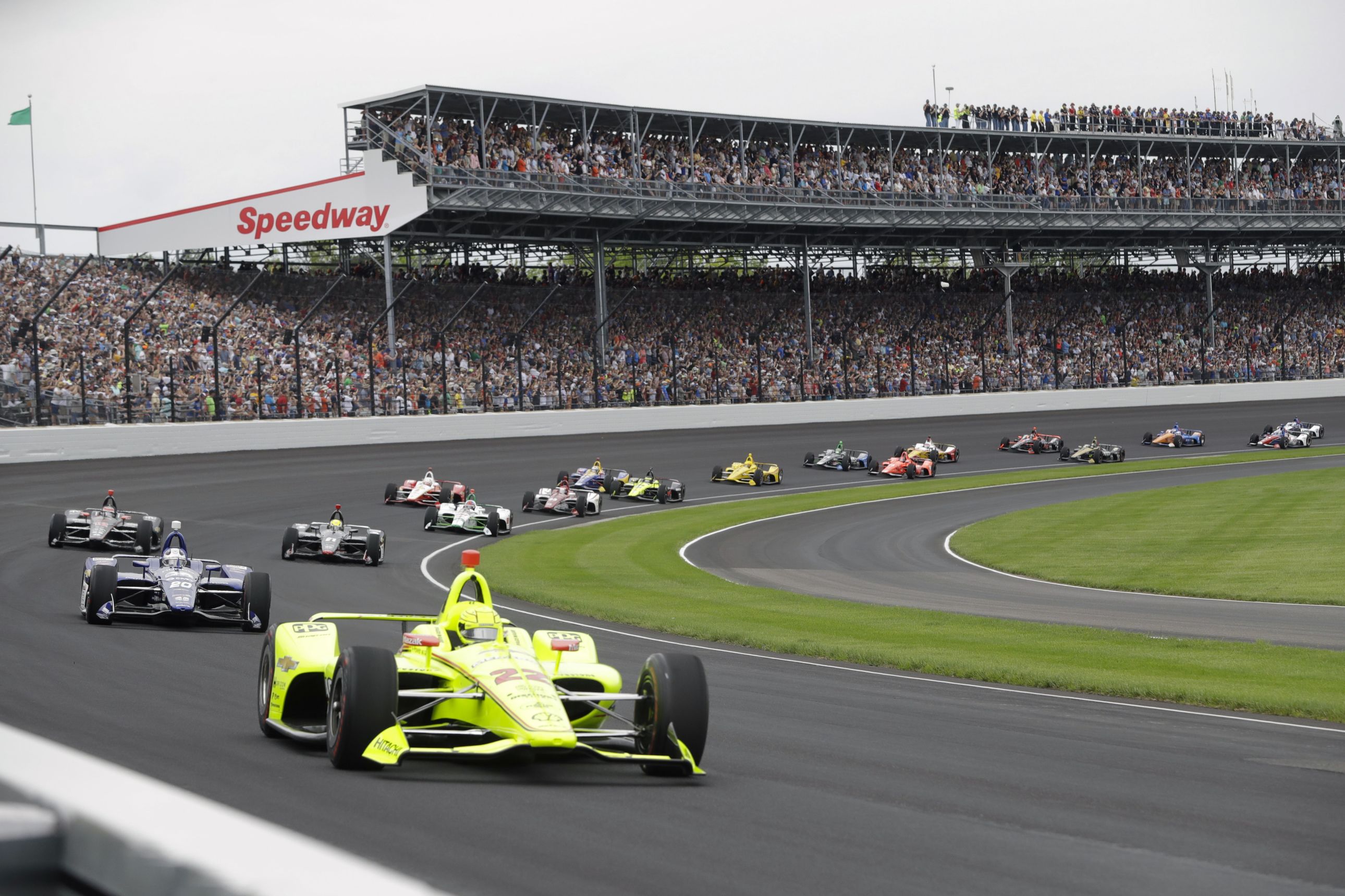
Simon Pagenaud leads the field through the first turn of the Indianapolis 500, May 26, 2019.
Photo: Darron Cummings/Associated Press
Indianapolis
For more than a century the month of May has meant one thing in Indiana: The Indianapolis 500, our annual celebration of spring and the Hoosier State’s nearly forgotten early dominance of auto manufacturing.
The race and its monthlong activities—practice laps, qualifying, the queen and her court waving from convertibles in a downtown parade, a 13-mile half-marathon, and all those people swarming local restaurants and nightclubs—pump an estimated $300 million into the local economy. On race day, close to 400,000 people crowd into the track’s huge bleachers and the Snake Pit, the infield’s writhing den of iniquity (itself an important boost for the local bail-bonds trade). Spectators watch open-wheel race cars “go like hell and turn left,” with the exhausted winner gulping a bottle of cold milk about three hours later.
In 1911, it took almost seven hours to finish the first 500-mile race. There was no milk for the winner. There will be no milk for anyone this year. The race should have been run this Sunday, May 24. It has been rescheduled for Aug. 23.
It’s hard to overstate the hole this leaves in Indianapolis life. Most years, “Welcome Race Fans” banners would fly all month at businesses and many private residences. There would be race parties every weekend leading up to the big day. Stores would be festooned with checkered flags and run Speedway Specials. Reporters would be pulling their hair out trying to find new story angles. And for blocks around the speedway, postage-stamp yards would have gone commercial as pop-up parking lots. At $50 or more a car per day for a month, raceway neighbors are all winners. Not this year.
It’s true that this town, once derisively known as India-no-place, punches above its weight as a small-market sports capital, consistently fielding competitive professional football and basketball teams. The Indianapolis Indians, the Triple-A affiliate of the Pittsburgh Pirates, sets minor-league attendance records at downtown Victory Field. The city is also home to a collection of unique museums—the NCAA Hall of Champions, the Eiteljorg Museum of American Indians and Western Art, and the Indianapolis Children’s Museum, with its life-size dinosaurs peering in upper-level windows.
But the Indy 500 is the anchor. Its name and imagery pop up in jokes, metaphors, analogies, casual comments and advertisements that reach far beyond the local market and far beyond the sport of racing. Indianapolis and Indiana ride along on the coattails of our own creation. When the world beats a path to our door every May, it confirms that we’re more than another flyover city, at least for a few weeks. Losing that stings.
We’re hardly the only community making a sacrifice. New York has lost Broadway, Boston its marathon, Los Angeles its beaches. Many towns around the country have put themselves into sleep mode. Under lockdown, we’re all a little bit less than ourselves, not a feeling Americans enjoy. But New York, Boston and L.A. always have other means of maintaining a steady presence in the national imagination. In Indianapolis, it’s been an especially empty May without the 500.
Even the most anti-lockdown protester would have to admit that postponing the race, the largest one-day sporting event in the world, was necessary. Bringing nearly half a million people to town for a month in the middle of a deadly global pandemic and then crowding them cheek-by-jowl into bleachers for three hours would cause a disease explosion, giving Indianapolis a global reputation as a coronavirus superspreader it would regret forever.
Indianapolis is somehow a bit less than itself without the race, and we who live here are searching for the balance point between the individual and the community. When you get down to it, America has always been about that.
At the end of every May, all but one racing team leaves Indianapolis disappointed, telling themselves, “There’s always next year.” This time the city is saying it too.
Mr. Lee is a writer in Indiana.