My ancestors lie on a peaceful tree-covered hill overlooking the site of the Battle of Atlanta.
Atlanta
Sylvester Cemetery clings to a steep, magnolia- and oak-covered hillside east of downtown Atlanta, on ground where Federal and Confederate troops fought a desperate battle in the last summer of the Civil War, 156 years ago this week. The oldest graves, some from before the war, are at the peak of the hill. This is a collection of interconnected family plots, many swept clear of leaves, revealing the reddish Georgia ground below. More than a few of the headstones bear the surname Terry. That is my mother’s family.
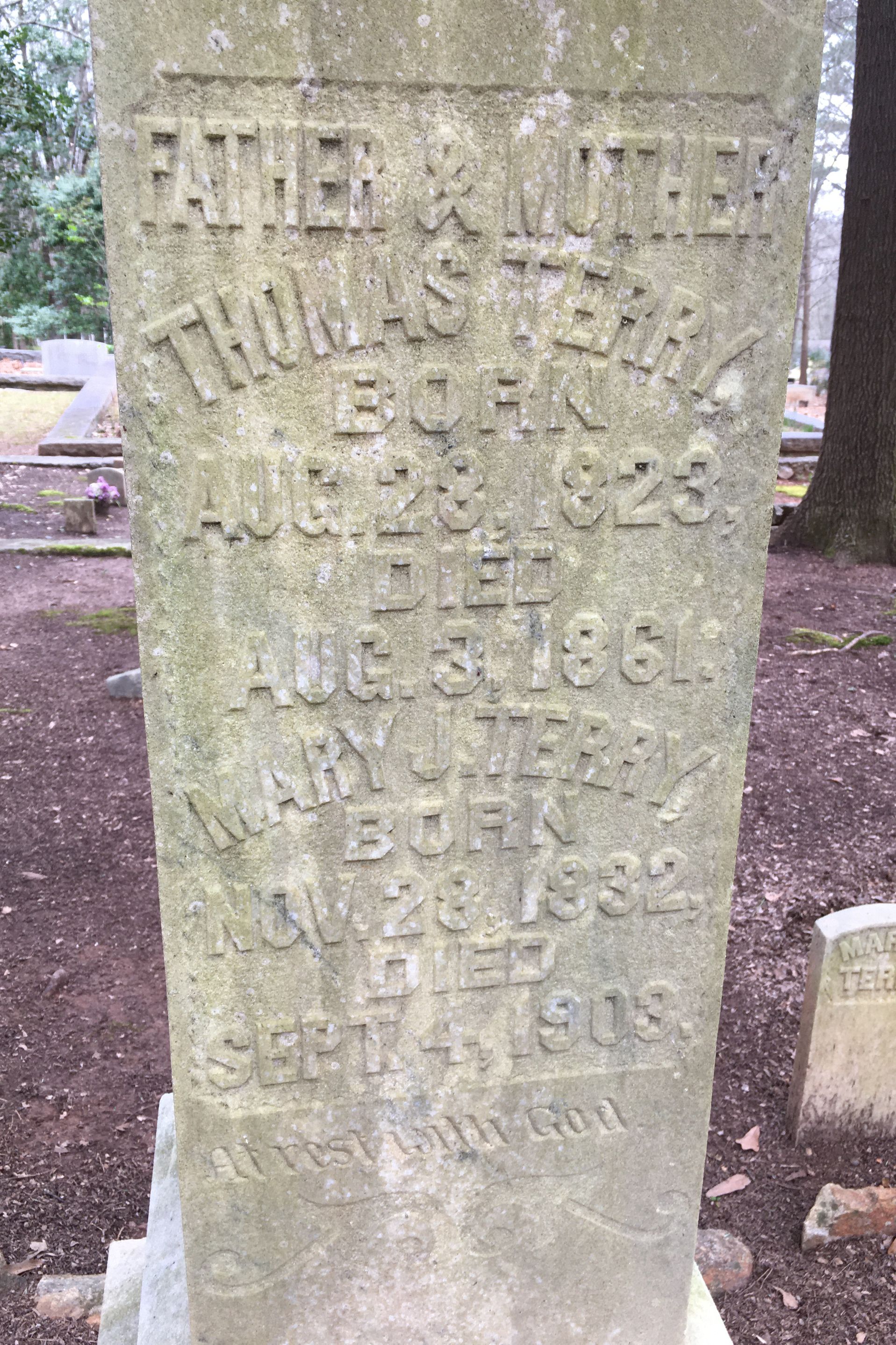
Thomas Terry’s grave stands in Sylvester Cemetery in Atlanta.
Photo: Daniel Lee
They were Southerners, but nowhere near the plantation class. They operated a grist and a lumber mill, the latter of which supplied wood for some of the earliest buildings in Atlanta, when it was still called Marthasville. They likely would have contributed to the war effort, supplying grain to the Confederate Army. After Fort Sumter, when their millworker joined up, the Terrys agreed to care for his wife and child. It may have been a substitution arrangement; the mill operator, Thomas Terry, was about 40, and the Confederacy permitted draftees to send someone else in their place at that point.
On July 22, 1864, the Sylvester Cemetery hilltop (then a few plain family graves among the trees) would have commanded a smoke-filled, sweeping panorama of Confederate troops attacking from the southeast across ground now traversed in part by a southward droop of Interstate 20. They were trying to roll up the left flank of Gen. William Tecumseh Sherman’s Federal troops, and they nearly did it. The Southern ranks faltered as they slogged through the marshy shallows and thick undergrowth of a large millpond on Sugar Creek in the valley below them. It was the Terrys’ millpond.
Union troops spotted the stalled Confederate attack, redeployed, and took them under fire, killing their commander and eventually repulsing the attack. In the aftermath, Federal soldiers burned the Terrys’ mills, perhaps not knowing, maybe not caring, that the mills and the pond had probably saved some of their lives and played a distinct role in giving the North a victory.
But Thomas Terry wasn’t there to see it; incredibly, he had been murdered three years before by neighborhood layabouts drunkenly celebrating the South’s win at what they called First Manassas. Thus he became, indirectly and with a razor-edged irony, one of Atlanta’s first Civil War casualties—600 miles from the fighting experienced by the man who may have been his substitute.
Thomas Terry was buried on the family hilltop, where he rested as the war rolled down from the north like a massive squall line, eventually thundering across his own family’s ground raining death, destruction and ruin. Thousands all over the South ended up in the same condition as the Terrys. Most hitched up their breeches and got on with things.
One of Thomas’s sons—only 5 when his father was murdered—matured into a successful Atlanta businessman. An alderman and town councilman, he helped found East Atlanta’s prominent Grace Methodist Church. Thomas’s wife, Mary, donated land for another church and the rest of the hillside for Sylvester Cemetery, named for a 15-year-old son who died after the war. A Terry great-grandson, Bill, ended up in the Major League Baseball Hall of Fame. He played for and managed the New York Giants. (Why couldn’t it have been the Yankees?)
Still, a stubborn bitterness suffused the South, eventually finding expression in the malignant “Lost Cause” mythology. But don’t discount ordinary nostalgia in its rise. The rose-tinted longing of aging men for their youthful exploits is well-known, and soldiers’ deep regard for comrades-in-arms doesn’t necessarily mean they’re defending the cause. Ask a Vietnam vet.
In 1913, the 50th anniversary of Gettysburg, aging veterans were asked to re-enact Pickett’s charge and the Union defense. Instead, the grizzled, doddering and short-of-breath survivors hurried—as best they could—to meet between the lines and embrace their old enemies. All of those men are long dead now. So too, it seems, is the spirit that allowed them to come together in forgiveness and remembrance. The ideals they shared, and which then served as a foundation for rebuilding a divided nation, are now under attack on grounds they were always fundamentally empty, mere window dressing for a culture whose sole purpose was to perpetuate and profit from slavery.
Today the area surrounding the Sylvester Cemetery hilltop is very different than in 1864. The onetime battlefield is mostly neighborhoods of small bungalows, strip malls, coffee shops, tattoo and vaping parlors—the gentrifying cool of the district just east of downtown. You can buy a T-shirt with the fashionably bearded visages of two generals who fought here, Union and Confederate, bearing the motto: “East Atlanta, Hip Since 1864.” But looking around, one has little sense of the former battleground.
Do we have a better view of the whole war—and the ordinary people caught up in it—from this century-and-a-half distance? In present-day Atlanta, the 1911 Peace Monument—a massive carved angel physically restraining a Confederate soldier—has been recommended for removal by a city monuments review committee. Less formally, it’s also been vandalized with a threatening “No peace” message explicitly contradicting its very purpose.
That bellicose intransigence is something the bitterest “Lost Cause” Confederates would have heartily approved.
Mr. Lee is an Indianapolis writer.