A golf course dedicated to tradition proves it’s easier to defend certain values than it is to recover them.
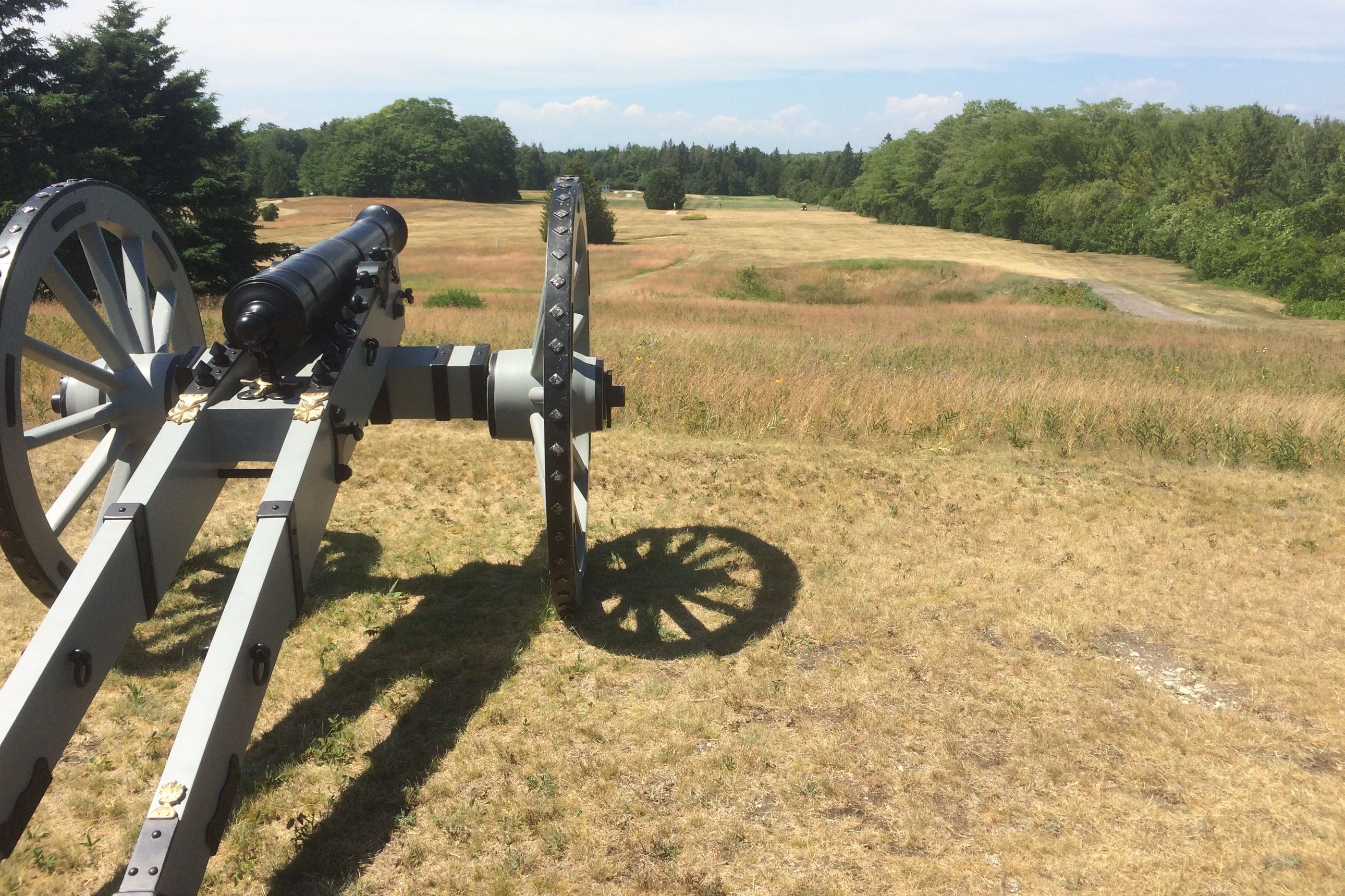
A cannon overlooks the first fairway at Wawashkamo Golf Course on Mackinac Island, Mich.
Photo: Daniel Lee
Mackinac Island, Mich.
Play the 123-year-old Wawashkamo Golf Course on Michigan’s Mackinac Island and you won’t soon forget it, not least because there’s a cannon aiming down the first fairway from the tee box. In the first week of August 1814, ranks of American soldiers, bayonets at the ready, advanced across what would eventually become the first fairway, into the teeth of British weaponry, a battle in the War of 1812.
That experience, thankfully, is not currently available at the course, but golfers can experience the sport as it was played long ago, before composite shafts, computer-designed club heads, and long, long, long fairways. You can even try playing the course with old hickory-shaft clubs available on loan.
Today Mackinac Island, off the northern tip of Michigan, is best known for its automobile ban and the imposing 19th century Grand Hotel featured in Hollywood films like 1980’s “Somewhere in Time,” with Jane Seymour and the late Christopher Reeve. Visitors relish the harbor-front shops and cafes that quietly bustle beneath the protective gaze of a whitewashed and gleaming hilltop fort. And everywhere is the quiet clop-clop of the horse-drawn carriages that are the primary form of transport here, along with bicycles and an unhurried form of walking best described as an amble.
At Wawashkamo, a moderately skilled player accustomed to 210- to 230-yard drives finds that a whippy, wooden “grass club” can spin the ball off the tee like a child’s whirligig, slicing it into the characteristic knee-deep rough perhaps 70 yards down the fairway. Approach shots with a “mashie iron” bound along the ground like terrified rabbits. The “niblick” seems altogether unequal to pitching a ball accurately on to the green, especially those girdled by the raised grassy hump common to golf courses of the oldest style.
Most players using the old clubs use modern golf balls, and not the hard-to-come-by vintage balls, said Wawashkamo PGA Pro Chuck Olson. “They tend to get lost and we only have a few,” Mr. Olson laughed.
Given time to adjust, the golfer begins to see the course’s virtues. It’s a slower game, he said. There are golf carts, but walking the ground makes it a more intimate, personal experience than racing along on asphalt cart paths, dismounting occasionally to launch another rocket. And nothing reveals the subtle challenges of a course like probing the underbrush in search of lost balls. Wawashkamo is generous in such opportunities.
But the decision to leave vintage features—the raised hump around the greens; the Amazonian rough that, waving in the wind, seems almost to be visibly moving to encircle the hapless golfer; the widely separated secondary tees that come close to making it an 18-hole course—was more than incidental. In keeping with the island’s purposeful cultivation of an older, slower lifestyle, playing through these anachronisms has been a labor of love through the decades.
Rather than modernizing the course and then tackling a complex, expensive, and very difficult effort to recover its early character—à la North Carolina’s famous Pinehurst No. 2, restored to its original archetypal Donald Ross design in 2010 at a cost of more than $2 million—Wawashkamo stayed true to its character all along.
On Aug. 4, 1814, the American attempt to retake the island covered the same route the British successfully used two years before. In defense, the British established a line of breastworks along the high ground that is now the south end of the Wawashkamo course, near what is the simple but cozy one-story frame clubhouse. Even outnumbered roughly 2 to 1, the Redcoats were able to repulse the U.S. assault as it moved up the open ground that would become the first fairway.
It was an early demonstration of something Wawashkamo and Mackinac Island illustrate to this day: It is easier to defend what one has than to recover what has been permitted to slip away. It’s worth remembering at a time when the American principles of free speech, free and credible elections, peaceful protest and ordinary law and order seem to be not just slipping away but bouncing out of play.
Mr. Lee is an Indiana writer.
Main Street: Ten years ago secular crusaders began their attempt to silence Jack Phillips for refusing to bake a cake for a same sex marriage. Today their intolerance continues over a cake celebrating gender transition. Image: Alliance Defending Freedom