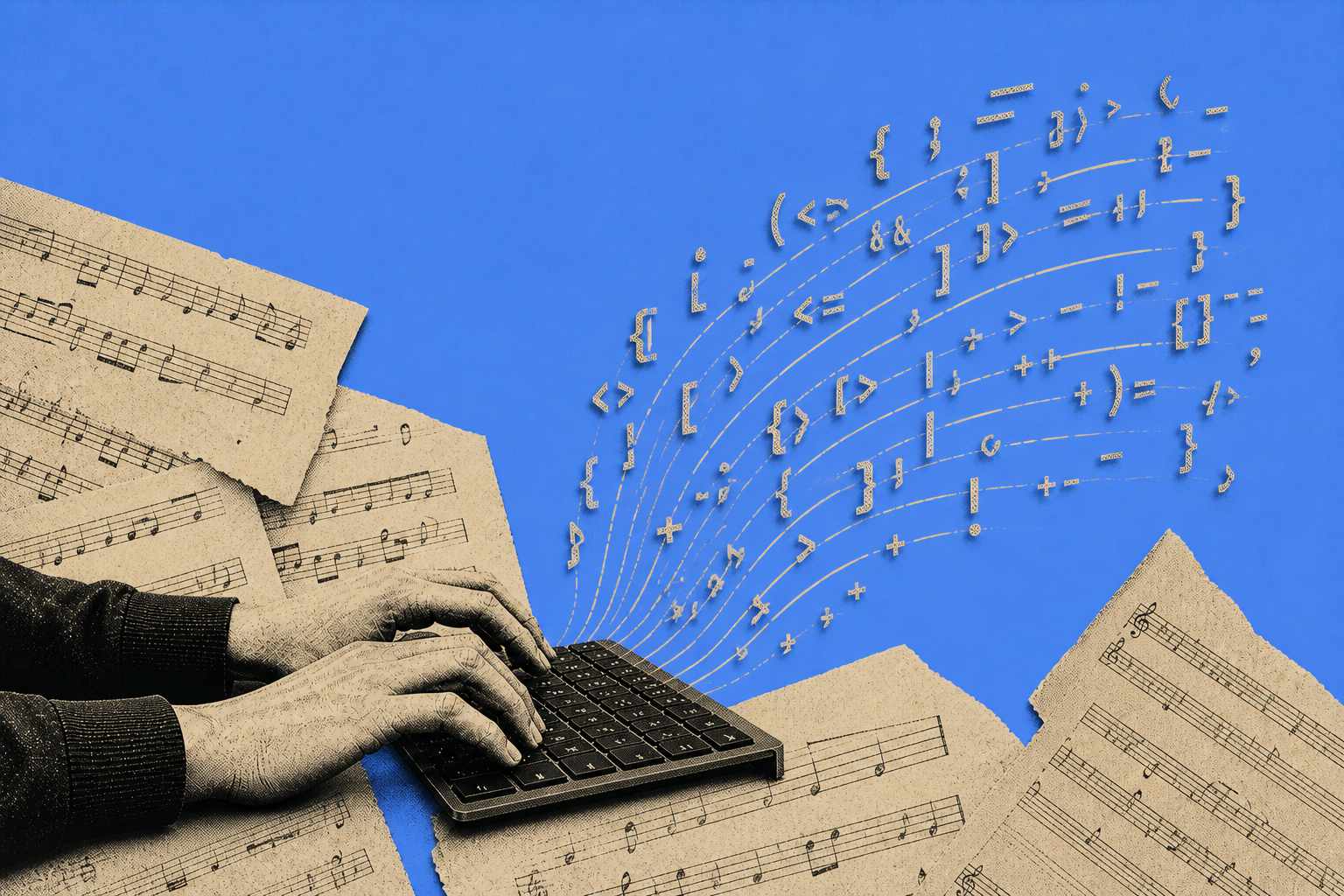
Over the past 50 years, programming required a fluent coordination of the programmer’s hands and mind. Now they’re being separated again.
“All skills, even the more abstract, begin as bodily practices.” — Richard Sennett, The Craftsman
On December 30, 1780, Mozart was in Munich composing Idomeneo, the work that would establish his mature operatic voice. Some parts (and people) were challenging for Mozart, and he wrestled with them. By late December, he was racing to commit the music to paper.
He dashed off a quick letter to his father and former teacher, noting at the end:
“Nun muß ich schliessen, den ich muß über hals und kopf schreiben — komponirt ist schon alles — aber geschrieben noch nicht —”
“I must close now, because I’ve got to write this thing at break-neck speed — it’s all composed already — but not yet written down —”
(Mozart to Leopold Mozart, Munich, 30 December 1780. BD 573. Internationale Stiftung Mozarteum, Mozart Letters and Documents – Online Edition.)
Getting the music out of his head was a bottleneck. It had to travel through his hands onto a keyboard. It had to emerge on paper through a pen and ink for other minds and hands to absorb.
This was a necessary part of composing — and of being Mozart.
When software developers’ hands go missing
Lately, I’ve noticed many developers confessing on their blogs that they aren’t writing code anymore. Usually, they reflect on their feelings about AI taking over that composition bottleneck. They use words like “manual” or “hand-coding” to describe what they’ve stopped doing. Often, there is a sense of loss, uneasiness, and even guilt beneath a question: Why am I still here?
No one loves raw data entry, but that’s a reductive way to describe what a developer’s hands are doing. For a fluent developer, writing code isn’t transcription. It’s the activity of a physical, tactile, hand-brain ensemble. A dynamic environment is that’s what’s in jeopardy and being registered as a physically felt loss today.
But what if keeping your hands in some amount of line-by-line code creation remains essential?
Many people accept this as a tradeoff: humans will move upward into design, planning, testing, review, and delivery. Employers under cost pressure may be tempted to take that bargain too far.
It’s critical to hold onto the visioning, planning, testing, optimizing, and polished delivery of human-crafted work fit for human use. But is this enough?
From weaving to typing code
For a long time, the work of “manual coding” in digital computing has lived many layers of abstraction above the earliest machine-input methods that were truly close to the metal: plugboards, switches, paper tape, and punched cards.
The teletype keyboard inherited a typewriter design born in the 1870s and eventually standardized by Remington. The familiar QWERTY layout that became programming’s most durable hand-to-machine interface began as something else entirely. An 1867 Scientific American article describing an early typewriter prototype called it a “literary piano.”
A Wisconsin printer, Christopher Latham Sholes, read that article and built a working version that took the piano concept literally. His first model had a keybed with two rows of ivory and ebony in alphabetical order. Mozart would have recognized this layout that had been stable for nearly two centuries.
If you want to imagine truly manual programming, think of the women at Raytheon weaving wire through magnetic cores for the Apollo Guidance Computer’s core memory rope. They implemented the code planned and designed at the MIT Instrumentation Lab (now Draper) by Margaret Hamilton’s team. The weavers were skilled industrial workers following detailed wiring diagrams. They understood what they were doing mechanically, even if they weren’t reading the code as code.
Between then and now, the designing minds and weaving hands merged at the keyboard. Now they’re being separated again.
Comprehension debt
What if manual coding is not an acceptable or sustainable loss in every context? What if it eliminates an essential path for students and junior developers? What if it diminishes even the most experienced people?
Jason Gorman of Codemanship insists it’s essential to keep coding manually, without AI, to avoid losing (or never gaining) fluency:
“The effect of AI use on code comprehension is well-documented. The more we use it, the less we understand the code that’s being generated. And not just because we didn’t write it, it transpires – our ability to understand code generally atrophies. Use it or lose it.”
Put more cautiously, passive reliance on AI-generated code (or work of any kind) can reduce mastery and create “comprehension debt,” especially when no human effort is made to build a mental model of the generated code.
When people become fluent in an interface — which is what all languages are — we think and create through them. The language enters a kind of muscle memory. It feels like part of us, because it is. It can be a spoken or written fluency. It can be both. Specialized additional interfaces with higher levels of abstraction can be added: poetry, philosophy, law, or Python, Haskell, and Lisp.
If we’re not speaking or writing our mental vision into existence anymore — if we’re prompting an LLM to take over all the intermediate processes between our minds and the finished product — we will eventually lose the language because we’ve physically removed ourselves from it.
Gorman says, “It’s essential, therefore, to keep your hand in. Write code every day. Read, understand, copy (don’t paste) and keep learning.”
In practice, this means students and junior developers need regular unaided coding, reading, copying, debugging, and refactoring. Senior developers should preserve some line-level work in high-risk systems and architectural seams. Teams using AI should treat generated code as material to be understood, not output to be accepted.
Most of all, mix people up. Juniors learn from seniors by watching them work; seniors keep their fluency by teaching it. Reserve key manual work for the most experienced hands, but make it visible as they lead and teach a larger team.
The work Masters keep for themselves
In his book, The Craftsman, Richard Sennett gives Gorman’s argument a broad and historical frame: even abstract skills begin as bodily practices.
Sennett’s own career as a cellist ended with a hand injury — a biographical fact that gives his treatment of craft and the hand a quiet personal stake. He covers Stradivari’s violin workshop and Cellini’s goldsmithing. As an example of what he calls ‘public craft,’ he digs into the Linux community. Across all of them, he finds a principle of tacit knowledge that lives in the hands and reasons to believe “making is thinking.”
Sennett argues that Linux developers are not just abstract thinkers but modern artisans who use their hands to engage in a slow, iterative, and communal process of crafting digital tools, embodying the same dedication as traditional physical craftsmen.
Other historical examples come to mind that Sennett doesn’t cover.
Old Masters like Rembrandt didn’t do all their paintings completely by themselves — they led a team of assistants and apprentices while keeping control of the essential features. Rembrandt’s Amsterdam workshop produced paintings through collaboration, but decades of technical study by the Rembrandt Research Project have shown that the master’s hand can be identified most reliably in faces, in expressive details, and in the thick impasto highlights. His idiosyncratic paint chemistry (recently identified by synchrotron analysis) has become a kind of fingerprint.
As a painter, Michelangelo was similar — he didn’t paint the Sistine Ceiling alone. He appears to have kept the most important figures and expressive passages under his own hand, while assistants handled preparation, logistics, and the decorative work, like architecture, ornamental borders, and secondary elements.
For sculpture, Michelangelo was unusually hands-on and may have done even the rough-hewing himself in some cases. Unfinished work in the Accademia Gallery in Florence exemplifies his non-finito (intentionally unfinished) technique, where the figures of slaves or prisoners appear to be emerging from the stone. They preserve his chisel marks at every stage from rough-out to near-completion within a single piece of stone. Where he did delegate was on the supply side: marble extraction, transport, scaffolding, and studio support.
Make no mistake, there have been no solitary geniuses in history: everyone stands on others’ shoulders and benefits from teams and cultures that enable great work. But when you look at the standout greats, you also find they kept a very manual hand in the process. Their signature is how they brought a vision composed in their minds into a public reality with their hands.
With or without AI, keeping your hands in your work may remain one of the most important and meaningful parts of it. Employers and educators, take note.
References & Further Reading
On code, craft, and AI
Jason Gorman ofCodemanship has been writing the most consistent practitioner-side argument for keeping manual coding alive in the AI era. The pieces I draw on directly are “The Hottest AI Coding Skill in 2026? Coding Without AI” (24 April 2026) and his ongoing AI-Ready Software Developer series, especially Part 10, “Comprehension Debt” (26 October 2025), and Part 11, “Staying Sharp” (27 October 2025).
The philosophical anchor for the muscle-memory argument is Richard Sennett, The Craftsman (Yale University Press, 2008). Sennett’s claim that “all skills, even the more abstract, begin as bodily practices” is the line that ties this whole essay together.
Sennett draws on Michael Polanyi’s books on tacit and personal knowledge — how much of what we genuinely know can’t be fully articulated. (E.g., how to ride a bicycle, how to recognize a face in a crowd, how a master craftsman judges when a violin’s varnish is right.) Tacit knowledge lives in the body and in practiced skill. It gets transmitted person-to-person through demonstration, imitation, and apprenticeship rather than written instruction. Thomas Kuhn applied tacit knowledge to his model of how “normal science” works within a particular paradigm, as a professionalized craft.
Nicholas Carr, drawing on Günther Anders’s concept of “Promethean shame,” explores how the loss of human craftsmanship is experienced. Promethean shame describes the modern feeling that our fleshy, error-prone, embodied selves are inferior to the machines we build. Feeling guilt, anger, and grief about the automation of formerly hands-on, fully engaging work might be how different people experience and struggle with Promethean shame — especially if they share Sennett’s conviction that the loss of a once-proud, essential, and human feature from a craft diminishes both.
On Mozart’s working methods
The 30 December 1780 letter from Munich to Leopold Mozart in Salzburg is BD 573 in the standard scholarly edition (Bauer & Deutsch, Mozart: Briefe und Aufzeichnungen, vol. 3, pp. 76–78). The Internationale Stiftung Mozarteum’s Mozart Letters and Documents – Online Edition hosts the original manuscript scans, a diplomatic transcription, and an English translation, all freely available. Wikimedia Commons has many scans of Mozart’s autograph scores.
The YouTube channel gabriella280659 has synchronized Mozart’s autograph manuscripts with recorded performances. “Mozart: Don Giovanni — Ouverture — autograph manuscript” lets you watch the pages of the Don Giovanni autograph (1787, held at the Bibliothèque nationale de France) scroll past in real time while Colin Davis conducts the Royal Opera House orchestra.
On Mozart’s compositional method, the foundational work is Ulrich Konrad, Mozarts Schaffensweise (Göttingen: Vandenhoeck & Ruprecht, 1992), with a more accessible English summary in his “Compositional Method” essay in The Cambridge Mozart Encyclopedia (Cambridge University Press, 2006). Konrad covers Mozart’s unusually thin sketch material and his relatively clean working scores compared to contemporaries like Beethoven, who left thousands of pages of sketchbooks.
On Mozart’s handwriting, Wolfgang Plath’s foundational palaeographic studies in the Mozart-Jahrbuch (1960/61 and 1976/77) compare it with his father’s writing in their correspondence. The Centre for the Study of Manuscript Cultures at Universität Hamburg has an accessible English summary that quotes Plath directly for some of his observations, like Mozart being “incapable of calligraphy.”
The clavichord that traveled with Mozart in his later years. His wife, Constanze, identified it as the instrument he used to compose Die Zauberflöte, La clemenza di Tito, and the Requiem. It’s held by the Stiftung Mozarteum and described on their Mozart’s Birthplace page.
On the Apollo Guidance Computer and core rope memory
For the long-form story of the Raytheon weavers and the parallel Navajo women’s circuit assembly at Fairchild’s Shiprock plant, see Joy Lisi Rankin, “Core memory weavers and Navajo women made the Apollo missions possible” (Science News, 21 February 2022). The underlying scholarly source is Lisa Nakamura, “Indigenous Circuits: Navajo Women and the Racialization of Early Electronic Manufacture,” American Quarterly 66, no. 4 (2014): 919–941.
For the technical details of how core rope memory actually worked, Ken Shirriff’s “Software Woven into Wire” is the most accessible explanation, with photographs and a careful note that the lore about LOL Memory made by “Little Old Ladies” is partly retrospective folklore. On Margaret Hamilton‘s role as the team’s “Rope Mother,” see the Smithsonian National Air and Space Museum’s “The ‘Rope Mother’: Margaret Hamilton” (11 March 2016).

On the QWERTY keyboard
The standard reference on QWERTY’s history is Jan Noyes, “The QWERTY Keyboard: A Review.” International Journal of Man-Machine Studies 18, no. 3 (1983): 265–281.
The commercially viable device that became the direct ancestor of all modern typewriters starts with Christopher Latham Sholes’s prototype patent (U.S. Patent No. 79,265, filed 1867, issued 1868). It features a piano-style, alphabetical layout with two rows of black and white keys. The Smithsonian Museum has one you can view online.
Sholes filed a separate patent later that shows a QWERTY-style layout (U.S. Patent 207,559, filed 1875, granted 1878). Even that version doesn’t describe the final form we use today, which eventually solidified in Remington’s commercial production.
The article that inspired Sholes is “Type Writing Machine,” Scientific American 17.1 (6 July 1867): 3. It can be found in the Internet Archive.
On Rembrandt’s workshop and the impasto fingerprint
A rare lead carbonate (plumbonacrite) identified in Rembrandt’s impasto highlights comes from V. Gonzalez, M. Cotte, A. van Loon, et al., “Unexpected Crystalline Phases in Rembrandt’s Paint,” Angewandte Chemie International Edition 58, no. 17 (2019): 5619–5622. For more accessible coverage, see Jason Daley, “Rembrandt Used Unexpected Ingredient to Create His Signature Technique” (Smithsonian Magazine, 18 February 2019), and Paolo Rossi Castelli, “The secret of Rembrandt’s ‘3D’ technique revealed” (IBSA Foundation, 25 January 2019).
On the workshop-and-autograph question more broadly, the standard scholarly source is Ernst van de Wetering, Rembrandt: The Painter at Work (Amsterdam University Press, 1997; reissued 2009). Van de Wetering’s Britannica entry on the Rembrandt Research Project is a useful overview of the decades-long project of sorting autograph from workshop.
The Rijksmuseum’s Rijksstudio tool gives you free, downloadable, public-domain detail crops of all their Rembrandts at very high resolution.
On Michelangelo and his assistants
The pivotal article that overturned the lone-genius mythology and documented as many as thirteen assistants on the Sistine ceiling is William E. Wallace, “Michelangelo’s Assistants in the Sistine Chapel,” Gazette des Beaux-Arts 110 (December 1987): 203–216. Wallace develops the broader “entrepreneur, not loner” argument in Michelangelo at San Lorenzo: The Genius as Entrepreneur (Cambridge University Press, 1994) and his accessible biography Michelangelo: The Artist, the Man, and His Times (Cambridge University Press, 2010).
For an interview-style entry into Wallace’s argument, see Diana Marie Delgado, “A Vision of the Heavens: Interview with Michelangelo Expert Dr. William E. Wallace” (Canvas, New Masters Academy, 2 June 2020). The ArtCurious Podcast also has an accessible debunking episode, “Did Michelangelo Paint the Sistine Ceiling Alone, on his Back?” (Episode 85).The Creation of Adam (detail), Sistine Chapel, 1508–1512 (public domain via Wikimedia Commons), shows the iconic near-touch of two hands. Atlas Slave, c.1525–30, Galleria dell’Accademia, Florence (photographs by Jörg Bittner Unna, CC BY-SA via Wikimedia Commons), preserves Michelangelo’s chisel marks at every stage from rough-hewn block to polished torso within a single piece of stone.
