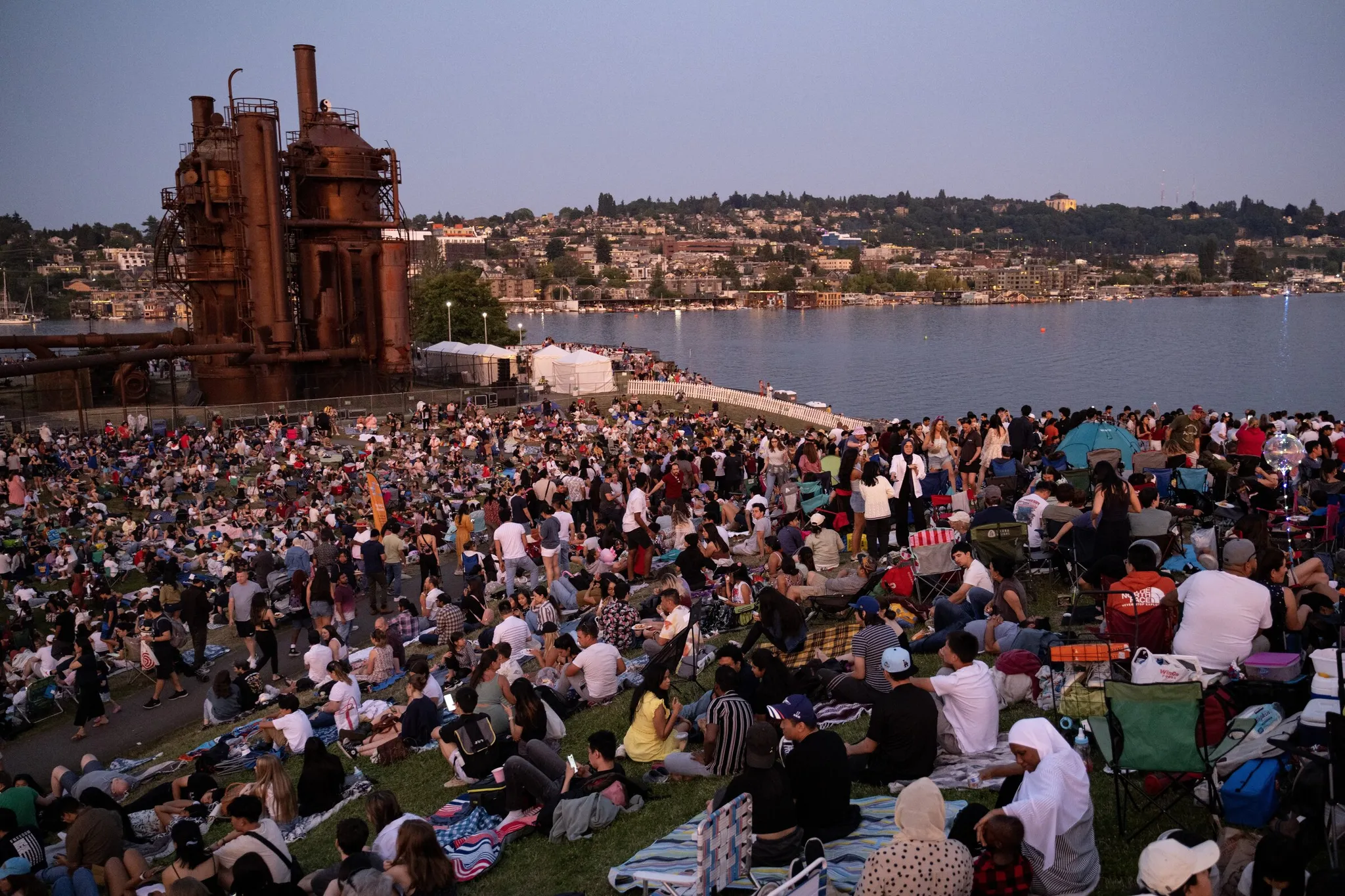
When she moved to Seattle nearly 40 years ago, Barbara Hubers-Drake discovered that she lived within walking distance of Gas Works Park. With its steep green Kite Hill, flat wide grassy fields spilling out into an unparalleled view of the city across Lake Union, and the breathtaking contrast of towering, rusted industrial equipment looming over all the wholesome picnics and kite-flying, the busy park immediately became a family favorite.
Hubers-Drake and her husband “brought our kids to play in the park often,” she says. The children loved to play and socialize in the large playbarn alongside brightly painted industrial tanks and pipes, and Hubers-Drake soon started to notice that Seattle loved Gas Works as much as she did.
Gas Works has been a part of the Seattle public parks system for 50 years, and from the day of its dedication, the 21-acre park has served as Seattle’s unofficial backyard — a place to hang out, come together and have fun.
But it wasn’t always so welcoming. Gas Works represents a breathtaking example of urban renewal: the decaying industrial hulks at the park’s center once served as a coal and oil gasification plant that helped power Seattle from 1906 to 1956. Though many Seattleites wanted to raze the structures and build a park from scratch, landscape architect Richard Haag reimagined the site as a public green space incorporating pieces of the gasification plant as a nod to its history. City leaders inaugurated Kite Hill as a public space in August 1973, after Haag’s bioremediation pilot program was proven to reduce pollutants in the soil enough to grow edible plants. The cleanup extended to the rest of the park that October. The area fully reopened as Gas Works Park in 1976.
More Gas Works Park
- How Gas Works’ belching hellscape turned into a postindustrial paradise
- How architect Richard Haag turned a gas plant into the beautiful Gas Works Park
- Postcards from the Past: Gas Works Park’s transformation
If you’ve lived in Seattle for longer than a few months, you’ve likely visited Gas Works for some event or another — maybe kite-flying with friends, taking photos of the spot where Julia Stiles and Heath Ledger engaged in an epic paintball battle in the 1999 film “10 Things I Hate About You,” applauding fire-spinners at a pop-up circus, or watching fireworks on a semi-soggy Fourth of July. Some of these events are arranged in advance with the city’s parks department, while others are more spontaneous acts of civic joy.
“We’ve gone to many music festivals there over the years,” Hubers-Drake says, recalling the annual Honk Fest street music celebrations as a highlight. “I thought it was one of the most fun festivals because you could have groups in various places throughout the park, performing at the same time.”
As an accomplished musician who plays the accordion, saxophone and piano, among other instruments, Hubers-Drake found herself contributing to the park’s musical legacy within a few years. First, she says, “I rehearsed with a group of English country dancers in the park every week,” and soon she was performing with any number of organizations, including an upcoming Oct. 1 performance with saxophone quartet Bamboo and Brass LTD in conjunction with the Seattle Composers Alliance.
You don’t need years of experience to put on a show at Gas Works. This summer the park’s fields were also home to a brand-new series of three free house music shows near the Concrete Railroad Trestle Arches called Groovin’ in Gas Works featuring local DJs including Shapey Rox, J.Sleep, Lili Alessa, FernFX, Marco Valencia, Karl Kamakahi and Kate Vaesil.
Groovin’ organizer Aaron Kroll, who performs as DJ Apocalypse, found that the first year was a period of “trial and error” and discovery. At one show, Kroll discovered a DJ unrelated to his event happened to be performing a pop-up set on the other side of Kite Hill, and attendees hopped back and forth between the two DJs.
While tens of thousands of musicians have performed at Gas Works, others, like members of Seattle’s Silent Book Club, head to the park for quiet reflection.
“Our group usually meets indoors, but in the summer it feels like a shame to waste that great weather,” says Stacy Kendall, who’s served as co-chair of the local group since 2019. “So we decided to do an outdoor meetup and [Gas Works] was the first place we picked.”
Participants came from all over the city with beach chairs and blankets and drinks and snacks to sit in Gas Works, read and chat about books while taking in one of Seattle’s unparalleled views.
“Seattle is not the biggest city ever, but it’s not tiny, either,” Kendall says. “When you’re sitting up on Kite Hill and looking out over Lake Union and the city, it sort of feels like you’re just right in the middle of everything and it all feels very close.”
Many Seattleites use Gas Works as a place to touch some grass and exercise. Grant Harrington, the owner and race director of the Snohomish Running Company, has been hosting a race now known as The Tenacious 10 at the park for eight years.
Harrington says he loves the park because “it’s an iconic location with plenty of space to it. The runners get to run through Eastlake, South Lake Union, Westlake and Fremont,” and they love to complete the race by “taking a selfie on Kite Hill with the Space Needle in the background.”
That I-word, “iconic,” comes up in nearly every conversation. It’s almost impossible to talk about Gas Works without lingering on That View over Lake Union.
“It’s really cool when we show up there at 4:30 in the morning to set up and all the city lights are lit and it’s dark and the water is calm. It’s really a beautiful place,” Harrington says.
Event planners like Harrington and Kroll also love Gas Works because it’s a way to get yourself in front of a wider audience.
Amber Parucha, a marketing specialist at local beverage company Yerbana, was tasked with creating a series of free public wellness events to promote their yerba mate tea blend. Yoga was popular with Yerbana staff, so they decided to host free classes. Parucha says Gas Works appealed to the group as a site because it’s accessible to North and South Seattleites and it’s reachable by car, bike and on foot.
The first yoga session, which brought maybe 25 people together, was considered a grand success. But now, Parucha says “anywhere from 500 to 1,000 people” come out on Wednesdays in the summer to practice yoga together in Gas Works. She says the series appeals to workers at nearby Google and SalesForce who need to decompress, as well as “folks that maybe don’t have the resources to be able to afford to go to a studio or go on a retreat to do breath work.”
Most Read Life Stories
“To see folks of so many different backgrounds and lifestyles be able to come and move together as one in their own unique way is really, really special,” Parucha says.
She also sees the group yoga practice as a way to reform and renew a plot of land that just a half-century ago was a decaying synthetic gas manufacturing plant.
“Transforming a space that was once used to extract from the land and people to turn a profit in kind of an icky way into something that an entire city can enjoy and utilize for social equity is a really cool story arc,” she says.
Gas Works is one of the most truly democratic public spaces in Seattle — all are welcome to put on a show, practice their art or spend time with strangers — and maybe become a little less distant in the process.
Bamboo and Brass LTD’s Hubers-Drake says Gas Works is one of her favorite places to perform music, but the park is more than just a venue to her; when she hired a photographer to take a portrait of her whole extended family, they chose Gas Works as the location for an obvious reason: “It’s home,” she says.
Paul Constant: thisispaulconstant@gmail.com; on Twitter: @paulconstant. Paul Constant is a Seattle-based writer and the co-founder of The Seattle Review of Books. His Neighborhood Reads series appears monthly in The Seattle Times.