Neighborhood Reads
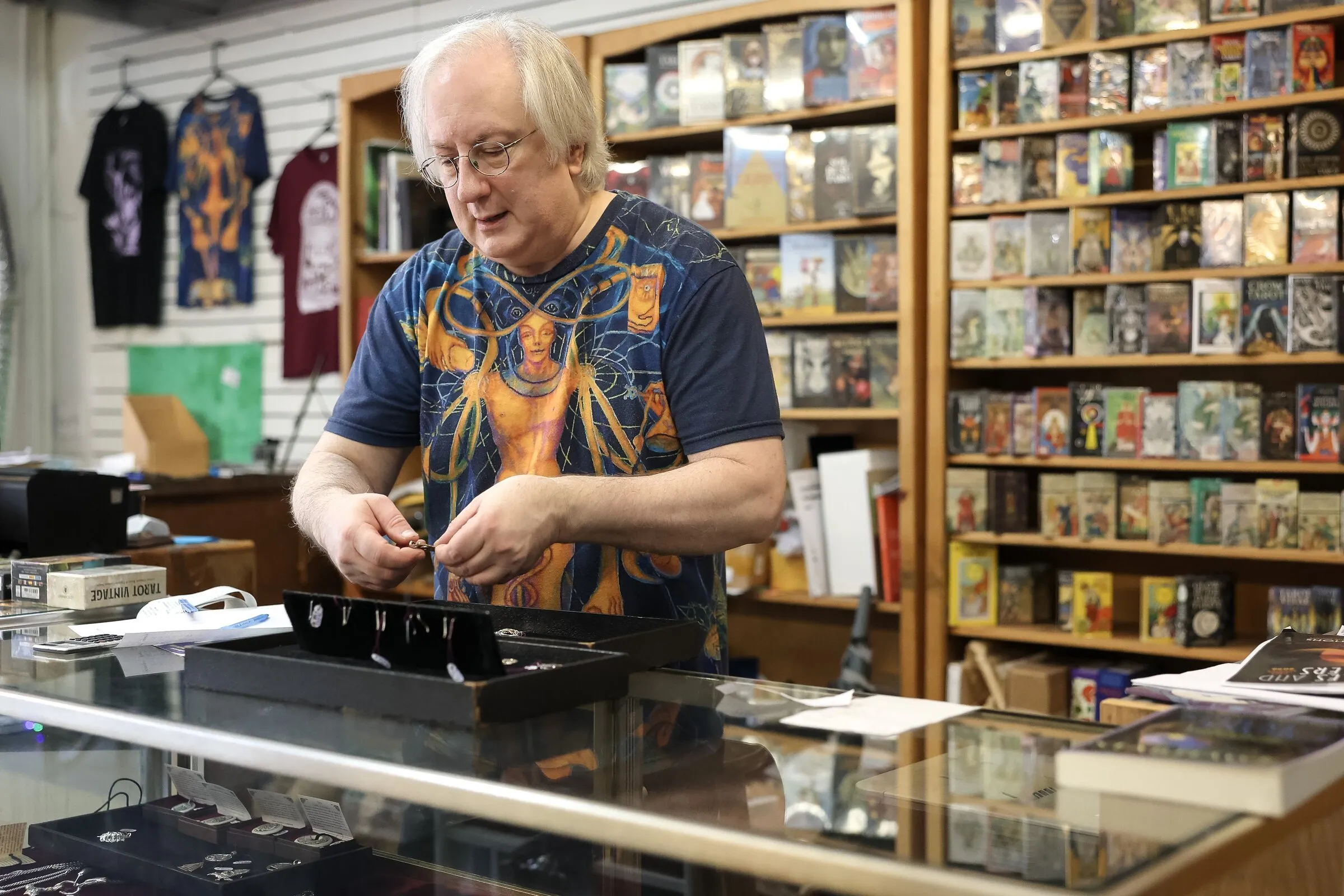
If you’ve never visited an occult bookshop, you might possibly harbor some suspicions about whether an ordinary, non-witchy, Patagonia-clad Seattleite would even be welcome in such a shop at all. Robert Anderson, owner of the University District’s Edge of the Circle Books, wants to put those fears to rest.
“Every nice person is welcome to come in,” Anderson says. He’s encountered nervous potential customers who ask whether Christians are welcome in Edge of the Circle, or if their beliefs would be mocked. “I am not here to do any harm, or to offend people,” Anderson promises. He adds, “I’m just trying to be here to provide for people what they want and need.”
Anderson explains that the shop that became Edge of the Circle Books started out as Shamanic Convergence, “a shack on 14th and Union, which has since been torn down,” sometime in the 1980s. A regular customer of the shop, Anderson started working there a year after it was renamed Edge of the Circle in 1992. In 1994, the store moved a few blocks away to its longtime home on Capitol Hill, at the corner of East Pike Street and Boylston Avenue. Anderson bought the business in 1995, and he shepherded its move away from Capitol Hill’s rising rents to its current home in the University District, a few doors down from the Neptune Theatre, in 2015.
On its website, Edge of the Circle Books refers to itself as “Seattle’s resource for Paganism & the Occult.” But the more apt description is actually a mission statement at the bottom of the home page: “Edge of the Circle Books strives to be everything that you could want in a Magickal Pagan store.” It’s that customer-centric promise which really gets to the heart of what Anderson’s shop is all about.
On Edge of the Circle’s bookshelves, you can find books relating to just about every major belief system, from Wicca to Nordic mythology to Afrodiasporic faiths to Santeria to Appalachian folk magic. There are guides to taking spiritual baths and taxonomies of all the angels in heaven. You can browse guidebooks for most forms of divination from astrology to palmistry to tarot cards.
“I have a lot, and I mean a lot, of tarot card decks,” Anderson says, adding that it’s “probably the widest selection of tarot out of anybody in the Greater Seattle area,” ranging from the popular decks you can find at other bookstores to rare examples from Il Meneghello Edizioni, an Italian publisher which describes itself as “the last artisans of tarot in the world.” Anderson explains that Il Meneghello’s “decks are made according to older practices. They make historical reproduction decks and other things, and they’re just wonderful.”
Perhaps most important, the shop stocks many levels of texts for seekers of all stripes, from practitioners to academics to novices. If you’re interested in learning more about the Orisha deities of the Yoruba people of West Africa, for example, you can find practical guides for ceremonies, histories of how the religion was practiced and shared, and critical works delving into the symbology of the religion.
Anderson is aware that his shop carries an aura of the taboo because the subjects of his books are often rejected by mainstream culture. But as a bookseller, he’s devoted to making sure that information is available. “I actually love that it’s easier to get this stuff now than it used to,” he says.
The shop also stocks a wide supply of jewelry, candles, incense, oils, T-shirts (many of which Anderson himself has designed using symbols and images selected from books in the shop) and other supplies for practitioners of almost any religion or belief system. Anderson and his staff of two booksellers love to track down extremely rare texts from tiny publishers halfway around the world and have hunted for ceremonial items to help their customers complete their rituals.
“If somebody needs, say, an iron pot of a certain dimension,” Anderson explains, “I can get that for them.”
And if there is a spiritual community in the area that can’t get the books, or supplies, or statuary, or symbolic jewelry that they need,” he says, “I’m going to get a whole bunch of that. And I will become their store.”
A life spent reading texts that more conservative institutions consider to be “forbidden” has endowed Anderson with a deep well of knowledge about the occult. If you’d like to learn a little bit about, say, chaos magic — the British punk-era reclamation of magic that was popularized by figures including comic book author Alan Moore, Anderson is happy to offer a crash course.
But in matters of faith, the most important rule is that nobody is more of an expert in what you believe than you are. “I love to let other people be the expert,” Anderson says. “This is part of how to get along well with your customers.”
What are Edge of the Circle Books customers reading?
It’s impossible for Anderson to choose a small handful of books to exemplify the breadth and depth of Edge of the Circle’s stock. But after much consideration, he recommends three titles for Seattle Times readers who might be interested in exploring alternative spiritual traditions.
Margot Adler’s “Drawing Down the Moon” offers “an overview of the Pagan religious movement in the United States,” Anderson explains. Subtitled “Witches, Druids, Goddess-Worshippers, and Other Pagans in America,” Adler’s seminal 1979 text helped to demystify earth-based spirituality for American audiences.
Anderson explains that Israel Regardie’s “The Tree of Life” is a historically important “description and explanation of Western occultism.” This volume has introduced generations of readers to ceremonial magic, explaining how to perform ceremonies that for centuries had been kept secret. Anderson recommends the edition edited by Chich Cicero and Sandra Tabatha Cicero, which offers commentary that further explains the text.
Luisah Teish’s “Jambalaya” offers “an accessible introduction to more than one aspect of African diaspora spirituality,” Anderson says. Ranging from Teish’s personal experiences as an Oshun priestess to a broader history of African traditions and their travels across the globe, this guide offers an opportunity for African peoples and their ancestors in the Western Hemisphere to tell their spiritual story on their own terms.
And because many new Edge of the Circle customers ask for tarot recommendations, Anderson offers two selections that demonstrate the available varieties. “The Original Rider-Waite Tarot Pack” is a recreation of Arthur Edward Waite and Pamela Colman Smith’s tarot deck as it was published in 1909, popularizing the divination technique. Anderson explains that “most modern decks are based on it.” But for those in search of a more singular experience, he recommends “The Aleister Crowley Thoth Tarot,” created by Aleister Crowley and Lady Frieda Harris, as “a brilliant example of an esoteric tarot deck that is VERY different from the Rider-Waite.”
| Edge of the Circle Books |
| 1307 N.E. 45th St., Seattle; 206-726-1999; edgeofthecirclebooks.com |