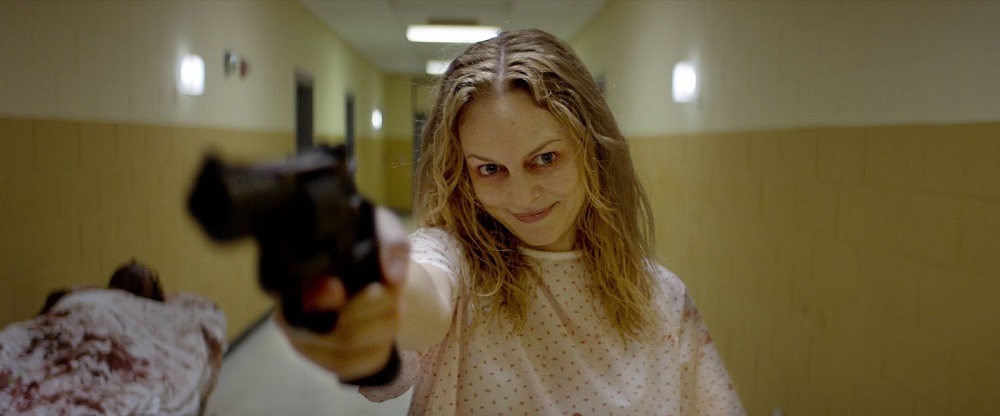
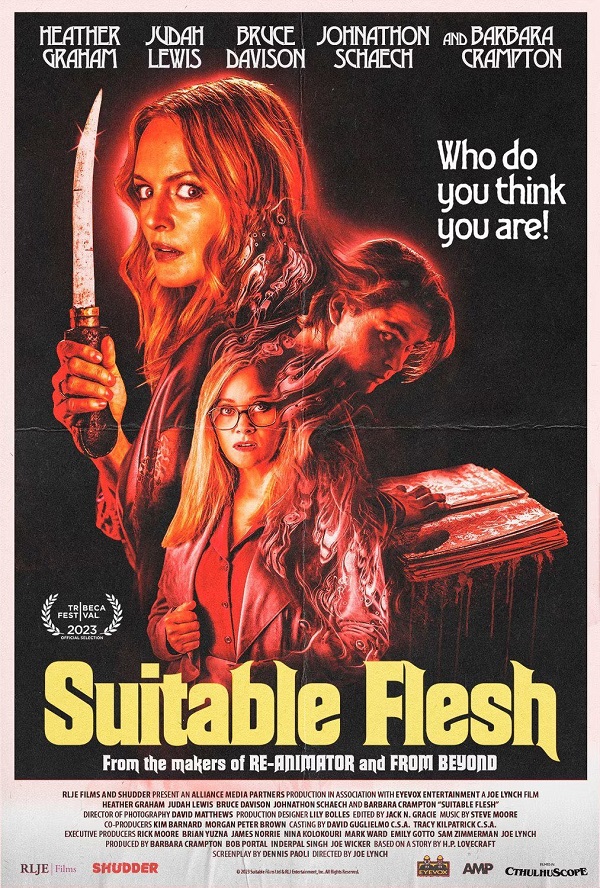
The horror film, SUITABLE FLESH (starring Barbara Crampton, Heather Graham, Judah Lewis, and Johnathon Schaech), premiered at Tribeca Film Festival this month, drawing in an audience with Lovecraftian lore and an all-star cast and crew. The film itself did not disappoint—far from it. Written by Dennis Paolo and directed by Joe Lynch, the modernized adaptation of H.P. Lovecraft’s short story “The Thing on the Doorstep” is a clever feature that combines humor, gore, and a playful attitude towards gender and sexuality.
We caught up with Lynch right before he boarded a plane to get to the festival to talk about his latest film, Lovecraft, and the cinematic power of watermelons.
What initially attracted you to this project?
Joe Lynch: Two words: Stuart Gordon. I was always a huge fan of his. [He’s] always been a vessel of all the kinds of things that I love in movies. He’s the one who got me into Lovecraft. He’s one of the filmmakers that taught me. He was one of those filmmakers that almost permitted the audience to be able to laugh and scream, and be disturbed and feel sexy, all sometimes in the same scene.
Up until [the] point when my mom brought the VHS home of Re-Animator (she doesn’t like me telling that but it’s true), I was always fascinated with that. I’d always seen movies that [were] either a horror or a comedy—never the same. Re-Animator was one of those films that started the splatter subgenre in the 80s, between Re-Animator and Evil Dead 2 and Return to the Living Dead, and even Friday the 13th Part 4, these were films that upped the gore but also infused a sense of humor. And that was something that I always cottoned to when I would think of Stuart Gordon; he was a big inspiration of mine.
So when the script came, I had already known that Stuart was doing it, or was going to do it, because it had been announced many times and I talked to him about it a little bit. So when the script came to me from Barbara Crampton, it felt very special, like an honor and a responsibility to be able to do this. But at the same time, if Stewart had made it himself, or had made it when he was originally going to do it back in the 90s, I think it would have been a different film.
We gender-swapped the two main characters, but we just didn’t do it because it was the hot, trendy, progressive thing to do; it was not done like that at all. I was even hesitant when we pitched it. There was something about the idea of taking these characters on a journey of identity and sexuality and obsession and desire in a way that I don’t think had been done before or not done in a long time, especially with older female characters.
Now, if this was the 90s and it was a Michael Douglas movie, no one would bat an eyelash. Today, if you [have] a character in his late 40s and he’s going through a midlife crisis and then this whole thing happens, I don’t think the audience would be as excited about it, or at least, interested in it. When we pitched to Dennis and Barbara and they were totally into it, we kind of went off to the races from there. And that, to me, was something that I [thought was] kind of [the] sensibility that Stuart Gordon would take if it were him.
Those are all the things that made me excited about the movie: the possibilities of making something that is a little bit dangerous, a little bit provocative, and a little bit sexy, but also able to tip the hat to one of the masters of horror that kind of made me who I am today.
I did really appreciate the whole notion in the movie that gender and sexuality are so fluid. I really appreciated how blatant that was.
Joe Lynch: I’m glad that you picked up on that. We tried to be both very aware of it, especially in these times, but not make it like an after-school special or not do it where it felt exploitative. Some of the best genre films of the past 30 or 40 years take politics, culture, things like sexual identity, and fear of the body and do it in a way while using tropes of horror and tropes of the genre. If this was just a regular drama, you’d feel pandered to. But if you use the genre, and you use iconography and tropes of this genre that we love so much, it’s kind of the sugar to make the medicine go down. What better way than to do something like this, to take a classic piece of literature from a genre master and flip it on its head and make it more subversive [and] still entertaining. We put a lot of thought into that [and] we tried to infuse a lot [of] what Dennis had done, all the way down to the editing of it.
Something that was [also] really important to me was that I wanted to surround the production with as many women as possible. In all of my films, as much as I’ve always been very close to taking the female gaze, I knew that there were going to be so many other people around me that was going to go like, “No, try like this”, or “What if we took it from this perspective” so by taking that purview, I feel like we did honor that sensibility, especially with our two female main characters I wanted it to not feel like it was coming from a misogynist point of view when it came down to the sex or the violence. We wanted to do it where it felt very respectful to that and have that point of view, and then take them on a wild ride.

Did you actually read the short story “The Thing on the Doorstep” before production started, or before you even read the script?
Joe Lynch: Oh, I’ve read it many times. But to be fair, I only read it once [before starting to make this film] years ago. It was just one of those stories that [you read] if you’re on the Lovecraft kick, thanks to Stuart Gordon and thanks to The Re-Animator being HP Lovecraft’s [story]. When I read it, I was 13 or 14, and at the time, there were a lot of body swap movies at the time, but they were all comedies [and] using the tropes of body swap in a zany and hilarious way. I never thought that you could take the body swap idea and do it as a horror story and done 80 years earlier. I was more of a Cthuluian kind of guy [but] I loved [Lovecraft’s] other stories as well. When the script came to me, I went back to the source material immediately, because I [was wondering] how much [the screenwriter] Dennis [Paoli] infused from the original story into the script. It doesn’t completely follow [it] to the word, but Lovecraft is one of those writers that is kind of like Clive Barker in [the] way [that] he’s almost unfilmable, [or] at least unfilmable if you take the structure of [the] story and prose and copy and paste into Final Draft.
Lovecraft uses first-person testimonials, he uses letters. He uses a storytelling form that is not always necessarily cinematic. When you look at what Stewart and Dennis did with From Beyond and Re-Animator and Dagon—which was originally Shadows Over Asmath—they were able to hone in on the essence of what makes Lovecraft not just the characters and the base plot, but also the atmosphere, and then apply that to a story that, whether it’s a classic retelling of it or a modernized telling of it, still feels very Lovecraftian. I’ve read [“The Thing on the Doorstep”] at least four times, from the moment that I got the script to even just a couple of days ago. One of the things I love about that story is that it’s this doctor telling the story about Dr. Derby, and you can picture someone telling that story. I wanted to make sure that we use that trope. A lot of times, that trope is used, especially when you’re like, “Let me tell you this tale…” and then it goes into the flashback. We always felt little bits of that throughout.
But then later on, my co-editor and I felt like we needed more, so we went back to the source material and siphoned some of the prose from the original story, just so that it felt like it was still Lovecraft, but also not making sure that it didn’t sound [like] all of a sudden our hero is starting to talk very [literarily] and very classical. Having those little bits felt like we were paying homage to Lovecraft, but also to a lot of the films that influenced us, like a lot of film noir.
Did you have the actors read the story?
Joe Lynch: I told them to! I sent it to everyone. But I also wanted to make sure that they knew that we were taking elements of Lovecraft, like hearing about the Necronomicon or Miskatonic University, but also, at the same time, we wanted to make sure that they knew we were telling a story to a modern crowd. You got to work the room, you know? You have to know your audience. Why wasn’t this set in 1822? Because that’s fucking expensive. Being able to tell a [story] like this, the way that we wanted to, making a modern version of it was probably the only way that we could afford.
But also if we were going to be able to get away with this kind of dark and provocative, exciting, and even dangerous way to tell this [story], the only way to do it is to do it in [the present]. I don’t think the gender fluidity would have worked as well in a society that would have been so classically patriarchal and so puritanical. I think that it would have been harder for us to tell that story. Whereas now, you can have someone like Judah [Lewis perform] that monologue [about gender]. And even if someone wasn’t [clear that] there is a 200-year-old entity inside of that person, [they] would just go, “Here’s someone who is, kind of, in a sort of sinister way, working on their gender identity and their sexual identity, and they’re proud of it.” Godd****it, you know, I think that would be a lot more accepted today than it would [have] been back then.
Did you have a favorite scene to shoot?
Joe Lynch: Actually, any of the scenes when it was just two actors talking was so exciting. When you’re doing movies like this, a lot of times there are gags and there are effects, and I love doing that, but they’re fucking terrifying because a lot of times you don’t have “take two” or “take three”—you get one take and hopefully everyone’s on their game because if something goes wrong, then that’s going to impact your day in production. But thankfully, we had these actors who came so prepared that it was such a joy to just see Barbara Crampton and Heather Graham [sit with] each other at a desk or in a padded cell and watch them create what we’ve been working so hard on.
Now that said, there are two sequences. Towards the end of the movie, there’s the crashing, and then there’s the stabbing. [The crashing] was something that I’ve had in my head for years ever since I got a Prius with a backup camera. I was like, “I gotta use this in something.” So that was something that I deliberately put into the script. It was really hard to be able to choreograph all of that stuff happening, all the way down to what we had to do in post. But to finally see it come together [with] the visuals and the sound was so freaking exciting.
And then right after it was what we call “the stabbening”—that was something that, on the day [of shooting], was terrifying because we had no time, we had one take and two cameras. And it just so happened that I went to a fruit stand and grabbed a watermelon because I have been in this business now [long] enough that I know that there’s nothing worse than an actor who tries to stab someone and they do it and there’s nothing there—you don’t get the tension and the torque on the wrist when [nothing is there so] it doesn’t look real. So I learned from that the hard way on my first movie, and I’m like, “If someone’s gonna be stabbing someone in the head, they need to stab something.”
So on the way to set, I went to this fruit stand and found a watermelon and brought that watermelon to set. And then it was time for Heather to do what she needs to do, over and over again, furiously, in a very crazy sort of way. The first take we did, the sun was coming up, there was no time left, and we were freaking out going like, “Oh my god, we’re not going to get this in.” This is such a huge, integral part of the movie. The first time she did it, there was no watermelon. And I’m like, “Guys, this is not working.” And you can tell she wasn’t into it either. I ran to my car, grabbed the watermelon, brought it back, and put it down, and I have never seen a fruit get so massacred in my life. And what was great about it was that the stuff coming up, that’s not gore. That’s not fake blood. That’s watermelon. That’s nature’s splatter.
After that was done, we realized we only had one angle of that, so in post, my editor and I found this technique that she actually kind of developed, and when she showed me [the cut], I got goosebumps, because that was something that I was so scared wasn’t going to work. And then it was something that we discovered in the edit together. It was so exciting to see. So those two scenes back-to-back, those are things that I’m so proud of. And one was definitely on the day. And then the other one was completely found in post. But those two scenes, I cannot wait to see with an audience.
SUITABLE FLESH had its world premiere at the 2023 Tribeca Film Festival.