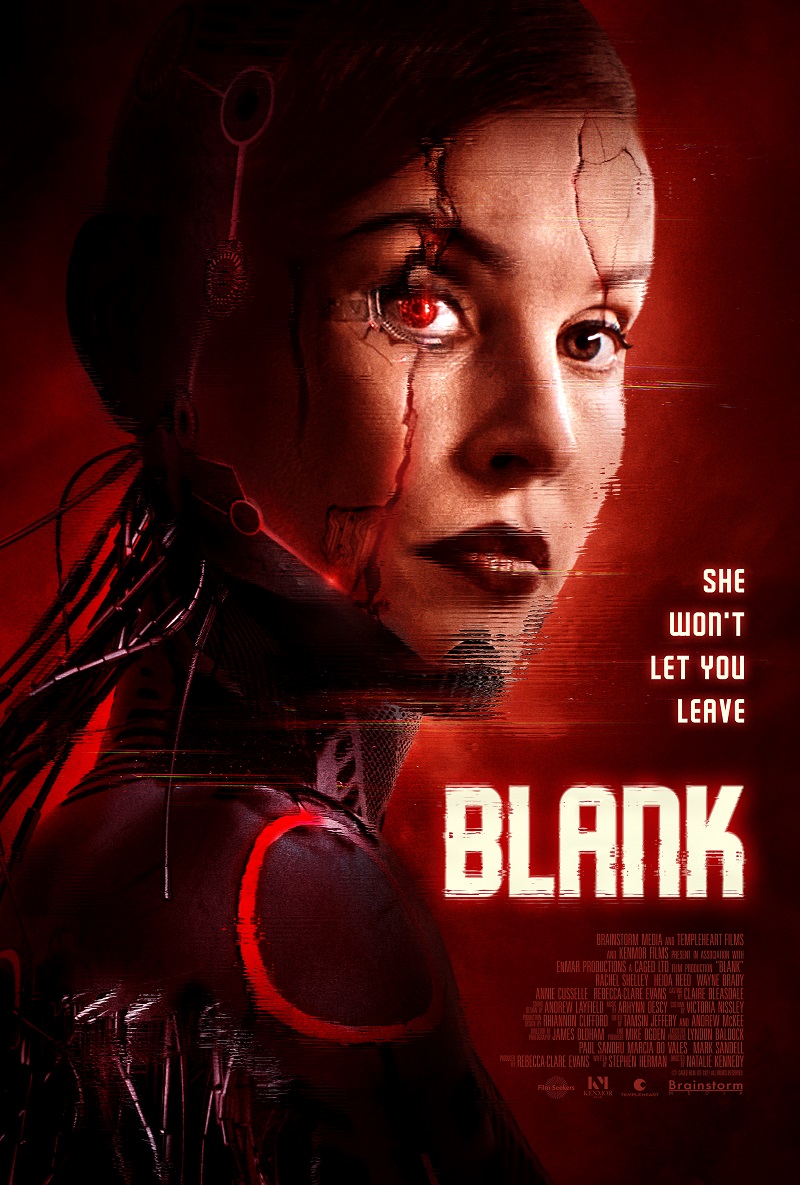
If you’re a writer or artist of any kind, you’re more likely than not familiar with the circle of Hell that is creative block. There’s an abundance of literary, cinematic, and artistic material that employs it as a plot device, often drawing from the creator’s own experiences. Art imitates life, right? The new film BLANK follows author Claire Rivers as she navigates, confronts, and overcomes her writer’s block with the help—and insistence—of some high-tech AI.
BLANK was directed by Natalie Kennedy and stars Rachel Shelley and Heida Reed. After screening and reviewing the film (spoiler: I loved it), I had the opportunity to interview Shelley and Kennedy during their virtual press tour. I somehow managed not to fangirl too hard.
Rachel, I was wondering if you could tell me a little bit about how you prepare for this role.
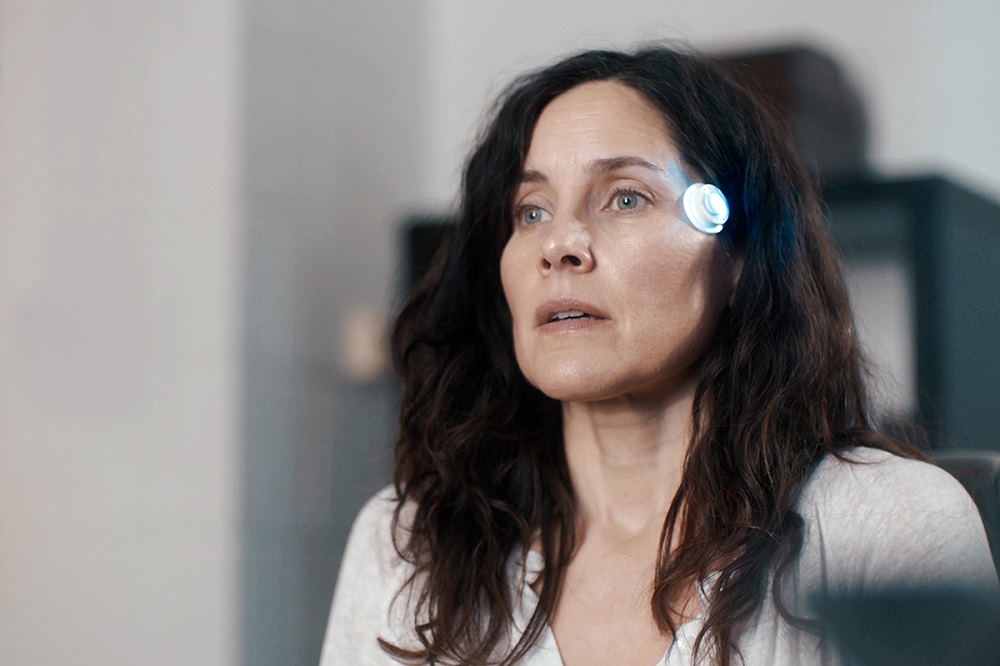
Rachel Shelley: I think the role had so many layers to her. And a fascinating element of it is obviously the blank page, the writer’s block. I’ve just recently found out that the writer Stephen, had experienced that himself, and that’s where a lot of this came from—this idea that he had the story and he didn’t quite know how to put it on the page. My husband is a writer, so I’m very aware of that sort of writer’s position where you’re in your head, and you’re so in your head that you’re lost in your world, and nothing else really matters. When you’re in that place, it’s all about what’s going on inside your brain. There were so many layers to Claire, her background, her story. Really interesting, dark places. It’s one of those scripts that when I read it, I almost knew immediately, exactly how it should feel.
I think Natalie said when she read the first few pages of the script, she could see it already immediately. I think when you respond like that to a script, it’s a good thing. I mean, you then obviously change things. You don’t stick to that. But you can feel it. You just feel it viscerally when you first read it. So yes, lots of preparations and lots of digging around in the character and her storyline and her arc and everything that happens to her, but a lot of it is there on the page. I responded to it automatically.
Natalie Kennedy: Coming into making my first feature, I kind of had an idea of what I wanted to make. And I knew I wanted it to be sci-fi, preferably around AI, but with a dramatic undertone, because that’s where I developed from when I directed shorts. We’d actually selected another script that didn’t quite fit the criteria and I just didn’t feel quite right going ahead with it. So I expressed myself to exec producer Linden Bolduc and producer Rebecca Claire Evans.
Driving back from Pinewood, we literally looked at synopses and I found this one. So I read it, and I was, like, two pages in and was blown away. Stephen Hammond did an absolutely fantastic job of writing it; he’s so talented. I just fell in love with it and love the fact that it was women in lead roles and in strong positions, because obviously I’m a female director and I want to show strong female characters. And that was something that really drew me to this one.
How long have you been a fan of science fiction?
Natalie Kennedy: Oh my god. I love science fiction. I mean, I read science fiction novels, and I love films like Man Who Fell to Earth, Andromeda Strain. Ex Machina was great and really inspired this movie. I’m a real fan of sci-fi and I have been for years. I literally grew up on it. So that’s why I felt for my first one, I wanted to do something sci-fi.
Rachel Shelley: It’s funny because I wouldn’t call myself a fan of science fiction. But that’s what’s quite interesting, because I think within that there is a subgenre of those films that kind of cross the line: they’re science fiction, but ultimately, they’re more character driven. I mean, I suppose big fans might say that all science fiction is character driven, but I feel like the really good ones are sort of bordering between the two. It’s science fiction but only an element of that. There’s a great book about an AI called “Klara and the Sun” by Kazuo Ishiguro, which is quite a recent book. It sounds like a science fiction book, but it’s not because it’s actually, at its essence, about the human experience. I mean, that’s what attracted me to this. It has an AI, but it’s actually about the human experience.
Rachel, you’ve done horror before, like the film The Children. What’s your relationship with the horror/thriller genre?
Rachel Shelley: It’s an interesting thing, because I think a lot of indie movies are horror, aren’t they? I think it’s a really interesting place for directors to come as first or relatively new directors like The Children. And the director, Tom Shankland, has gone on to have this illustrious career. It might have been [horror or] science fiction, but again, it was just a hint of it. It was really about the personalities and the characters. I think a lot of indie films are horror [because] that’s what gets made— there is a market [and] a taste for them. They do well in a way that maybe straight drama doesn’t. And they allow a creativity for first-time directors [that] maybe that straight drama wouldn’t.
Natalie Kennedy: I think that’s what attracted me to BLANK actually: the creative freedom. I started in drama—my short [film] career was in drama—and I felt like for a first-time feature film horror was an obvious fit, but I wanted to do something a little bit different. I feel like Blank actually has some horror elements. It’s quite creepy. Not so in-your-face, but it’s certainly there. And I think that’s a great place to start in indie filmmaking.
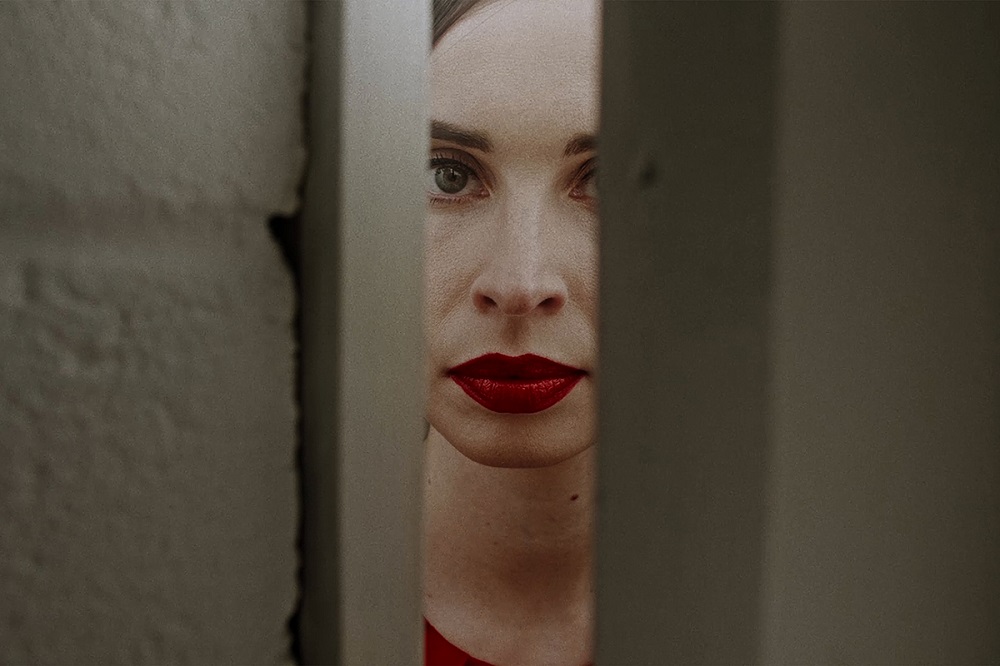
Rachel, could you talk a little bit about your experience working so closely with only one or two actors? There are so many close and really intense scenes with Heida Reed, so I was wondering if you could talk about working so closely with one other actor versus a whole cast?
Rachel Shelley: I think we were really lucky that it worked [and] that Heida and I loved working with each other. We fell very quickly into a good rhythm. We support each other really well. We both have the same way of working and discussing the scenes. As a scene partner, [she was] fantastic, but we also got on well, which [is lucky when] you’re in close proximity with someone for five weeks. Our working relationship was great. There was a lot of trust, [so] we could do things [and] try things out.
But also, we had Natalie steering us and digging into each scene to find out what was at the core of it, what were the beats that we wanted to hit. I really liked the intensity of doing what was pretty much a two-hander. I think it only helps because it’s immense, your relationship as characters, and you really get stuck in and we spent all our time with each other for those weeks, [which] only makes it deeper. It was great. Quite an intense experience generally, wouldn’t you say Natalie? Because we were all pretty much locked in that house.
Natalie Kennedy: Yeah, super intense. We all were staying together. We had accommodation separate from the set, and we were just together all the time. Very intense.
Rachel Shelley: Everything was in that house: our little green room, the makeup room, we ate there…there was no getting away from it. It really was like a little boiling pot of all the drama.
Natalie, was that intentional on your part, or did it just happen that way?
Natalie Kennedy: It just kind of happened that way. But I did want to build up the tension in those scenes; I felt that it would work well. Having everybody intensely filming together in a location, staying together, staying close by, it was really important to use the real-life situation in the film situation. It was very intense.
Rachel, your on-screen relationship felt very intimate, and it was so jarring because there’s so many intense physical scenes between you two, with all the stunts. How was the preparation and the training for that?
Rachel Shelley: I think it was a very clever move to schedule a lot of the really physical stuff for the end of the shoot so that [Heida and I] were very familiar with each other, very comfortable with each other. We could work it out between us but the stunt people [Kenan Ali and Kaitlin Howard] were really good, they really helped. What’s interesting is that when I watched it back, which was a fair amount of time after we shot, there was a lot that I had not quite forgotten, but I was seeing it in a new way. You don’t need a lot, if it’s done well, to give this idea that there’s a lot of physical fighting, but there really was only one [fight]. I mean, there was the wrist [grab]…
Natalie Kennedy: There was the grab of the wrist earlier on, and then there was [the fight] sequence that came later, but it was intercut with other scenes. And there was the fight choreography that Kaitlin Howard did in the story with Young Claire and [her mother] Helen Rivers.
Rachel Shelley: We only had a couple of days of doing that fight sequence, but it’s very interesting: I think that the filmmaking art, what’s implied, what you capture in the story, you can tell with just a few moments. And I think it’s done very well there. And like you say, there’s that whole other story—which I wasn’t a part of—that you filmed which was probably more physical.
Natalie Kennedy: it was really important to me that the fight sequences were really balanced out. Rita kind of shows a version of Helen [and] in a way she kind of takes on that role. She’s reading the story [and] she kind of becomes that character.
After doing this film, if you were given the chance to spend 30 days in a completely AI-driven house, would you do it?
Rachel Shelley: Would I have to do it with a film crew?
Nope. Just you.
Rachel Shelley: Okay, then yes. What about you, Natalie?
Natalie Kennedy: Oh, I would not. That’s why I made the film! It’s to question how much AI should play a part in our lives.
BLANK is now available in select theaters and On Demand.