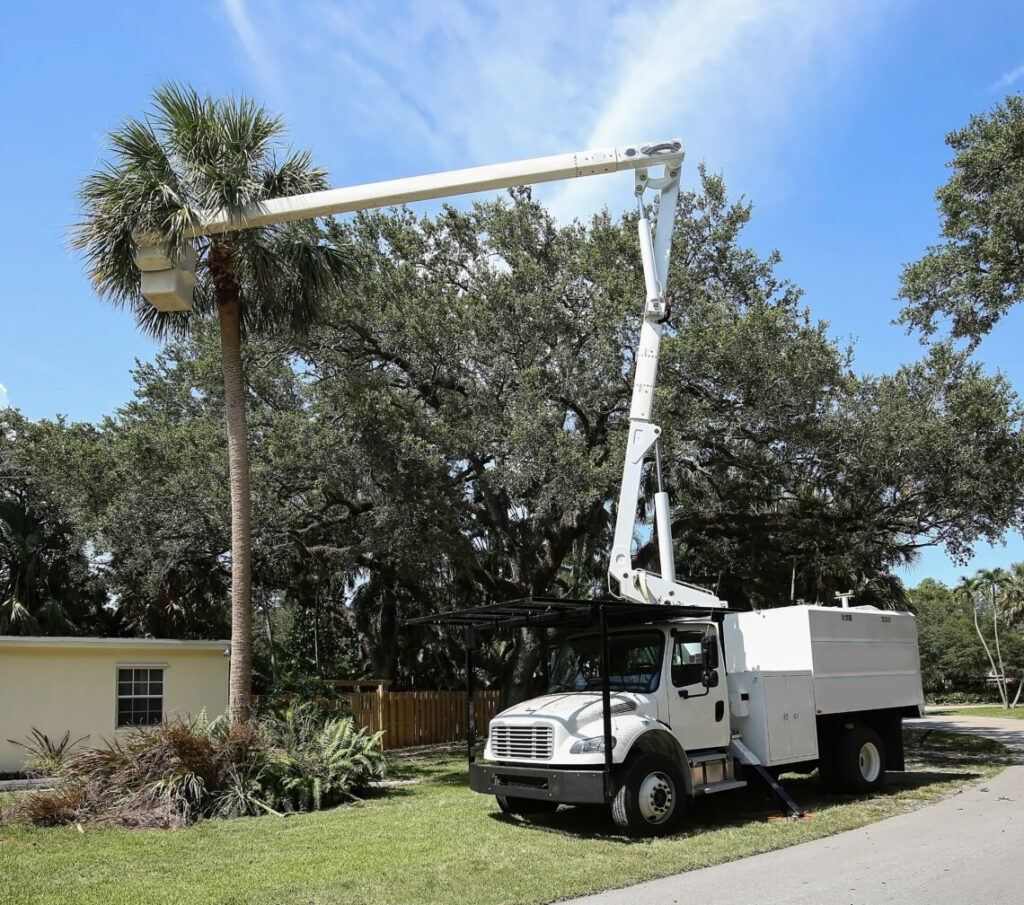
When a tree on your property becomes a danger to your home or landscape, it’s best to address it as soon as possible. You’ll want to remove the tree safely and effectively, whether on your own or with the help of a local tree removal company.
“With trees, there’s no margin for error,” said Chris Kemp, ISA Certified Arborist and tree and plant health care manager at Piscataqua Landscaping & Tree Service in Eliot, Maine. “When a tree or branch falls, it can be catastrophic. You don’t want to kick the can down the road too long.”
The larger a tree gets, the more complex and dangerous the removal process becomes. Dead trees can also be unstable and pose additional hazards. This guide explores factors such as safety, the tree removal process and professional tree removal costs.
What do you need to remove a tree?
Before you remove a tree, ensure that you have all the necessary permits, tools and safety equipment.
Permits
Review your local regulations or contact your township to see whether you need a permit to remove a tree or stump. You’ll likely need to apply in advance, and some municipalities will require you to hire a tree service for the job.
Tools and materials
The tools you need will vary by the tree’s size. You’ll most likely need a handsaw, axe or chainsaw to cut through the tree trunk. A pole saw or loppers can be useful for low-hanging branches, and a stump grinder or shovel can be used to remove the stump. All of your tools should have new blades and chains.
“The protective gear is the most important,” Kemp said. “You want to have hearing protection, eye protection, a face shield, a hard hat, chaps and steel-toe boots.” This equipment can protect you from sharp tools as well as falling branches and other hazards.
Safety precautions
Trees can be unpredictable and may not always fall the way you assume they will. Follow these tips to remain safe.
- Know how to use all the tools you need.
- Clear an area equal to the distance of the tree’s height in all directions.
- Don’t allow children or pets near the work area.
- Let your neighbors know that you’re planning to remove a tree so they can stay clear.
- Enlist someone to watch for falling branches and warn you when the tree starts to fall.
- Consult with a professional arborist if you have any doubts about where the tree will fall.
7 steps to remove a tree
How you should remove a tree depends in part on its size. The steps below are for felling a tree, which means notching it at the base and controlling the direction in which it falls.
The experts we talked to don’t recommend felling a tree anywhere close to a target, which refers to a structure such as a home, shed, garage, fence, pool or anything that a felled tree could damage.
“Trees have personalities,” Kemp said. “It might be leaning in one direction, but it can fall in another direction when you cut it. It takes expertise to control. If you’re in the woods, that’s one thing, but if you’re in the backyard and it goes the wrong direction, it’s going to end up in a neighbor’s pool.”
If the tree you want to remove is in a safe area clear of potential targets, and you plan to remove it on your own, follow the steps below so that you and those around you are safe.
1. Evaluate the tree
Look at the tree from all angles to see if it has a natural lean, which indicates the direction it’s likely to fall. Ensure that the tree will not hit any targets such as buildings, vehicles, fences, power lines or pools. If you have any doubt about the direction the tree is likely to fall, contact an arborist to prevent property damage from occurring.
2. Plan your escape
If you decide the tree is safe to cut, know that it can still be hard to predict where it will fall. Plan two clear escape paths in different directions: A primary path in the opposite direction of where you think the tree will fall, and a secondary path about 45 degrees away from that. Clear any hazards on both routes as far away as the tree’s height. This includes brush, furniture and tools.
3. Remove as many branches as possible
Use a pole saw to remove any tree limbs that you can reach from the ground. This will help the tree fall in a more predictable way. Don’t climb to remove higher branches, as this can be dangerous.
4. Make an angled notch cut
Make a notch on the side of the tree where you want it to fall that takes up about a quarter of the tree’s diameter. Standing with your shoulder against the tree, use your saw or axe to cut at a 70-degree angle in an upward direction. At the bottom of your angled cut, make a horizontal cut parallel to the ground. You should be left with a triangular notch.
5. Cut the tree
You and a partner should keep your eye on the tree at all times, as the tree should fall during or after this step. Start to cut horizontally on the opposite side of the tree in line with the bottom of the notch. This is called a back cut. Stop cutting when only about 10% of the tree’s diameter is left in the middle. This is the hinge.
6. Make the felling cut
Make slow, deliberate cuts at the hinge and watch carefully until the tree begins to lean. When it does, pull your cutting tool free and follow one of your escape routes. Stay well clear of the tree until it falls completely.
7. Disposal and cleanup
With the tree successfully felled, use a chainsaw to cut it into smaller pieces. These can be saved for firewood or hauled away later. Trim down the tree stump as low as you can. If you want to remove the stump as well, look into a stump removal service or stump grinder rental. Grinding a stump can turn it into mulch that you can use for landscaping.
When should you call a professional?
Tree removal is complex and dangerous. As a general rule of thumb, you should call an arborist or professional tree removal service when reaching a tree’s problem areas would require climbing. Felling a large tree can take a trained arborist eight hours or more, so you can save a significant amount of time by calling a professional.
“I strongly recommend not doing your own tree climbing or tree cutting,” Kemp said. “If you’re doing minor pruning from the ground and have a small hand saw or pole saw, that’s one thing. But control falling a big tree is a whole different category.”
It’s also worth noting that falling branches can be unpredictable, so you should still wear safety gear and use the proper tools when doing minor pruning on your own. An electric pole saw, for example, costs just a few hundred dollars and allows you to stand out of the direct path of falling branches.
How much does tree removal cost?
The average cost to remove a tree is between $2,500 and $3,500, according to Lisa Tadewaldt, ISA Board Certified Master Arborist and owner of Urban Forest Pro in Portland, Oregon. That accounts for three workers on-site for one day. Those in rural areas with a lower cost of living can expect to pay between $1,700 and $2,300, while those in areas with a higher cost of living might pay $3,300 to $4,700, according to Tadewaldt.
“Generally, when I do an estimate, I look at how long it’s going to take to do the work, travel time, time to dispose of wood chips, prep saws and fuel trucks,” Kemp explained. “You’re looking at anywhere from $75 to $95 per person per hour.”
Factors that impact price include the location of the tree and the landscaping around it.
“Sometimes you have to use a crane because the yard is immaculate,” Tadewaldt said. “There are other jobs where we do a cut-and-leave, which means we just throw it on the ground because the backyard is basically just a forest. That affects the price.”
When should you remove a tree?
There are many key indicators that it’s time to remove a tree. Keep your eye out for the following signs:
- The tree is starting to lean.
- The tree shows visible decay, cracks, cavities or dead areas.
- The tree was struck by lightning.
- The trunk is starting to upheave and expose the root system.
- A significant part of the tree was lost in a storm.
- Dead branches hang over wires, buildings, driveways, playsets or pools.
What’s next?
If you’re concerned about a tree on your property, contact a few arborists. Many provide free consultations to determine whether a tree is unsafe, along with strategies for safe tree trimming or removal.
“Get multiple bids,” Tadewaldt advised. “I highly recommend being there in person. It’s a big project. There are a lot of details that get discussed.” To find a pro, start with word of mouth or by searching online for the best tree removal services in your area. Look into the best lawn care services if you want help trimming or pruning trees.
“If a neighbor uses somebody and they’re happy, that’s the person you want to call,” Kemp said. “Ask a lot of questions. If you feel a connection to the arborist, that’s great.”
Before you sign a contract, check with your state to confirm the arborist’s licensure and certification.
Homefront has an affiliate disclosure policy. The opinions, analyses, reviews or recommendations expressed in this article are those of the Homefront editorial staff alone (see About Homefront). Homefront adheres to strict editorial integrity standards. The information is believed to be accurate as of the publish date, but always check the provider’s website for the most current information.
Nick Cellucci is a contributing writer for USA TODAY Homefront. He specializes in educating fellow homeowners on home improvement topics including flooring, renovation, HVAC, home security, moving and solar. His work has been published on Angi, HomeAdvisor, Forbes Home, Mohawk Home and Yelp. Nick is based in South Central Pennsylvania and enjoys traveling in a DIY-renovated retro camper van with his wife.
Erika Skorstad is a senior editor for USA TODAY Homefront. She covers topics ranging from home warranties to lawn care. Previously, Erika edited content about venture capital, marketing and cloud computing. She has a BS in professional writing with a minor in interactive narrative. Her fiction has been published in Marathon Literary Review, Levitate Literary Magazine and the Burlington Writers Workshop Cold Lake Anthology. Outside of work, Erika enjoys reading psychological thrillers, doing yoga, going on nature walks and spending time with her sassy black cat, Cassie. She lives in Washington.