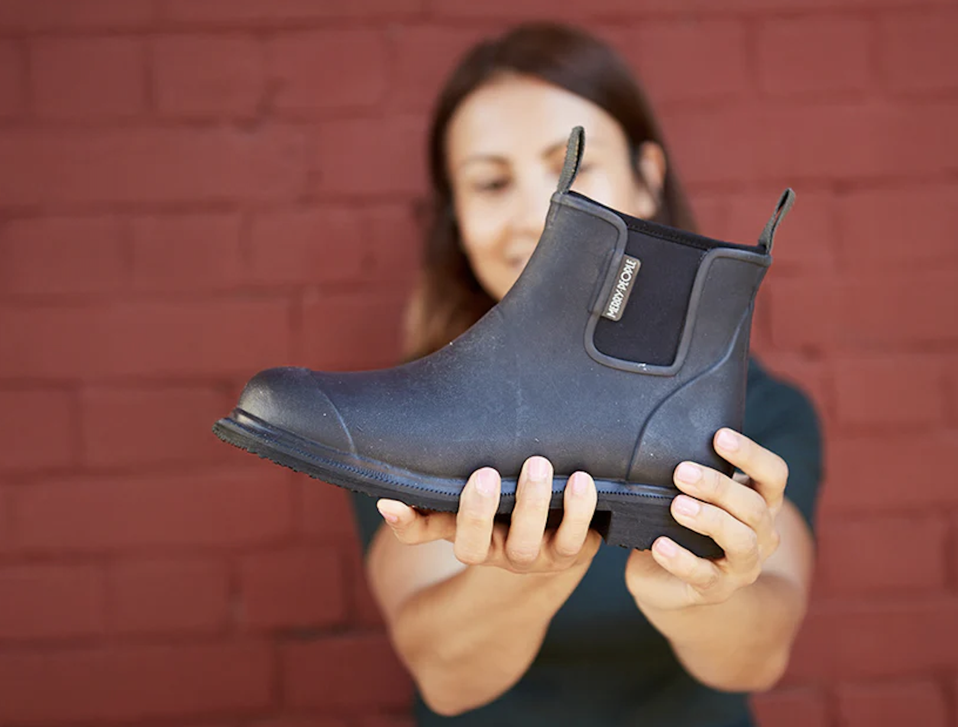
Hunter now makes some, as do Barbour, Aigle, and plenty of others, but Australia’s cult gumboot brand Merry People—a self-funded startup founded in 2014 by then twentysomething project manager Danielle Pearce and sold first from solo stalls at farmers’ markets—shook up the footwear scene when its fashionable yet practical ankle wellies launched in the U.K. and the US in 2021.
Australia’s summer is winter in the northern hemisphere so the transition to export gave the wet-weather-reliant business potential for year-round sales, funding its Instagram-fuelled expansion.
Using natural rubber—“tapped” from Pará rubber trees without felling—from audited and regulated plantations subscribing to Forest Stewardship Council guidance is one of Pearce’s ways of staying true to her “be kind” founding ethos. Another, in 2024, was commissioning environmental audit firm Pangolin to carry out a life cycle analysis (LCA) of the company’s best-selling Bobbi boot, a Chelsea-boot-style ankle welly. (Wellies are called gumboots in Australia and rain boots in the US.)
The analysis—not so much a carbon footprint snapshot as a wellyprint one—found that a pair of Bobbi boots creates, on average, 11.6 kg of CO2-e emissions. “This is in line with general footwear,” explains Pearce, “but gives us lots of room to improve.” To put this into perspective, she quoted from the LCA report, making 86 Bobbi boots causes the same emissions as flying from Adelaide to Melbourne in economy class five times, or sending 476 kg of food to landfill.
Pangolin rated the sustainability of the raw materials used by Merry People’s Chinese factories, as well as company-wide waste management, electricity sourcing, and consumption. Also tracked was the process of sending the finished boots to warehouses around the world and the disposal of both worn and unworn damaged boots.
Using data supplied by Merry People, Pangolin found that material usage was the most significant driver of the firm’s carbon wellyprint, contributing 37.4% of total emissions. The second largest contributor was the assembly stage, contributing 26.7%—this includes the power and resources used during manufacturing. The third largest driver—at 17%—was the transportation of the wellies from Australian warehouses to customers around the world. End of life makes up 8.4%.
“It was an extensive task,” says Pearce, “but now we truly understand what changes we need to lower our carbon footprint.”
Carbon footprint
The term “carbon footprint” was a PR construct, designed to make individuals feel guilty for Big Oil’s pollution. Writing in 2020, Mashable science editor Mark Kaufman explained: “British Petroleum, the second largest non-state owned oil company in the world, with 18,700 gas and service stations worldwide, hired the public relations professionals Ogilvy & Mather to promote the slant that climate change is not the fault of an oil giant, but that of individuals. It’s here that British Petroleum, or BP, first promoted and soon successfully popularized the term ‘carbon footprint’ … The company unveiled its ‘carbon footprint calculator’ in 2004 so one could assess how their normal daily life—going to work, buying food, and traveling—is largely responsible for heating the globe.”
The company’s website-hosted carbon footprint calculator (since taken down) worked out how individuals affected climate change. In 2006, the slogan of the PR campaign ‘It’s time to go on a low carbon diet’, implied that individuals, rather than corporations, were to blame for greenhouse gas emissions and resulting climate change.
Today, carbon footprint calculators are ubiquitous, found on the websites of, among many others, the European Union, Greenpeace, and the WWF. (The one on the US Federal Environment Agency website was squished by the Trump administration.)
Lifestyle
Pearce started out selling Merry People boots at farmers’ markets in the Melbourne area on weekends. “I moved from the farm to the city for study and work, and whilst in the CBD, I couldn't find an all-weather boot to get me from my daily commute to the corporate world and then back to the farm on weekends,” she said.
“I felt that an everyday waterproof boot could be the most practical type of boot. I began wondering if I could merge the function of my childhood farm boots into an on-trend, fashionable silhouette for everyday, city, and country living.”
Touting her wares at farmers’ markets was better, said Pearce, than taking the crowdfunding route.
“Early days, I was still trying to assess whether the business had legs,” she said. “I’m a solo founder, and I wanted to see if people liked the product first. There were a lot of start-up businesses launching via Kickstarter at the time, but it was a lot of work to put together a campaign, so I kept it simple. There were parts of Melbourne where the boots sold well, and then others where I wouldn’t get a single sale all day. I worked out what my early adopters wanted and went from there.”
Starting the business was a lifestyle choice.
“I was in my late twenties, at a stage in my life where I needed a different pathway. I was in the corporate world, and I wasn’t happy. I was working in banking [for New Zealand’s ANZ bank] in a comms position, although I had been an arts journalism major at university. At the time, it was tough to get a job, so I thought, ‘I’ll just take this; it’s a great opportunity; it pays well; I’ll work it out later.’ I got sucked along the conveyor belt of money and opportunities, and not really doing what was right for me.
“I had a relationship through my twenties that broke down. I felt lost and didn’t connect with the person I was anymore. I remembered what it was like when I was in high school and university—I was creative and fun and had a real passion for life. When the relationship broke down, it almost permitted me to get out of the corporate world. I threw myself into my brand while all my friends were buying houses, growing their careers and settling down. I moved into a share house and put all my money into this gumboot business. I thought, ‘if I don’t do this now, I never will. I don’t have any children, I don’t have a mortgage, I’ve got savings; at worst, I will lose all my money and I’ll end up living with my parents.
“I wasn’t surrounded by other business people at the time, so I didn’t know much about getting investors. I just worked hard to get this thing off the ground.”
Her first order was for 3,000 units. “Which was a lot,” she said.
How did she work out which sizes to order?
“I went to shoe stores and asked them, ‘What are your most popular sizes?’ I also looked at data online, but in the end, it was a risk. When you start a shoe brand, and when it’s your own designs, you need to pay for molds and tooling and things to set up that particular design, so there were plenty of initial costs; it was all of my savings, money that I was going to buy a house with. But I was in a risk-taking, startup mindset. I really believed in it. I felt that there was a genuine gap in the market. There weren’t any ankle wellies in Australia at that time. I grew up on a farm wearing wellies, and I felt that no one from the city was going to start a welly business.”
With no experience in footwear or brand building, Pearce’s Merry People does its own thing.
“We never go on sale,” said Pearce who now describes herself as a “busy mum and CEO.”
“When we do a high-fashion, risky color, we’re happy for it to sell out rather than have ordered too many in the first place. Sometimes my commercial and finance team pushes me, telling me we’re leaving money on the table, but I think that if we constantly had everything in stock all the time, then we wouldn’t create the scarcity that we’re now known for. We’re honest: when we say a product line or color might sell out, we mean it.
“I don’t have any investors. I’m personally responsible for our stock. There is an element of how much risk I am willing to take on. I don’t want to have tens of thousands of stock items sitting in a warehouse. I’d rather undershoot and move all the products we’ve made. I’ve had advisors who tell me that this model won’t scale, but I tell them, well, I’m just going to keep trying.”
Not overstocking has environmental benefits.
“We’re not dumping in landfill,” said Pearce.
“I’m proud that we’re creating a practical product that is built to last.”