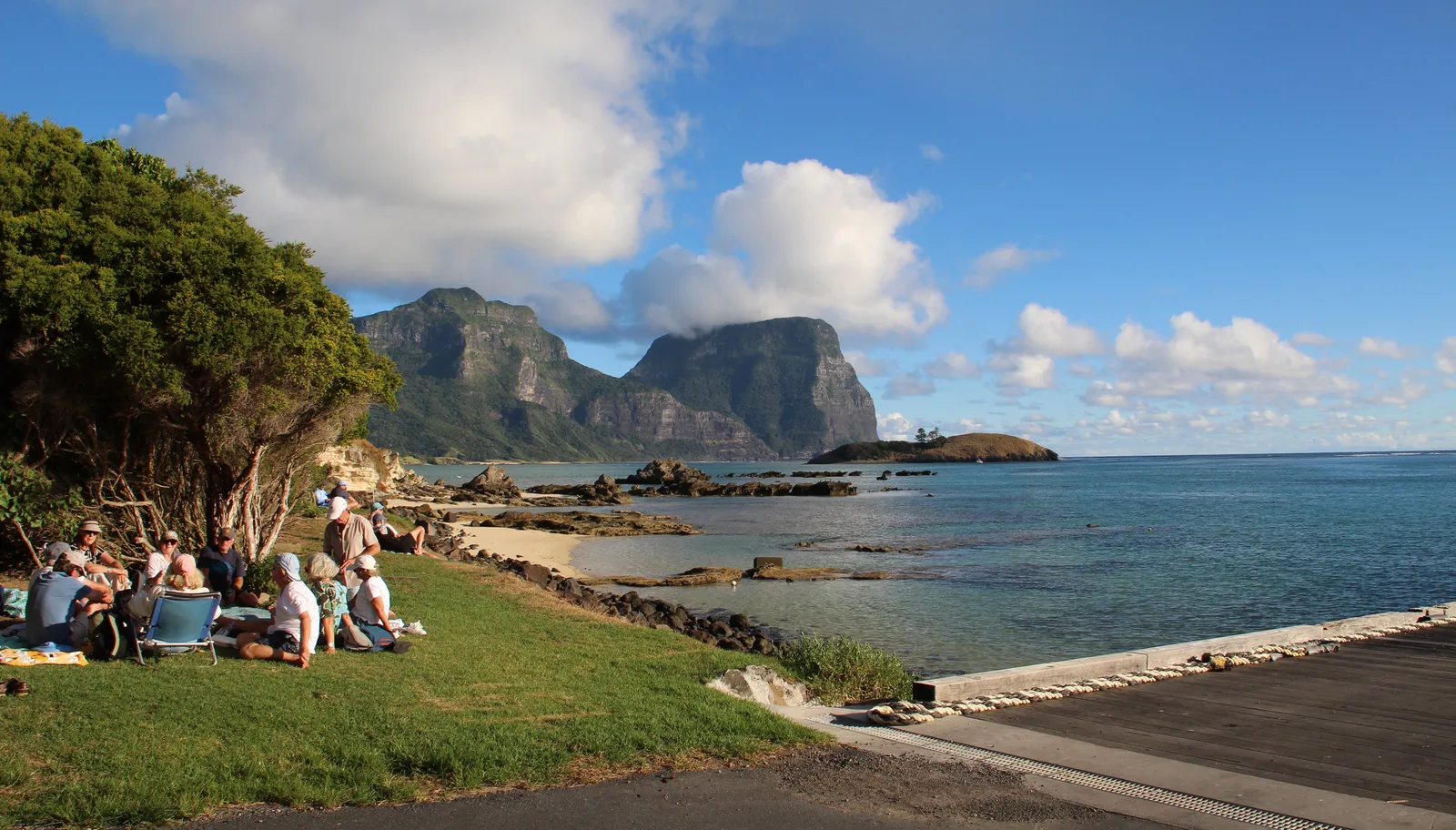
People used to say a holiday to Lord Howe Island begins on the plane. This was back in the days when people travelled to this small remote island, about 780km north-east of Sydney in the middle of the Tasman Sea, aboard ‘flying boats’. These charming, luxurious aircraft operated from about the 1940s to the ’70s. They had dramatic descents over Lord Howe’s iconic mountains and valleys before landing in the jaw-droppingly beautiful lagoon. The seaplanes and their aquatic ‘airstrip’ landings were adventures in themselves.
Fast forward to 2026. While flights are now on jet-engine Dash 8s – and touch down on a more conventional airstrip on land – these planes are still comparatively small. When I boarded one earlier this year, not only did it feel like an adventure, but I definitely felt a holiday vibe as soon as I entered the aircraft.
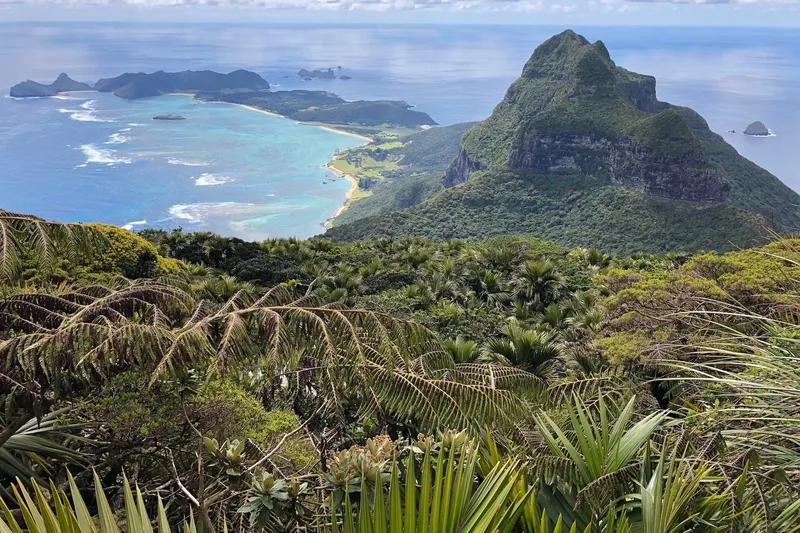
Taking off from Sydney, for a couple of hours nothing but blue ocean filled our window views. When the island finally appeared as a tiny green speck, I could feel the excitement of everyone on board.
As we flew closer and the island’s lagoons, reefs, beaches, towering peaks and Jurassic Park-esque forests came into view, I thought to myself: I can’t believe people actually live here. Not just because it looks so unspoiled, but because it’s just so very isolated.
As it turns out, this island paradise was uninhabited by humans until very recently. Fascinatingly, no indigenous peoples ever lived here. And while explorers, sailors and whalers came and went from the island from the late 1780s onwards, it wasn’t settled until the 1840s and ’50s.
A ‘unique’ destination
The word ‘unique’ is thrown around a lot these days – especially when spruiking travel destinations. But in the case of Lord Howe Island, it’s 100 per cent justified. Its volcanic landforms shelter a stunning 6km-long, 1.5km-wide lagoon. Its waters host the world’s most southern coral reefs. Needing warm waters to survive and thrive, coral only grows this far south of the equator because of the East Australian Current, which swings past the island. This influx of warmer waters converging with the region’s otherwise mild waters creates an environment that supports diverse marine life – tropical, subtropical and temperate species, all in one place. What’s more, many of these marine species are endemic, found nowhere else in the world.
Meanwhile, the landmass itself packs a lot of punch for such a small place. Just 11km long and about 2km wide, an incredible number of habitat types exist here, each supporting endemic animals and plants that evolved in isolation for millennia.
While some wildlife populations were decimated by invasive pests after human settlement (including farm animals, but rats and mice caused the most damage), a recent eradication program saw Lord Howe become Australia’s first inhabited island to eradicate invasive rodents.
The island community is also unique. Home to only 400 residents (give or take), the population size is tightly regulated, the majority being descendants from early settlers. Visitor numbers are also capped at 400 so the island is never ‘overrun’ by tourists, regardless of the season. There’s also minimal development, and few cars. No mobile phone towers mean limited phone and internet reception, and powerlines are all located below ground. Strict biosecurity measures dictate restrictions on domestic pets and even garden plants.
Considering all the above, it’s no surprise Lord Howe Island is a place where people go to relax. The Beach Boys once sang, “We’ll get there fast, and then we’ll take it slow” – and that’s the ethos of most holidaymakers here. A remarkably high percentage of them are repeat visitors; it’s an escape from the rat race, allowing people to rest and recharge.
It’s almost impossible to stress here. With no mobile phone coverage, you have no choice but to disconnect. Everyone is on ‘island time’, and only a handful of hire cars are available. It’s pretty hard to be strung out when you’re cruising around paradise on a bicycle!
Reef to rainforest
The marine environment here is incredible, so it’s no surprise snorkelling and diving are popular tourist activities. Several local operators offer tours to the inner and outer reefs, many on glass-bottom boats. Hiring snorkel equipment or a kayak is easy if you want to get to all the top spots.
After arriving on the island, the first thing I do is join a boat tour with Marine Adventures and head out on the water. Ten minutes after jumping into the water, I’ve already spotted – among the hard, soft and spongy corals – a bunch of the famous native and endemic species I was hoping to see, including the halfbanded angelfish, Coleman’s pygmy seahorse and Lord Howe pipefish. A cheeky Lord Howe moray eel even pops its head out, seemingly to say hello. My favourite, though, would have to be the McCulloch’s anemonefish. A black version of the more famous bright orange anemonefish, I like to think of it as ‘goth Nemo’.
Later, a curious green sea turtle suddenly appears beside me and doesn’t mind when I swim parallel to it, keeping pace, not wanting the interaction to end. My focus is only lost when I see another turtle below, a hawksbill, scratching itself on a bommie of hard coral.
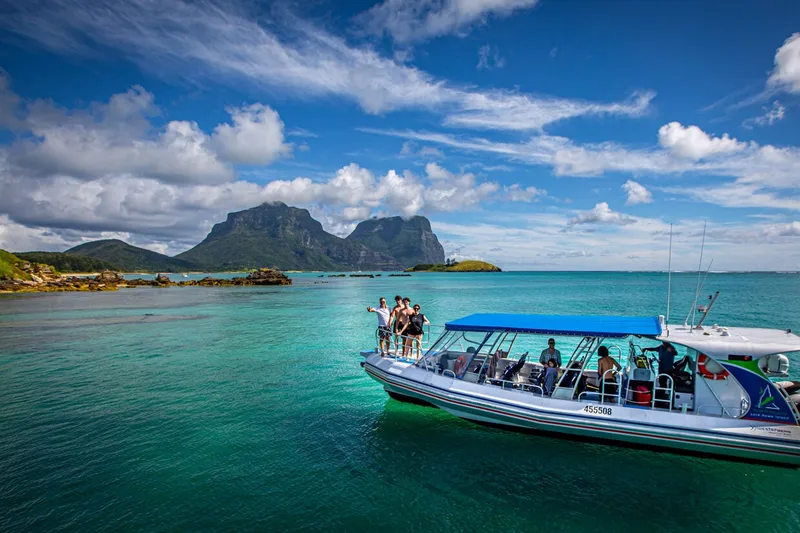
The next day I visit the outer reef with Lord Howe Environmental Tours. I experience two bucket-list wildlife encounters when I come face-to-face with the two ‘big boys’ of these waters: the doubleheader wrasse and the Galapagos shark.
If staying closer to shore is more your style, Lord Howe also has you covered. There are 11 beaches (many secluded and only accessible by walking tracks) dotted around the island, so no matter the wind direction, you can find the perfect conditions.
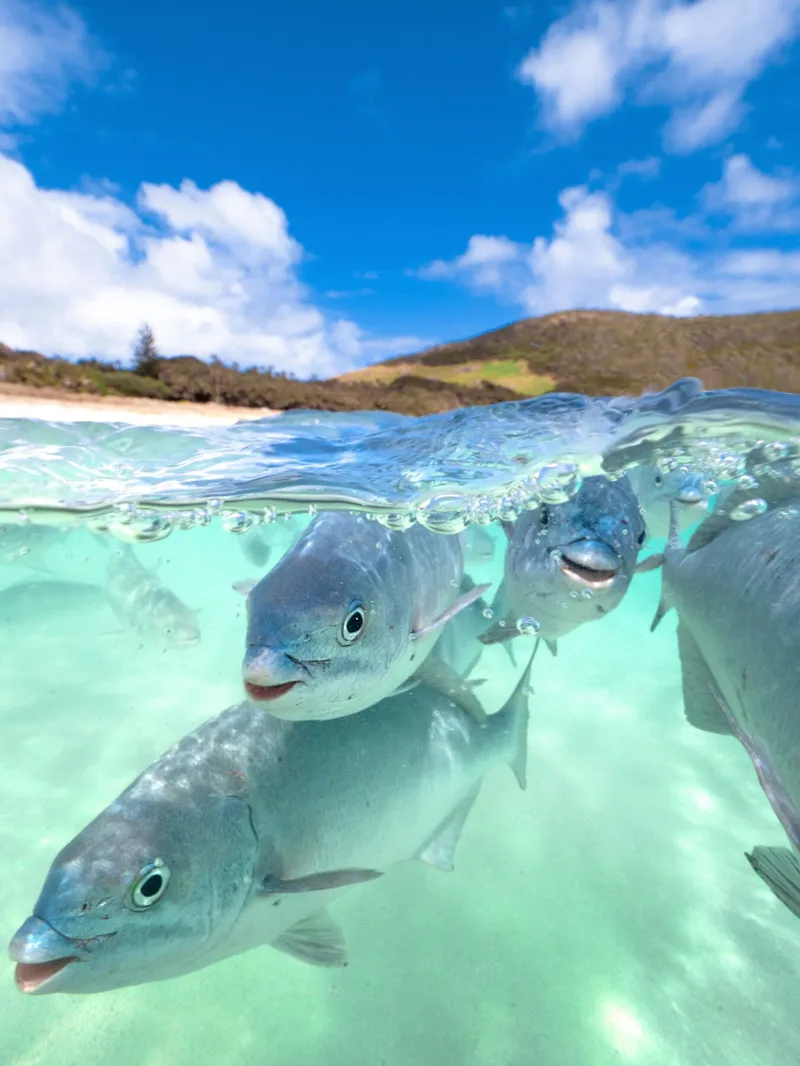
At Ned’s Beach there’s a designated fish-feeding area and a nearby shed where fish food can be purchased using an honesty box system (another testament to just how laid-back this island is). As I toss my pellets into the crystal-clear water, a throng of silver drummers – known as ‘smiling fish’ for their apparent grins – dart towards me from every direction. Bluefish are peppered throughout the mass of shining silver, along with a rainbow kaleidoscope of different wrasse species. It’s the most beautiful feeding frenzy I’ve ever seen.
And the cherry on top? Unlike other famous Australian ‘reef and beach’ destinations, here there are no marine stingers in the water, or crocodiles on the beaches!
The same applies on land. While exploring the island – whether it be a casual foreshore stroll, a curious walk through the backstreets, bushwalking through dense forest, hiking to a scenic lookout, or an epic mountain climb – there’s no need to worry about snakes. They don’t exist here.
Birds, on the other hand, do exist here. For keen birdwatchers, Lord Howe is a top destination. Like New Zealand, the island has no native mammals (bar one bat species), so birds here have few predators.
The Lord Howe woodhen is one species commonly observed by visitors. These small, brown, unassuming flightless birds are everywhere, especially in the settlement area. This wasn’t always the case. In the 1980s the Lord Howe woodhen almost went extinct. And in 2019, before the island’s rodent eradication program, fewer than 250 individuals were left in the wild.
To learn more about the island’s birdlife, I join a guided walk with naturalist Ian Hutton. Ian teaches me not only about Lord Howe’s resident birds but also about the many colonies of sea and migratory birds that breed and nest here.
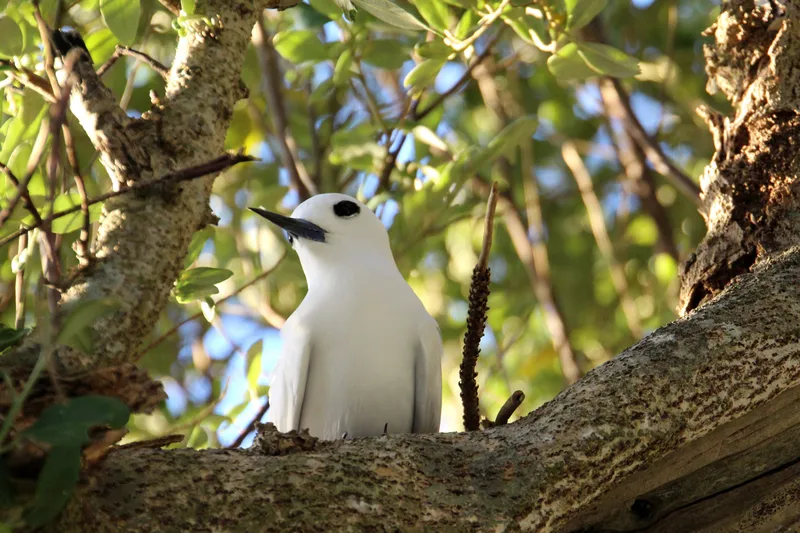
As we walk and talk he also becomes my personal bird-spotter, taking me to see a family of white terns bunkered down in the branches of a foreshore tree, a shearwater chick nestled in a burrow in the sand dunes and a black-winged petrel sheltering in a ground shrub on the headland – to list just a few.
He also gives me some hot tips for birding experiences during the rest of my stay. One is the daily sunset spectacle of the shearwaters’ return from the sea as they fill the sky before landing and clumsily waddling about the island, making their way to underground burrows. Another leads to one of my favourite Lord Howe moments: sitting on the dunes of Ned’s Beach in the early morning, surrounded by thousands of sooty terns, who go about their business as if I wasn’t even there.
My walk with Ian ends at the Lord Howe Island Museum. Ian, a man who wears many hats, is also a self-made island historian and the museum’s curator.
Peeling back the layers
Sure, you can come to this island and simply enjoy its natural beauty (and there’s nothing wrong with that!). But if you’re like me, with an ingrained need to dig deeper, there are so many layers of this island and its community to peel back – and a great place to start is here at the museum. From the collection of artefacts and information displays, I learn about the lives of the first settlers and how they got here (some were New Zealanders, others Americans via whaling ships), what sustained the island’s economy (including the export of native kentia palms), how families grew, how they farmed, and how they were educated.
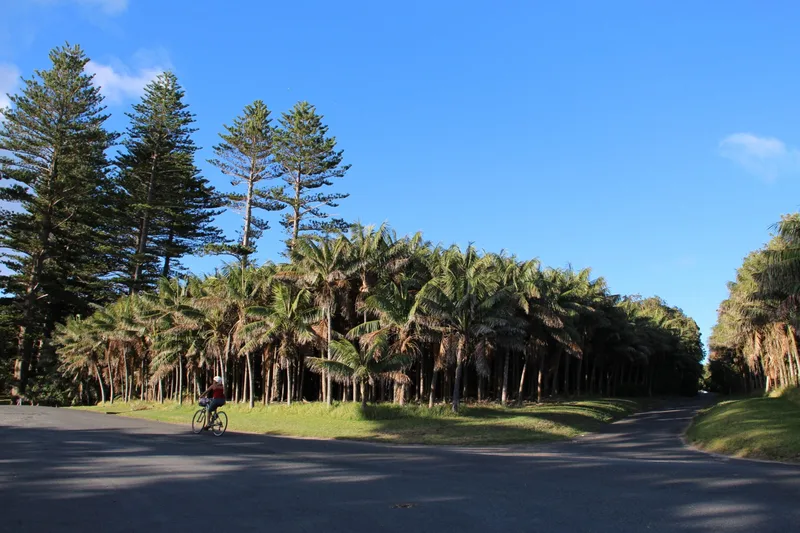
But it’s not just the history that draws me in. I’m fascinated by how this modern-day isolated community functions. I ask questions to any local who will humour me, until one day I walk past a sandwich sign advertising a tour catering exactly to this. I join the Chase ‘n’ Thyme bus tour on my last day on the island. Guide Peter Phillipps fills in my knowledge gaps, explaining how everything on the island works – from governance and land ownership, to electricity and sanitation, to freight and farming. And he does this while driving the small bus along every inch of the island’s 9km of roads.
That afternoon, as I board my Dash 8 to return to the hustle and bustle of the mainland, I realise my list of sights to see, activities to experience and things to learn is now longer than the day I arrived. And as the plane ascends over the island’s lagoon, I think to myself, like all of those return visitors: I’ll be back.
Candice travelled as a guest of Lord Howe Island Tourism Association and was accommodated by Howeana.