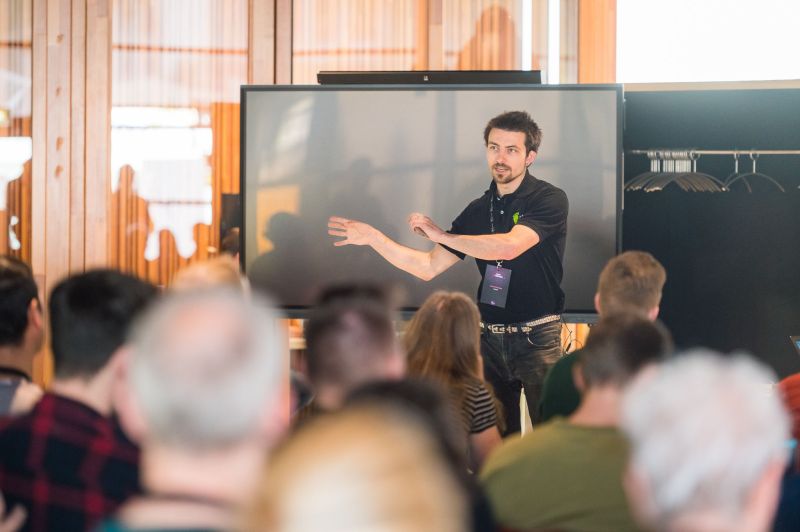
The top voted Q's & my A's from my latest deep dive on applying AI for Good at the Fontys ICT IT Festival - I've never had such an engaged crowd ❤️ notice my SPOTS wildlife ranger shirt? 😊 👕 Q&A ->
🤔 = Q, 💡 = A, ♻ = my reflection
---------------------------about the dangers-----------------------------
🤔 How do you ensure the open source material you create is not used for bad? For example, when your challenge is tracking elephants, I could hunt them down.
💡 While we open source the AI model & accompanying software, we do not share the data it was trained on, and we don't even have access to live data. So you'd first have to get your hands on the live data the rangers are using our model on. But there is a lot of corruption, so it's a real risk. This is why in other AI for Wildlife challenges we actually only track poachers, not the animals. But we trust the researchers at Stanford & Cornell in this case.
♻ Another example of AI being commoditized, and data being the really valuable thing.
🤔 Which challenge was the most difficult and why?
💡 AI for Food where we tried to build the hardware ourselves. Hardware is hard, we learned to stay in our lane and only work on challenges where we can focus on the software :))
---------------------------about data-----------------------------
🤔 How do you train on the data? Do you get access or do you bring the ML models to the client?
💡 We work on everything from open-source data (like in our remote sensing challenges with ESA) to on-premise computing (like the hospitals).
Usually the challenge owner shares the data with all challenge participants who have signed an NDA, but sometimes we need to anonymize the data or even use methods like federated learning to never have the participants see the private patient data. It's pretty exciting work!
---------------------------about the quality-----------------------------
🤔 How do you ensure the quality of the AI? And how do you keep it up to date after the challenge?
💡 We ensure the quality by recruiting both vetted industry experts next to the juniors in our projects. Then we have about 50 engineers, so we can afford some drop-off. We also make a very clear project description based on our extensive experience. Over the last 2 years we've come to a really effective formula of how we run every step of these challenges and we've seen results improve tremendously. Professionalizing open-source crowdsourcing.
In total we went through 18 questions over 40 minutes! This is how I'd like all my presentations to be. Short intro, and then diggin' deep with the crowd!
Fontys ICT is a unique school that does a lot of things right. They're one of the only schools who put challenge-based learning at the core of their programs. Students are mostly graded on their portfolio, rather than theory tests - exactly how it should be!
Thanks Wim van Dooren for this opportunity!
#ai #aiforgood #education Sako Tjomme
🤔 = Q, 💡 = A, ♻ = my reflection
---------------------------about the dangers-----------------------------
🤔 How do you ensure the open source material you create is not used for bad? For example, when your challenge is tracking elephants, I could hunt them down.
💡 While we open source the AI model & accompanying software, we do not share the data it was trained on, and we don't even have access to live data. So you'd first have to get your hands on the live data the rangers are using our model on. But there is a lot of corruption, so it's a real risk. This is why in other AI for Wildlife challenges we actually only track poachers, not the animals. But we trust the researchers at Stanford & Cornell in this case.
♻ Another example of AI being commoditized, and data being the really valuable thing.
🤔 Which challenge was the most difficult and why?
💡 AI for Food where we tried to build the hardware ourselves. Hardware is hard, we learned to stay in our lane and only work on challenges where we can focus on the software :))
---------------------------about data-----------------------------
🤔 How do you train on the data? Do you get access or do you bring the ML models to the client?
💡 We work on everything from open-source data (like in our remote sensing challenges with ESA) to on-premise computing (like the hospitals).
Usually the challenge owner shares the data with all challenge participants who have signed an NDA, but sometimes we need to anonymize the data or even use methods like federated learning to never have the participants see the private patient data. It's pretty exciting work!
---------------------------about the quality-----------------------------
🤔 How do you ensure the quality of the AI? And how do you keep it up to date after the challenge?
💡 We ensure the quality by recruiting both vetted industry experts next to the juniors in our projects. Then we have about 50 engineers, so we can afford some drop-off. We also make a very clear project description based on our extensive experience. Over the last 2 years we've come to a really effective formula of how we run every step of these challenges and we've seen results improve tremendously. Professionalizing open-source crowdsourcing.
In total we went through 18 questions over 40 minutes! This is how I'd like all my presentations to be. Short intro, and then diggin' deep with the crowd!
Fontys ICT is a unique school that does a lot of things right. They're one of the only schools who put challenge-based learning at the core of their programs. Students are mostly graded on their portfolio, rather than theory tests - exactly how it should be!
Thanks Wim van Dooren for this opportunity!
#ai #aiforgood #education Sako Tjomme