By Bliss Bowen
“Everybody’s a gardener. It was the first position on Earth.”
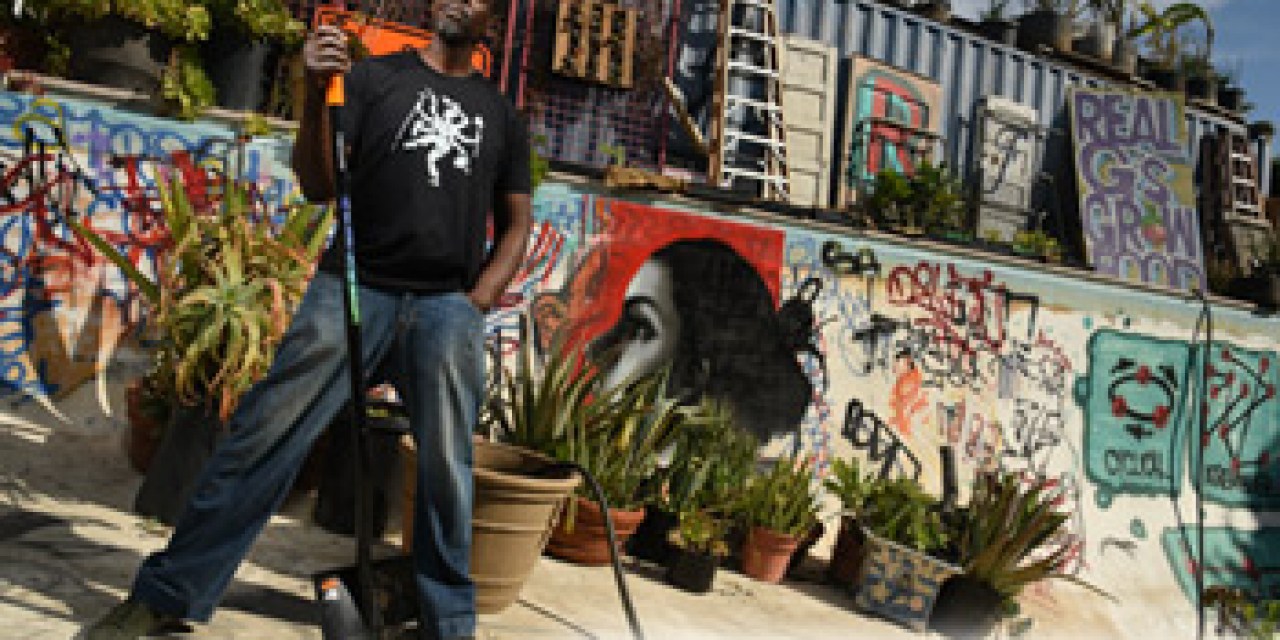
So says “gangsta gardener” and popular TED speaker Ron Finley, who landed in the news when his vegetable-packed garden on the strip of land between the street and his sidewalk in South Los Angeles earned him citations from the city. He fought city hall and won, getting the law changed in the process to allow parkway gardens like his that feed him as well as neighbors. It was a notable victory in the often frustrated “eco-lution” of urban gardening. It brought him international press coverage, and made him a prominent subject in Delila Vallot’s John Legend-produced documentary “Can You Dig This?” which he is still promoting.
Finley will speak at Saturday’s grand opening of the Arboretum’s Crescent Farm, which is dedicated to water conservation. Like Crescent Farm’s stewards, he is a passionate advocate of utilizing available resources.
Crescent Farm, which regards water as a crop, harvests water and builds soil utilizing techniques such as terracing, rills, stone-covered swales, and hügels (a German system of layering logs and branches). Its beds of vibrantly colored flowers and vegetables are a thriving testament to the benefits of composting, worms and moisture-carrying fungi.
“I use a lot of historic models, like oasis gardening from the Middle East [and] dry farming,” Leigh Adams explained during a tour of the garden while it was still under construction last year. Adams, a lifelong gardener who has guided the Crescent Farm project, describes her mother as “a water Nazi” who trained her to “catch the water and use it” — a mantra she now tries to instill in children who visit the garden.
At his garden in South Los Angeles, Finley says he’s growing almonds, amaryllis, apples, apricots, artichokes, figs, lavender, lilies, nasturtiums, onions, oranges, pomegranates, purple dandelions for salads, spinach and 12-foot sunflowers, among many other things. “It looks like Eden,” he says proudly. “It’s a forest. You can’t stop Mother Earth.”
The water-conscious principles he follows are in sync with those that guided the design of Crescent Farm — and proof that environmentally friendly productivity is not the exclusive province of big public gardens.
“I use ollas — it’s a 4,000-year-old irrigation system. They’re porous clay pots that you bury in the ground with a spout on top … plants can go to these clay pots, the water source. A lot of countries have been irrigating crops like this for thousands of years. We could have implemented them. We have special gray trashcans to collect rainwater. Those should be at every house in California — they put them in certain neighborhoods but didn’t roll them out [because of] bureaucratic ass dragging. They could have stepped up on this problem [the drought] and it wouldn’t be as severe as it has been. I have my swales. I have my soil with organic matter to absorb and store water, and rocks saving water. Compost holds a lot more water than just the soil.
“You mimic what Mother Nature does. A leaf falls for a reason in a particular season; it’s by design. It protects the soil, it turns, and when it rains it saves some of the water, and then it turns into soil itself. Feeds the tree.”
Maximizing resources at hand is a central rule of thumb for gardeners, one that Finley expands to apply to the surrounding community. Need baskets for compost bins? Weave some from tree branches (like he did). Don’t have money for compost? Hold a “garden raiser” with neighbors and “work collectively” to “build soil just like the forest does.” Want mulch? Use leaves and sawdust. Want money? Plant a tree.
“My thing is, money grows on trees,” he says with a laugh. “We don’t look at trees as a resource in people’s backyards; they give fruit all the time, for years, and nobody does anything with that fruit. People have lemons on their tree, and they’ll still go to the store and buy lemons. My thing is, let’s stop this stupidity, let’s change culture to what it used to be, where we’re sharing and building.”
In a presidential campaign season substantially driven by populism, one would expect to hear more of that kind of community-focused view. Yet there’s been relatively little meaningful discussion by candidates of the cultural changes needed to advance greater community involvement in food production, or of the connections between that and bigger-picture problems like poverty and institutional racism.
“It’s getting pushed to the wayside, I think, because of the fighting amongst the candidates,” Finley observes. “Democratic or Republican, the dog party, the cat party, the independent party, whatever party you’re in, you have to realize that you have to eat. And that what you’re eating is not healthy for you, I don’t care where you are, because of the way they’re growing food now commercially. It’s affecting our water, it’s affecting our air. It’s real simple. We are hemorrhaging Mother Earth every day. For what? For some people to have fat pockets? They could never spend all the money that they’re making. The values have to change.”
A fashion designer by trade, Finley took to gardening after his business was hit by 2008’s economic meltdown. He misses design and hopes to produce another fashion line soon: “In my mind, I’m creating clothes,” he acknowledges. “Honestly, I want to come out with a line of clothes. I’m working on [that].”
But mention that your zucchini inevitably succumbs to powdery mildew, or that your backyard soil contains too much clay, and Finley readily offers a practical remedy. He is a hands-on gardener who gets down in the soil. That he wastes no opportunity to place his painstakingly cultivated patch of greenery in broader social context, citing it as an example of how to address urban food deserts and broken communities, illustrates the metaphorical importance gardening holds for him.
“With me this whole thing is not really about food,” he says. “Food is a catalyst. Most people are like, ‘Well, how much food can you really grow in that space?’ And I’m like, ‘I really don’t care.’ I know I did, I know I can, I know that little girl planted that little teeny seed and now it’s a carrot and now she’s gonna eat it. I’ve got her. For life. You can’t take that kind of power from nobody.
“That’s what this is about: empowering people, showing them you can change the system. Change the paradigms. It’s right here. You don’t have to go anywhere to do it. Change your mind and you’re going to change your life.”
Grand opening of Crescent Farm at the Arboretum, 301 N. Baldwin Ave., Arcadia, 10 a.m.-2 p.m. Saturday, April 16; $9. Ron Finley speaks at 11; reservation required for general seating. Info: (626) 821-3222. arboretum.org, ronfinley.com, canyoudigthisfilm.com