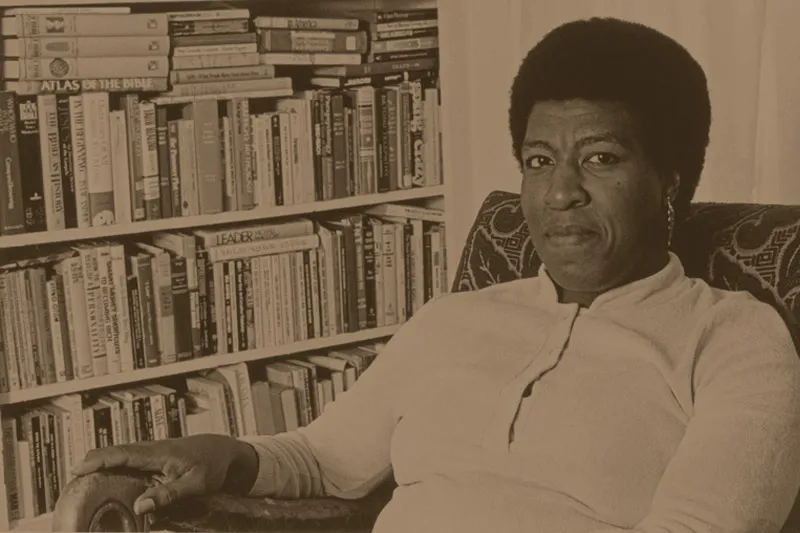
New Huntington exhibit offers insights into the ambition, insecurities and worldview of pioneering sci-fi author and Pasadena native Octavia Butler
By Bliss Bowen
“I am comfortably asocial — a hermit in the middle of Los Angeles, a pessimist if I’m not careful, a feminist always, a black, a quiet egoist, a former Baptist, an oil-and-water combination of ambition, laziness, insecurity, certainty, and drive.”
—Octavia E. Butler
Perusing the roughly 100 items in the Huntington Library’s just-opened exhibit “Octavia E. Butler: Telling My Stories,” what makes the most lasting impression is the pioneering author’s fierce tenacity. Butler posted many self-motivating notes on the walls of her home, and the exhibit features two from the early 1970s and late 1980s. Along with photographs, lucid journal entries, story outlines, lecture texts, receipts and fictional maps (all culled from more than 8,000 individually catalogued items in the Butler archive), they help illuminate her development as a writer and original thinker.
“I am a bestselling writer. … Every day in every way I am researching and writing my award-winning, bestselling books and short stories,” she wrote in clean print, willing herself to succeed. She also made notes about the “excellent Santa Monica home” that she would someday own “free and clear.”
“I will find the way to do this,” the future MacArthur Fellowship “genius” grant recipient declared. Both notes include the exhortation, “So be it! See to it!”
These weren’t conveniently co-opted Internet memes. These were methodically envisioned plans for a life she was continually advised was beyond her reach, at a historical time when her gender and ethnicity made her the target of dismissive prejudice.
“It’s a continuing theme for her of how she dealt with her struggles,” says Assistant Curator of Literary Collections Natalie Russell, who conducted a press preview of the exhibit last Friday. “She wanted to be out there. She wanted that success. She wasn’t afraid to drive for it. I don’t know how much she shared that with everyone else, but for herself she was driven.”
Born in Pasadena on June 22, 1947, Octavia Estelle Butler was the only child of a shoeshine man who died when she was 7 and a maid who frequently sacrificed personal security to further her daughter’s opportunities. Shy, dyslexic and awkwardly tall (eventually six feet), Butler found refuge and enlightenment in the Pasadena Public Library’s children’s room, where her girlish love of horse stories was eventually supplanted by fascination with science fiction. (Throughout her life, libraries remained sanctuaries where she could slake her insatiable thirst for knowledge.) Not seeing herself in the stories she devoured, Butler started writing science fiction from the then-unheard-of perspective of an African-American female.
After graduating from John Muir High School in 1965, she worked a day job to afford night classes at Pasadena City College, where she won a short-story contest; the first page of “To the Victor” is on display at the Huntington. Another five years would pass before she again earned money as a writer, during which time she took mentally undemanding jobs (sorting potato chips, stuffing boxes with hinges) so her mind could freely roam through the alternate worlds she was creating in the very early morning hours before work. Undeterred by relatives who advised that African-American women could not be science fiction writers, she found a champion in sci-fi icon Harlan Ellison. He not only urged her to join the six-week Clarion Science Fiction & Fantasy Writers’ Workshop in Pennsylvania, he helped underwrite the cost of her attendance. There, Butler sold her first two stories and finally discovered what Russell calls a “science fiction geek squad” — an understanding cohort of fellow writers offering the constructive criticism Butler needed.
Five years later she published her first novel, 1976’s “Patternmaster,” the first in a five-book series based on telepathic characters and ideas she’d begun formulating as a child. Butler, who referred to her writing as a “positive obsession,” continued submitting stories to publishers, and continued filing rejection slips. Not until 1978 could she afford to support herself with writing alone. The following year, she published the bestselling “Kindred” — still her best-known work — about an African-American woman in modern-day Altadena who is mysteriously transported to pre-Civil War Maryland to protect a slave-owning white ancestor, to ensure that she herself will be born.
Was it the solitude she’d known as an only child that provided the inner fortitude to weather immense isolation and rejection? No one can know for certain, but it is inspiring to read Butler’s notes as she confronted numerous social and economic impediments by marshaling her resolve and work ethic. (“She was a perspiration, not an inspiration person,” Russell says.) An exhibit photo of her grandmother’s Barstow-area chicken ranch is accompanied by rhetorical musings about how children in the city might “reach for the stars” when they can’t see them: “How are they going to go forward and imagine something when they don’t have any context for that imagination?” She then observes that science fiction is a means of tapping into what seems unattainable.
Butler’s achievements transcend genre, but she found a rule-breaking freedom within science fiction limited only by her probing imagination. Writing helped Butler cope with the world as she explored meaty, still-relevant themes: male and female identities, political and cultural divides, gender and racial relations, disease, pharmaceutical research and medical ethics. Grounding them in detailed, recognizable reality deepened their impact on readers.
“Tell stories filled with facts,” she reminded herself in one exhibit note. “Make people touch and taste and KNOW. Make people FEEL! FEEL! FEEL!”
After her mother’s death, Butler relocated to the Seattle area in 1999; she’d been captivated by the region’s lush greenery while traveling there in her youth. In February 2006 she was preparing to return to her hometown to speak about “Kindred,” which was Pasadena’s One City One Book selection, when she fell in her yard and died, probably of a stroke. She was 58.
Last year saw the publication of Gerry Canavan’s “Octavia E. Butler” (researched at the archive), the first biography and comprehensive analysis of Butler’s oeuvre, and Russell says more scholarship is coming. The Huntington will host a symposium, “Convergence of an Expanding Field,” on June 23 — the day after what would have been Butler’s 70th birthday — where scholars will delve into her writing and ideas. Russell says Butler’s papers, bequeathed to the Huntington in her will, have constituted “one of the most actively researched archives” at the library since their arrival in 2008.
“Unfortunately, I never got to meet her,” Russell says, “but I like to say that I met her in her archive.”
“Octavia E. Butler: Telling My Stories” is on view 10 a.m.-5 p.m. Wednesday to Monday through Aug. 7 at the Huntington Library, 1151 Oxford Road, San Marino; $23 weekdays/$25 weekends and holidays for adults, $10 for youth. Info: (626) 405-2100. Huntington.org, octaviabutler.org