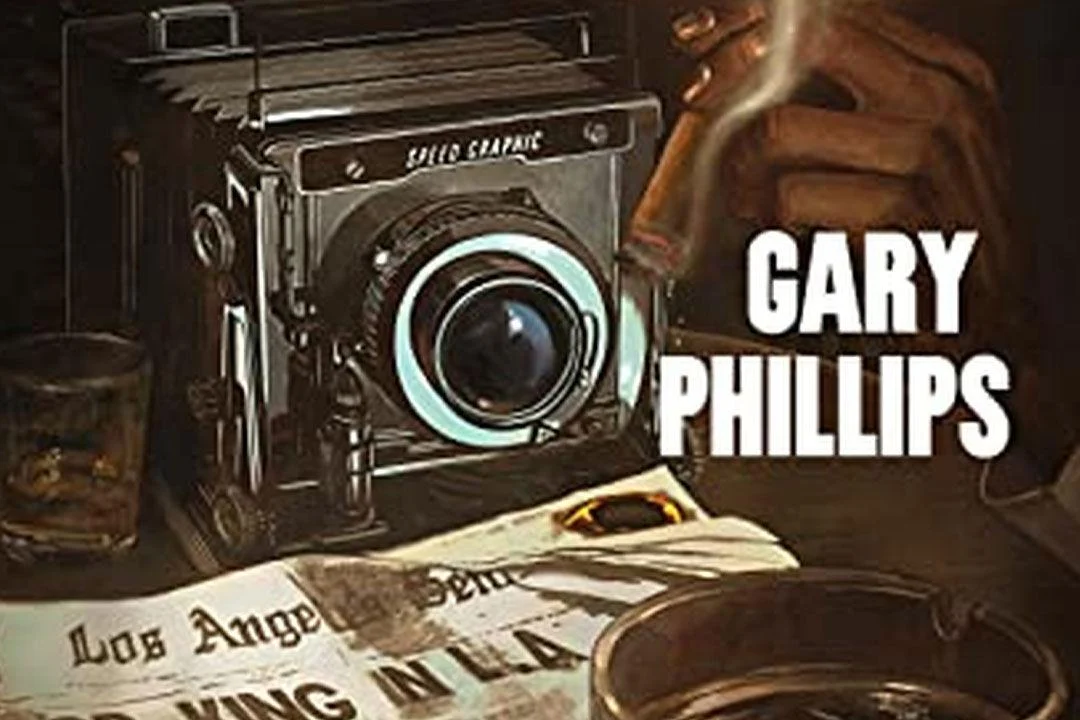
Gary Phillips’ savory new novel “One-Shot Harry” is a noir mystery positioned at Phillips’ familiar intersection of crime, politics and race. The time is 1963 and the place is Los Angeles, a city buzzing with anticipation of Dr. Martin Luther King Jr.’s forthcoming Freedom Rally at South LA’s Wrigley Field and Tom Bradley’s historic campaign for a seat on LA’s City Council.
Unlike Phillips’ Ivan Monk and Martha Chainey mystery series, “One-Shot Harry” is a stand-alone work, albeit one with tantalizing hints of a future return.
Familiar to local readers via his prolific stream of novels and comic books as well as his LitFest appearances, Phillips is scheduled to discuss his book at Vroman’s Bookstore on Thursday, April 7.
The premise is simple: Harry Ingram, a blues-quoting Black news photographer and occasional process server, sets out with his trusty Speed Graphic camera to discover who arranged the car crash that killed his old Army buddy Ben Kinslow, a white jazz trumpeter with whom he had just reunited. But as Ingram quickly discovers, nothing is simple, and no one is quite who they appear to be.
That includes Kinslow as well as the tight community of childhood friends, reporters, political lefties and fellow Korean War veterans with whom Ingram, still battling PTSD, plays dominoes and trades sometimes questionable favors. Life has bruised them all: blind shopkeeper Arthur Yarbrough, dice-playing nun in plainclothes Sister Violet O’Shay, church elder Shoals Pettigrew, country-raised club singer turned “hoodoo dame” Hanisha, menacing businessman Winston Hoyt, and Ingram’s whip-smart and politically active lover Anita Claire. They intersect with real-life figures such as Bradley, R&B bandleader Johnny Otis and actress Dorothy Dandridge.
Los Angeles is as much a character as any of them, and part of the joy of reading “One-Shot Harry” is immersing oneself in Phillips’ grittily detailed rendering of the city, informed by his past experiences as a community activist in South LA.
He deftly evokes the early ’60s via references to period cultural luminaries (comedian Redd Foxx, saxophonist Dexter Gordon, Central Avenue jazz joints) and setting scenes in a graveyard for junked trolley cars, the modest California Eagle newsroom, and a swank party in the Sugar Hill section of West Adams.
More importantly, Phillips demonstrates a keen understanding of history’s repetitive cycles; with only a change in costume, scenes of police brutality could easily be transplanted to the current day. Violent encounters with William Parker’s LAPD underscore the tangled everyday calculations forced upon African Americans and other citizens of color in midcentury LA, when the “velvet glove application of Jim Crow” at clinics and shops contrasted with the physical dangers created by sundown laws in towns such as Maywood. When Ingram receives an offer to serve papers on a lawsuit in Glendale, he grimly responds, “You might as well have said Mississippi.”
“Letrec was white, but she knew about sundown towns like Glendale. If you were Black, it was best you not be caught there after the sun set — by the cops or by the self-righteous residents. Ingram wasn’t going to be there during the day if he could help it.”
The shadows of Raymond Chandler and Dashiell Hammett are discernible throughout Phillips’ lively narrative, which is speckled with Chandler-esque red herrings. Phillips takes his time establishing Ingram’s night terrors and daylight flashbacks to Seoul City Sue, and his relationships within LA’s Black cultural and political communities.
“One-Shot Harry” is propelled along a somewhat linear trajectory by distinctive plot twists — no fun giving them away — but ultimately, the story is driven by its very human characters and revelations about who they really are. When Nation reporter Eddie Burrows asks Ingram whether he believes a Black man will ever become president, more than a little contemporary history resonates through Ingram’s answer:
“Not sure why any colored man would want to be the president. The aims of the Confederacy are alive and well in plenty of white folks’ hearts, Eddie. Black man as president, well… that fella would be living in a glass house. Every step he took, every sneeze he made would be a reason to find fault with him. … (And) right around that corner will be another white wall. Taller and harder to get over than the last one.”
Gary Phillips discusses “One-Shot Harry”
WHEN: 7 p.m. Thursday, April 7
WHERE: Vroman’s Bookstore, 695 E. Colorado Boulevard
COST: Free admission; masks strongly encouraged.
INFO: 626-449-5320, vromansbookstore.com, gdphillips.com.