‘The Dissident’ uncovers new information about Jamal Khashoggi’s murder
By Bliss Bowen
We’ve barely entered the second week of this new year, and already it’s been a week like no other in American history since the Civil War.
Since the Jan. 6 insurrectionist riot at the Capitol in Washington, D.C., we have compulsively doom-scrolled through Twitter feeds, glued ourselves to news reports, and wished for Solomon’s wisdom in resolving thorny issues about our democracy, constitutional processes, and free speech vs. hate speech. We have also—not for the first time during this administration, or even this month—confronted the reality of authoritarian political tactics and a volatile contingent of Americans attacking democracy.
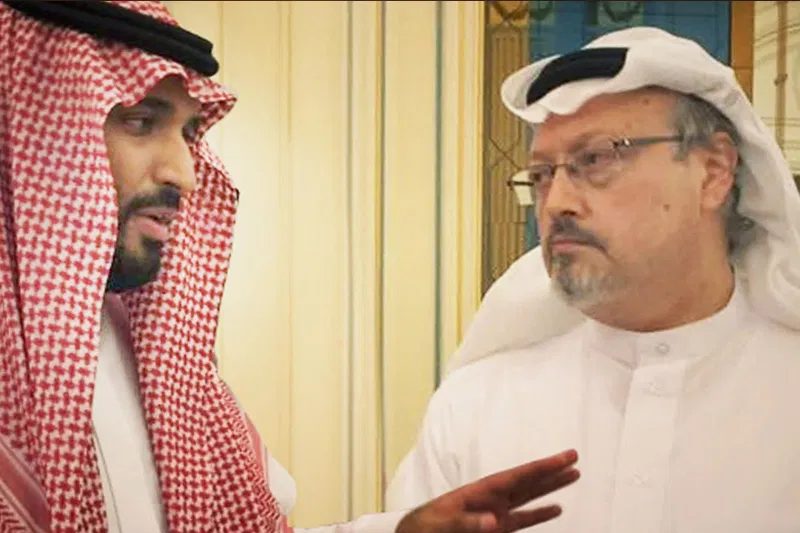
Against that backdrop, director Bryan Fogel’s documentary “The Dissident” (thedissident.com), about the 2018 assassination of Washington Post journalist and Saudi Arabian dissident Jamal Khashoggi, hits the screen with unsettling impact.
Fogel’s last film, 2017’s Oscar-winning “Icarus,” which helped expose the Russian doping scandal, crackled with spy-thriller adrenaline. “The Dissident,” available through video-on-demand platforms, pulses with quieter menace while uncovering disturbing information about Crown Prince Mohammed bin Salman’s role in Khashoggi’s dismemberment inside the Saudi consulate in Istanbul.
“As his murder unfolded, and my ears perked up that this might be a film I could take on, the first question I had was: Who was Jamal?” Fogel recalled during a phone interview.
“What was being painted in a lot of the media, especially coming out of the Trump administration, was ‘this guy was Muslim Brotherhood, he was an ISIS sympathizer, he was a friend of bin Laden, he was an extremist.’ But as I started to read his opinion columns in the Washington Post, and other materials he had written, and pulled archival interviews he had done on television, it was clear that this guy was a moderate. He loved his country. He loved his country so much that he went into self-exile so he could have freedom of speech and opinion and be able to write freely about what he believed was going on in his country. For that, he was murdered—essentially for simply being critical of his government.”
Fogel slowly earned the trust of Khashoggi’s modest Turkish fiancée, Hatice Cengiz, whose campaign for justice for Khashoggi leads her to testify at the UN and discover her voice as a human rights advocate. He also connected with Omar Abdulaziz, a young Saudi dissident granted political asylum in Canada in 2014 who had been working with Khashoggi. “Jamal Khashoggi had one dream: to be the voice of the voiceless. That was his vision,” Abdulaziz recalls in low tones.
“Your voice matters. Your words matter. Jamal taught me that.”
His memories humanize the now iconic journalist, as do Cengiz’s personal stories and family photos that illuminate his complicated story. (Khashoggi was forced to divorce his wife and abandon his family when he fled Saudi Arabia.) Interviews with Turkish authorities and UN Special Rapporteur Agnès Callamar about his slaughter provide chilling new details about his final minutes. But some of the film’s biggest jolts are generated by revelations from Abdulaziz and Citizen Lab senior researcher John Scott-Railton about high-tech spyware.
“I know why Jamal was killed. It’s because of me,” Abdulaziz states. The two men had been secretly recruiting online “bees”—social media users assigned to combat Saudi-funded “flies” repressing dissent by Saudi citizens. (Animated graphics cleverly illustrate the operation.) The “bees” were winning when Abdulaziz’s phone was hacked by Pegasus, a cyber weapon supposedly sold only to governments, and texts exposed Khashoggi’s involvement. That pushed him over the line from exiled journalist to activist—and, the film persuasively argues, triggered bin Salman’s wrath. (It also draws connections to a similarly retributive hack into Jeff Bezos’ cellphone via a personal text from the crown prince.)
We will never know if there would have been meaningful international repercussions for Saudi Arabia if the Trump administration had imposed sanctions after Khashoggi’s death, because it chose not to do so; neither did it boycott November’s Saudi-hosted G20 summit. But on Oct. 2, the two-year anniversary of Khashoggi’s assassination, now President-elect Joe Biden issued a statement honoring Khashoggi that pledged to “reassess our relationship with the Kingdom.” With authoritarian movements strengthening across the world, does it take a case like Khashoggi’s to motivate the international community to more highly prioritize human rights?
“Yes, it takes a case like that, in the sense of the amount of press and media that the Khashoggi murder brought … this story was front and center on the global stage,” Fogel replies. “But at the same time … global leaders—members of the G20, the US administration—have been very fast to move on and go back into business with Saudi. We’ve seen Saudi money and investment ultimately take precedence over human rights. There has been no justice for Jamal. There has been no true accountability for his murder—much like Vladimir Putin (and the poisoning of Russian opposition leader) Alexei Navalny. We are living in a day and age where essentially dictators, authoritarians, can commit crimes like this and get away with it because the global politics and business interests are so big, and so profound.”
In 2018, during an interview with this writer, Oscar-winning documentarian and Pasadena resident Morgan Neville said we were experiencing “a gold era for documentaries.” But Fogel says things have changed substantially since then. “Icarus” became a global talking point within days of streaming on Netflix, yet “The Dissident” was not snapped up by any streaming platforms—despite receiving “multiple standing ovations” early last year at its Sundance Festival premiere and critical plaudits.
“We know this is a film that hundreds of millions of people around the world who liked ‘Icarus’ would want to see—a big cinematic thriller [with a] huge global interest story,” Fogel said. “There was no offer for distribution. This speaks to not only the power of Saudi money, but the global business environment that we’re in. Human rights take a back seat to the bottom line.”
He retains “wonderful relationships” with Netflix, and is grateful to Briarcliff, which eventually offered theatrical distribution. But business factors driving media companies to seek global domination, he says, are in “direct competition with taking on subject matter that the world needs to see,” and films like “The Dissident” struggle to contribute to wide discussions of such topics without the accessibility afforded by streaming.
Fogel admitted disappointment that “The Dissident” won’t be available at “the push of a button” to millions of homes around the world like “Icarus,” but said he’s “optimistic” it will lead to greater dialogue about cybersecurity, privacy and human rights. “I made the film for Hatice and for Omar,” he said.
“And I remain committed to helping to seek justice and accountability for Jamal’s murder, and helping Omar in his battle to free his brothers and friends, and the countless tens of thousands of people that sit in Saudi jails for doing nothing other than wanting their country to be a better country.”