By Bliss Bowen
When discussing our rights, we routinely invoke the Constitution and its Bill of Rights — and their foundational predecessor, England’s Magna Carta. But what is Magna Carta? How is it relevant to US law?
Those questions are addressed in “Magna Carta: Law & Legend, 1215-2015,” a comprehensive exhibit opening Saturday at the Huntington Library, curated by William A. Moffett, curator of Medieval and British Historical Manuscripts, Vanessa Wilkie and her recently retired predecessor, Mary Robertson.
Eight hundred years ago, on June 15, 1215, the original Magna Carta was sealed by “bad” King John near the banks of the Thames at Runnymede. The peace treaty between the king and rebellious barons also enumerated specific rights, which were expanded upon in subsequent revisions. That original document no longer exists; four official copies reside at the British Library and Lincoln and Salisbury Cathedrals.
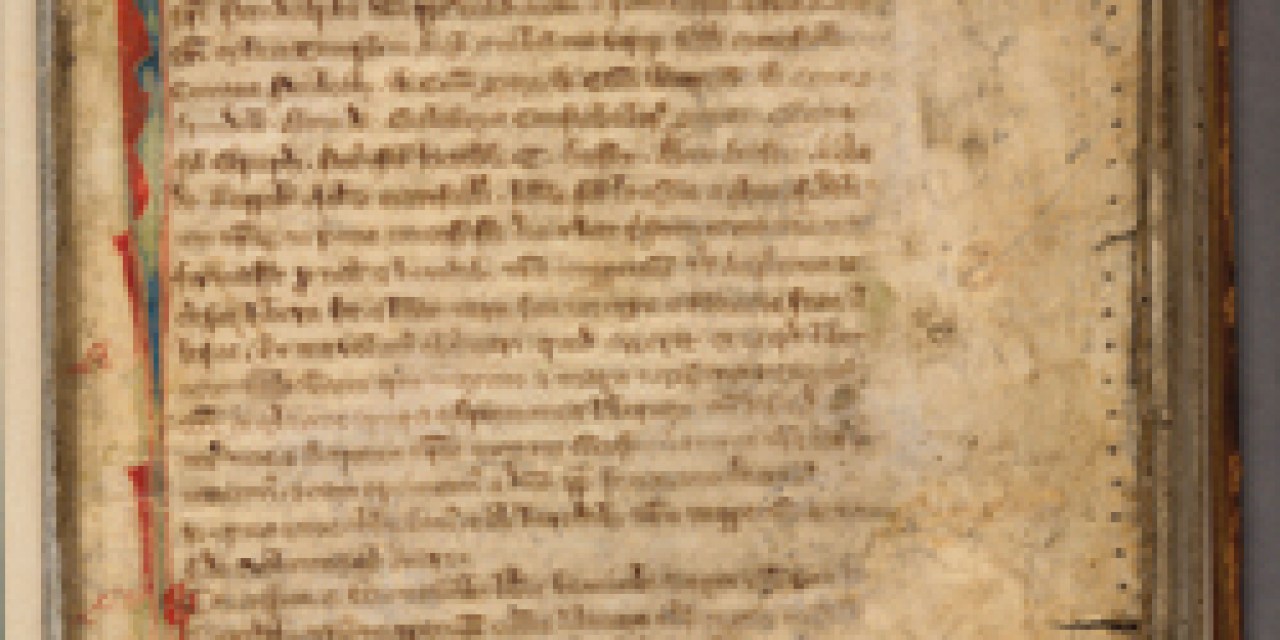
The centerpiece of the Huntington’s exhibit, which is comprised of materials from its archives, is a copy of a preliminary draft made before the king signed and sealed the final Magna Carta. It’s presented alongside centuries-old illuminated manuscripts, maps, charters and books such as Sir Edward Coke’s landmark 17th-century tome “Institutes of the Lawes of England” and Thomas Paine’s “Common Sense.” Collectively, they trace the through-line bonding Magna Carta to Henry VIII and the Church of England, bedrock US principles of habeas corpus, freedom of speech and separation of church and state, and contemporary issues concerning Guantanamo Bay and Edward Snowden.
Robertson offered advance peeks at carefully preserved pieces during an hour-long discussion animated by her enthusiasm and historical insights.
Bliss Bowen: What inspired the exhibit?
Mary Robertson: It was an opportunity to look at the idea of what it means to live in a nation governed by the rule of law. It gave us a chance to celebrate the 800th anniversary of the sealing and acceptance of an extraordinary document. Through its iconic nature and later reinterpretations, it has become a major symbol of human rights. … When Eleanor Roosevelt, who had chaired the UN commission that was charged with drafting the Universal Declaration of Human Rights and wrote it, introduced it at a speech in the General Assembly on the day it was unanimously accepted, she said that she wanted it to be a Magna Carta for the world. It’s that kind of powerful symbolic position that makes Magna Carta far more than the 63 specific liberties that it gave (in 1215). … People might not know the individual provisions, but people know that Magna Carta stands for liberty.
Benjamin Franklin referenced it while defending colonists’ right not to pay the stamp tax in the House of Commons, though it didn’t have quite the mythic stature that it’s since acquired.
It’s not all that far off; perhaps a century or so. I think when it began to acquire that mythic stature was at the beginning of the 17th century, when it was reinterpreted and its meaning was broadened and expanded. Sir Edward Coke (pronounced “Cook”), (a) great chief justice in Great Britain who was one of the major figures in the opposition to the absolute monarchy of the Stuart kings, looked at it again and said, ‘This has relevance to the present day,’ to the 1630s, the 1620s, when Charles I is attempting to rule without Parliament, when they are raising taxes without parliamentary approval, when they are billeting soldiers in people’s houses, when they are arresting people without cause and not bringing them to trial, when habeas corpus is not granted.
Does Magna Carta have standing in the history of establishing freedom of religion?
Yes and no. The original provision was that the English church shall be free, but what that meant was that the king could not impose his will on the English church’s structure and rights to elect its own personnel. … It sort of elides into freedom of religion, in the same way that it elides into larger human rights that weren’t specifically mentioned at the time and weren’t really thought of or even conceived in those terms. By the 18th century, as opposition to the crown grows in new directions, Magna Carta takes on larger meaning. That’s one of the big stories of this exhibit: There are about three periods where it grows by leaps and bounds and begins to mean not so much something different, as something bigger. … In the 1620s and 1630s, Coke looks back at Magna Carta and says, ‘That says something important about the fact that the king is not above the law.’ When Coke looks at the individual bits and pieces of Magna Carta, he sees not what were said to be individual liberties, which meant privileges; he sees liberty, in general.
When is Coke writing?
He’s talking between 1620 and 1642. The colonies are starting. So all the people who are leaving for religious freedom, for political liberty, go to the New World with Coke’s interpretation, with this new attitude toward rights and liberties … If you look at colonial charters, both Virginia and Massachusetts specifically reference Magna Carta. From the very beginning of the American experience, there’s a strong association with Magna Carta. At the time of the American Revolution, the argument (becomes) not that Parliament is sovereign, but that individuals have freedom and liberty and that no one, neither Parliament nor the king, can infringe on that in this new country, without attacking the rights that we have as freeborn Englishmen. That goes right back to Magna Carta: the right to trial, the right to habeas corpus, the right to free justice, etc.
In the Declaration of Independence, Jefferson wrote “all men are created equal (and) endowed by their Creator with certain unalienable rights,” which some take as evidence that our system is based on the Bible; but we’re a system of law.
By the time Jefferson is writing, not only has English law and its interpretations of Magna Carta evolved, so has the Enlightenment and the concept of human rights and natural rights. A number of 18th-century philosophers and enlightened politicians and lawyers would say, ‘Freedom doesn’t depend on a specific law passed by a king in a particular place; it depends on the natural rights to freedom.’ That’s what Jefferson’s talking about.
In terms of establishing freedoms, including freedom of or from religion, it would seem to be shaky ground to have a system of law based on religious text, not an enshrined legal document.
Yes. That’s one of the big debates over the ratification of the Constitution. Many of the colonies will not ratify until they see that there will be a specific list of freedoms and liberties promised to the people in writing. And if you think that’s not relevant now, look at the Second Amendment, the First Amendment, look at Guantanamo. We had access to a wonderful database through Westlaw, and between 1794 and 2012, the Supreme Court referenced or cited Magna Carta 187 times in various decisions. … As a rhetorical tool, it’s fascinating.
If we didn’t have Magna Carta, what would we have?
A very different kind of heritage, probably.
In a digital age, what’s the essential value of witnessing physical documents like Magna Carta?
If you stand in front of a case and say this rather scruffy-looking book that’s two feet from you was here before Columbus, was here before the Black Death, was here before the Crusades, and it’s still here — that’s important.n
“Magna Carta: Law and Legend, 1215-2015” will be on display in the Huntington Library’s West Hall, 1151 Oxford Road, San Marino, from Saturday, June 13, through Oct. 12; the Huntington’s hours are 10:30 a.m.-4:30 p.m. Wednesday-Monday. Admission: $23 weekdays/$25 weekends ($19/$21 for seniors and students). Info: (626) 405-2100. huntington.org