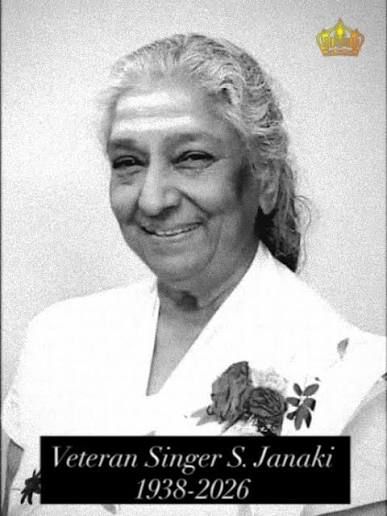
I find it hard to believe that S. Janaki hasn’t been recording or singing in live performances for the last decade. Since her voice is with me every day, I never realized that her singing career had, in a sense, ended a long time ago. Every other song in my playlist is a Janaki song. When an artist is so constantly with you in spirit, as a companion in all your emotions, death loses its sting, or it doesn’t even matter. In such cases, death leaves behind no absence, no void. Art fills the gap. For my generation of South Indians, Janaki’s songs, her voice, her distinctive voice, are part of our listening psyche. We can never detach ourselves from it.
South Indian film music owes a lot to Janaki’s voice. For more than sixty years, her voice has adorned the compositions of numerous music directors. There is hardly any South Indian language, and a few North Indian languages, in which she hasn’t sung. It is estimated that she has sung about forty-eight thousand songs, but I’m always skeptical about these numbers. There’s no real way to track them, but it is fair to say that very few playback singers have sung as many songs as Janaki has sung. To me, she has, and shall always remain, the quintessential playback singer, a genre that is unique to the Indian ethos. While many singers in the film world aspire to be known in the classical world, and not just for their film songs, to the best of my knowledge Janaki devoted herself, heart and soul, to film music and to perfecting that art. For anyone wanting to learn how to sing for film, her execution can be the perfect playbook.
When I listen to the song “Paadava En Paadalai,” I feel the anxiety and ache of love and the premonition of tragedy. “Putham Pudhu Kaalai” evokes the image of a rose-tipped dawn lighting the sky with morning colors. “Senthoora Poove” from 16 Vayathinile convinces me what innocent love can look like. "Enthan nenjil ezhulangangal" from Guru leaves me intoxicated. There are hundreds of songs like these that bring up so many emotions and memories just by listening to her voice. It may be argued that these were brilliant compositions. No doubt about that. But what is in a song if there is no singer? Janaki understood the nuances of the composer’s art well. She did as she was told—which composers like—and then she would improvise the aesthetics of it in her own signature style. There are so many such songs that simply shift the state of mind of the listener. She had this uncanny knack of infusing life into the most mundane, the most ordinary composition. That is why music composers coveted her. Even Raaja, the most high-nosed of the composers, couldn’t do without Janaki. When they had a minor difference, it is rumored, in the 80s or 90s, over a very trivial matter, Janaki stopped singing for Raaja for a short while. The great composer was helpless because his compositions lost their soul. Eventually they got back together; they had to, for the sake of music.
Her greatest strength, however, is that she could and did sing any type of song, from a lullaby to romance to tragedy to devotion to lusty item numbers. There is nothing that she said no to or had preferences about; and that is why, in my opinion, she was the most complete playback singer ever and a true exponent of that job. Playback singing is all about feeling and less about classicism. You don’t have to be a trained classical musician in order to be a playback singer. Janaki wasn’t one either, and neither was S. P. Balasubrahmanyam. What they lacked in classicality they made up by giving the song its contextual soul. Film music is sung within strict boundaries; individuality is rarely permitted. Only the most creative find ways to infuse themselves into songs without distorting the composer’s or the director’s vision. Janaki was one of very few who could do that, song after song.
The image I have of Janaki, and I’ve never seen her otherwise, is in sari, fully draped, with a large bindi on her forehead ( and later with sacred ash) , a serene smiling face, a little notebook held in her right hand containing the lyrics, an erect bearing, not a flutter either in her body or h dress, except for her lips and her throat that would effortlessly render the most intricate and complex tunes . How she managed to produce those magical notes from that creative stillness, one can only imagine.
As music lovers, we will not miss you, Janaki Amma. How can we? You have showered us with abundance for a lifetime. Thank you.