Mike Flanagan's Carrie is now streaming on Amazon Prime. I have been waiting for this series for the last two years. Until a few years ago, Flanagan was making films and television series for Netflix; he has since moved to Amazon, and Carrie is his first production under the Amazon banner. I love Flanagan's work in the horror genre. Particularly impressive was his reimagining of Edgar Allan Poe's brilliant short story "The Fall of the House of Usher" as an eight-part modernized series. Poe is one of my favourite authors, and when I watched Flanagan's adaptation a few years ago, I was deeply satisfied. If Poe were alive, he would have been proud of what Flanagan made of that short story: a man brooding over a family curse, coming slowly apart in a dilapidated manor.
King and Flanagan have now collaborated on four adaptations, and by King's own admission Flanagan's approach to his books resonates with him. It was announced in late 2024 that Flanagan would create a mini-series for Amazon based on Carrie, which readers all over the world know was King's first novel, published more than half a century ago. The paragraphs that follow trace the arc of Carrie as a book, and my own reading experience of it.
As a young boy, I always wondered what it would feel like to have the power to move objects around me with the sheer force of my mind. If there was one superpower I wished for, it was this one. It seemed such fun to draw the coffee mug towards you rather than reach out for it. As children, not yet knowing the boundaries of what it is to be human, our imagination has no limits, and we believe in such things wholeheartedly. Stephen King's 1974 debut novel Carrie was about a young, introverted, shy girl with telekinesis: the power to move objects simply by focusing her mind on them. I remember reading King's novel for the first time in college.
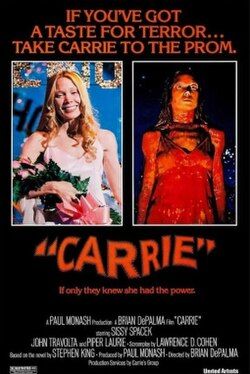
Carrie did not quite impress me the first time. My idea of literature had been formed around Dickens and Trollope and the prose of Henry James. King's writing seemed workman-like, rooted to the ground, colloquial. Carrie was branded a horror book, but I found no horror in it at all, nothing like what I had felt reading William Peter Blatty's The Exorcist or Bram Stoker's Dracula. It was Brian De Palma's 1976 adaptation of Carrie that changed my perception of both the book and its author. This was one of those rare cases where a film sent me back to the book that had given birth to it. Sissy Spacek played Carrie White; a brilliant performance, and one that earned her an Oscar nomination. On a second reading I saw how King's narrative structure worked. Even though King himself, in later interviews, dismissed Carrie as an amateurish attempt (which it may well be, set beside some of his later novels), there was no doubt that it had all the elements that would make him one of the most successful writers ever.
Writing and publishing Carrie wasn't easy. In his memoir On Writing (2000) King mentions that Carrie was not the first novel he had written: there were five others lying on his desk, unpublished. Carrie might never have been completed if not for his wife, Tabitha, who saw that this story her husband was writing — a shy, introverted girl finding herself menstruating for the first time, in public, in a school locker room — held great promise. King had given up on Carrie after three pages, those famous locker-room pages. It was Tabitha who pulled the crumpled sheets out of the trash and urged him to continue. Some nine months later the short novel, of under two hundred pages, was done. Like his earlier novels, this manuscript was rejected some thirty times before Doubleday picked it up for a hardcover edition, with an advance of $2,500, hardly enough to stir a man living in near poverty in a trailer, working as an English teacher at a local school. But fate changed dramatically a few months later when Signet paid $400,000 for the paperback rights, of which King's share was $200,000, an enormous amount in those days. King could not believe his life had suddenly changed. From a writer living in poverty he was now a man who could afford the time to write more books. The first thing he did was buy Tabitha the hair dryer she had always wanted.
Readers of Stephen King usually fall into two camps: those who adore his books and those who despise them. Personally, I oscillate somewhere between the two. Standard airport pulp fiction has never captured my imagination; whenever I attempted one, I rarely made it past the first twenty pages. Having read roughly twenty of King's books over the years, I can say that not all of them held me. His are workman-like, well-chiselled books, structurally sound, fast-paced and usually riveting. By his own admission, King never believed in purple prose; he likes to keep things simple, to the point where at times you feel he could have done more with a sentence. Yet to his devoted fans his stories represent the pinnacle of dark and supernatural literature. King's grasp of the uncanny is remarkable: he unearths evil in daily life and in ordinary people. The sheer scale of his literary production — sixty-seven novels and novellas (seven of them as Richard Bachman), five works of non-fiction, and over two hundred short stories — is astounding by any standard. During his peak years between 1975 and 2000 he routinely published two books a year. That is phenomenal output for a writer.
Carrie stands out for its brilliant exploration of evil emerging from psychological breakdown, in the increasingly alienating world of a young girl struggling with her own identity. Strangled by religious fanaticism at home, living with a fanatically religious mother who locks her in a closet as penance for imagined sins, ostracized and bullied by her peers and burdened by telekinetic powers she does not know what to do with, Carrie's breakdown and revenge, while terrifying, trigger not fear or revulsion but sympathy and compassion. King takes the reader to a place where he or she starts to feel that what Carrie did was perhaps the right thing.
King's writing is precise, crisp and always down to earth. That is one of the significant aspects of his style. You will hardly find an unnecessary word in a paragraph, and his language is very accessible. He writes with the simplicity of a man who knows he has a good story to tell. Even when King writes a thousand-page novel, readers do not shy away from it, because they know he will keep them on their toes and carry them along with his narrative. That is a promise not many writers can keep for so many years and that is the reason his books have sold millions of copies worldwide.
You can finish reading Carrie in one sitting; it is one of the few books you can actually do that with. It may take a few pages to understand its narrative structure, but once that falls into place, it is a joyful read, what one would call a page-turner. What strikes me, reading Carrie again, is King's eye for the visual. It seems to me King always wrote with an eye to adaptation or reimagination, and that is why his books are perfect raw material for a good filmmaker. So many of his books have been transformed into movies. Carrie itself has been adapted for the screen three times before (1976, the 2002 television version and 2013), besides a sequel in 1999; Flanagan's series is the fourth screen version of the novel. I have watched all these adaptations. Among them, I still think De Palma's 1976 version was the most powerful. Sissy Spacek perfectly fits the description and the image we carry of Carrie from the book. There is a nervousness about her, a muted excitement bubbling within, and when she breaks, the fury is unnerving and disturbing at once: a complete transformation of personality.
I am sure Mike Flanagan would have done a good job with his adaptation. He may well have changed the source material to suit his own imagination, and the Carrie he portrays may be radically different; news reports already suggest as much. But the overall effect, I am sure, will be as chilling as any of the earlier versions. And if King has approved Flanagan's work, it should be fine.
I plan to watch the series over this weekend